

5 Battery Failures BESS Operators Usually Detect Too Late

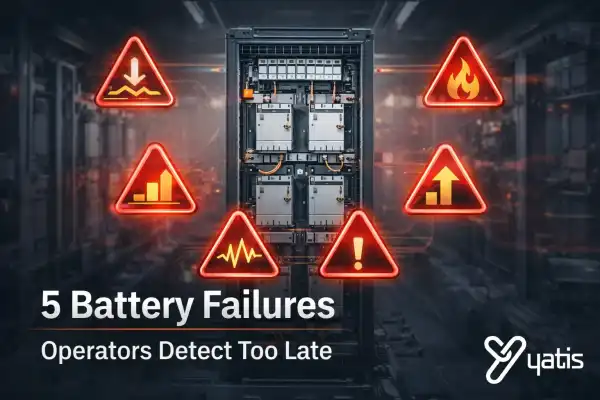
Battery failures in energy storage systems rarely happen without warning. In most Battery Energy Storage Systems (BESS), early deviations begin long before a major fault becomes visible, but many of these warning signs are difficult to identify through routine operational checks alone.
By the time alarms become critical, the battery may already be experiencing accelerated degradation, reduced efficiency, or elevated safety risk.
For operators managing industrial battery assets, delayed failure detection often leads to higher maintenance costs and avoidable downtime. This is why modern battery monitoring systems increasingly focus on identifying small anomalies before they become larger system events.
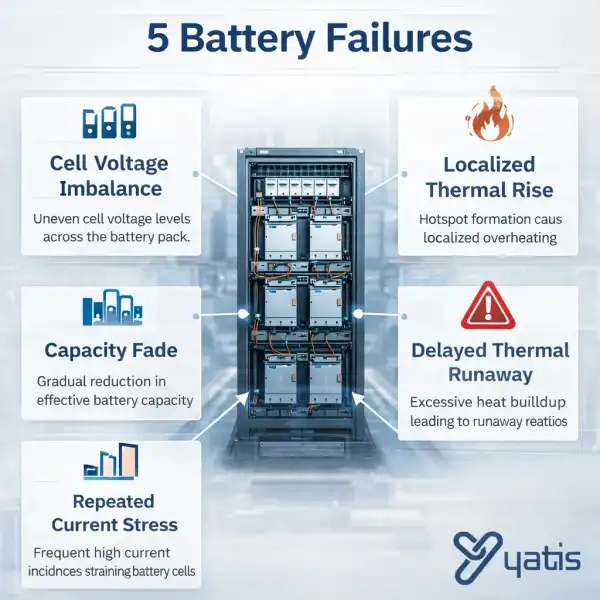
1. Cell Voltage Imbalance
One of the earliest battery failures operators often miss is uneven voltage behavior between cells. A small voltage gap may appear insignificant at first, but repeated imbalance gradually weakens pack stability.
When one cell consistently charges or discharges differently from surrounding cells, long-term battery performance begins to decline.
2. Localized Thermal Rise
A battery module may show normal average temperature while one section begins heating faster than the rest. This localized temperature rise often appears before broader thermal alarms activate.
In many cases, these hotspots are early indicators of internal stress or abnormal electrochemical behavior.
3. Capacity Fade Hidden by Stable Operation
Battery packs can lose usable capacity while still appearing operationally normal during routine cycles. Operators often notice this only when runtime shortens or discharge behavior becomes inconsistent.
This is especially difficult to detect without trend-based monitoring.
4. Repeated Current Stress
Frequent current spikes place cumulative stress on battery components even when individual events do not trigger alarms.
Over time, repeated overcurrent exposure can accelerate internal wear and shorten battery life.
5. Delayed Thermal Runaway Precursors
Severe battery incidents often begin with subtle thermal patterns that remain below alarm thresholds. Slow temperature drift, repeated hotspot recurrence, or abnormal thermal spread may all appear before serious safety events.
Why These Failures Are Often Seen Too Late
Traditional dashboards often emphasize summary indicators while deeper cell-level deviations remain unnoticed.
A stronger battery failure detection strategy monitors voltage behavior, thermal distribution, current trends, and cycle consistency continuously rather than waiting for threshold events.

Frequently Asked Questions
Conclusion
Battery failures usually begin as minor technical changes rather than sudden events. Detecting those small changes early improves battery reliability, safety, and operational continuity.
Early anomaly visibility becomes more valuable when battery teams can identify small technical deviations before performance loss affects operations. Yatis helps operators monitor battery behaviour continuously across critical failure indicators.
Detect Battery Failures Before They Escalate
Contact Yatis Telematics to learn how our BESS monitoring solutions help identify early warning signs across voltage, thermal, and current behavior.
Contact Us →