

What KPIs Matter Most in Battery Fleet Monitoring?

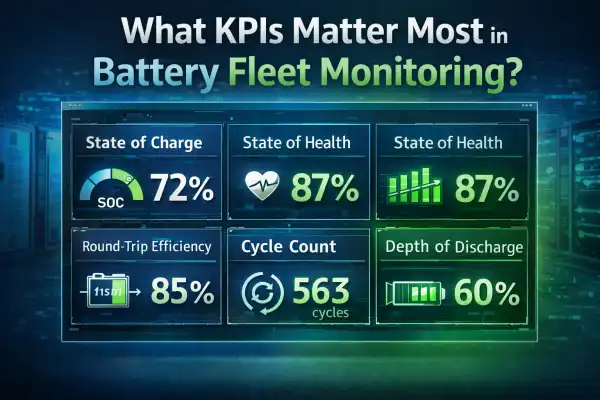
Battery Energy Storage Systems are increasingly deployed as fleets across solar plants, industrial sites, and grid-scale installations. As these fleets grow, operators need clear performance metrics to ensure reliability, efficiency, and long-term asset value. This is where battery fleet monitoring KPIs become essential.
Instead of relying only on alarms or basic dashboards, modern monitoring systems use key performance indicators (KPIs) to measure how effectively batteries operate under real-world conditions.
Why KPIs Are Critical in Battery Monitoring
In large battery deployments, small inefficiencies can scale into significant performance losses. Without defined KPIs, operators may struggle to identify underperforming assets, detect early degradation, prioritize maintenance, and measure operational efficiency.
KPIs convert raw battery data into actionable performance insights.
6 Key KPIs That Matter Most in BESS Monitoring
1. State of Health (SOH)
SOH measures the overall condition of a battery relative to its original capacity. It helps operators understand degradation level, remaining usable life, and long-term asset performance.
2. State of Charge (SOC)
SOC indicates how much energy is currently stored in the battery. While useful for operations, SOC must be evaluated alongside other KPIs to avoid misleading conclusions about battery health.
3. Round-Trip Efficiency (RTE)
RTE measures how efficiently energy is stored and retrieved. Lower efficiency often indicates internal losses, aging cells, or thermal stress.
4. Cycle Count
Cycle count tracks how many full charge-discharge cycles a battery has completed. Battery lifespan is often tied directly to cycle usage.
5. Depth of Discharge (DoD)
DoD measures how much of the battery capacity is used in each cycle. Higher DoD increases usable energy but may accelerate degradation.
6. Thermal Performance
Temperature behavior is one of the most critical KPIs. Operators monitor temperature variation across modules, hotspot formation, and cooling efficiency. Thermal imbalance often indicates early risk conditions.
How KPIs Improve Battery Fleet Performance
Tracking KPIs allows operators to move from reactive management to data-driven decision-making. Benefits include early detection of performance drift, optimized charging strategies, improved maintenance planning, and extended battery lifespan.
KPIs also help compare performance across multiple battery systems in a fleet.
Why KPI-Based Monitoring Is Becoming Standard
Battery fleets are becoming too large and complex for manual monitoring. KPI-based systems provide standardized performance measurement, real-time operational insights, and scalable monitoring across assets. Yatis BESS monitoring converts raw data into actionable KPIs for better performance visibility and decision-making.
Frequently Asked Questions
Track the KPIs That Actually Matter
Contact Yatis Telematics to learn how our BESS monitoring platform converts raw battery data into actionable KPIs for fleet operators.
Contact Us →