

Why Do Two Battery Strings Degrade Differently in BESS Systems?

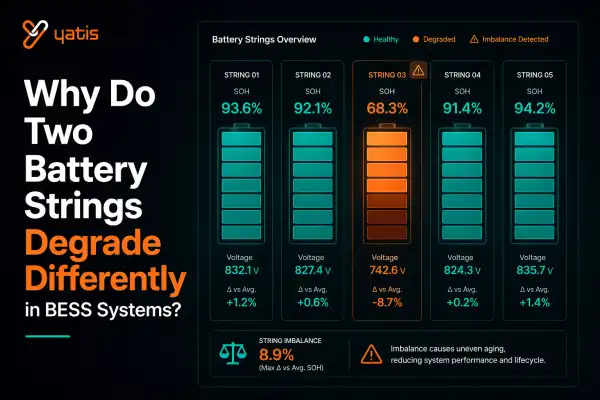
What Operators Observe in Real Systems
In real BESS deployments, operators often notice:
- one string underperforming earlier than others
- inconsistent discharge behavior across the system
- uneven thermal profiles despite identical installation
Despite identical installation conditions, performance begins to diverge over time.
This is not an anomaly — it's expected behavior as cumulative usage patterns accumulate differently across strings.
Why Degradation Becomes Uneven
Key factors that drive variation between strings include:
- Temperature gradients across racks — even small thermal differences accelerate degradation in warmer strings
- Uneven current distribution — internal resistance differences cause strings to carry unequal loads
- Manufacturing tolerances — cell-level variation from production compounds over hundreds of cycles
- Varying cycle exposure — strings positioned differently in the system may experience different charge-discharge patterns
These differences are small initially — but compound over time into measurable performance gaps.
The Hidden Impact on System Performance
When strings degrade unevenly, the consequences extend beyond the affected string:
- Weaker strings limit total system output capacity
- Overall energy dispatch efficiency drops
- Failure risk increases as imbalance accelerates
One degraded string can constrain the entire system's performance. In utility-scale BESS, this means reduced revenue from energy storage and potential violations of performance guarantees.
Why This Often Goes Undetected
Most systems monitor:
- Overall system performance metrics
- Average values across all strings
But ignore string-level variations that reveal the true picture. Averaging masks imbalance — a system can appear healthy at the aggregate level while individual strings are deteriorating rapidly.
Advanced monitoring platforms like Yatis Telematics provide granular visibility across individual strings, enabling operators to detect divergence before it reaches critical thresholds.
Final Insight
Uniform systems don't behave uniformly. Performance depends not on design — but on how closely you monitor variation.
The operators who catch string degradation early are those with visibility at the string level, not just the system level. This is the operational difference between proactive management and reactive maintenance.
Frequently Asked Questions
Need string-level BESS visibility?
Yatis Telematics provides granular battery monitoring across individual strings — catching degradation before it affects system performance.
Contact Us →