

Early Signs of Thermal Runaway in Battery Energy Storage Systems

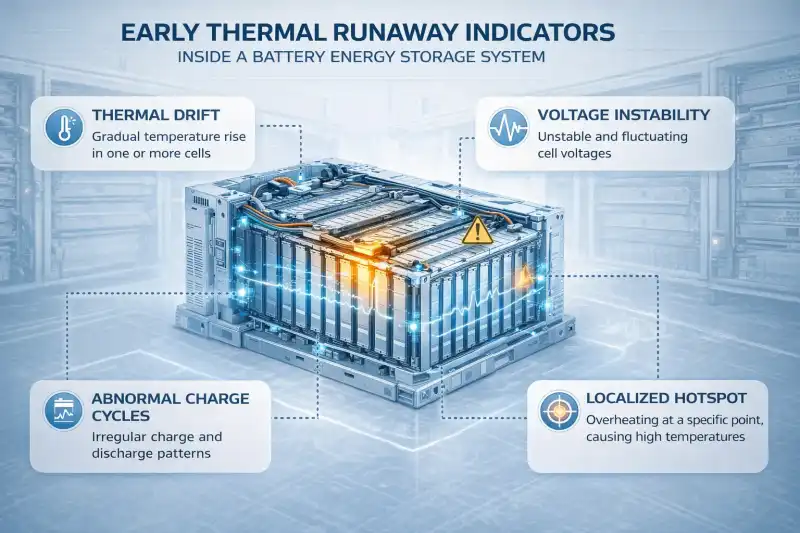
Thermal runaway is one of the most critical safety risks in modern Battery Energy Storage Systems (BESS) because it can escalate rapidly once internal battery heat begins to exceed safe dissipation limits. In lithium-based battery systems, thermal runaway occurs when rising temperature triggers internal chemical reactions that generate even more heat, creating a self-accelerating failure event.
The challenge for operators is that thermal runaway rarely begins as a sudden incident. In most cases, early warning signs appear gradually through small electrical and thermal deviations long before severe alarms activate. This is why battery thermal monitoring has become a core requirement in advanced BESS operations.
What Causes Thermal Runaway in BESS
Thermal runaway usually begins when internal battery conditions become unstable and heat generation exceeds cooling capacity.
Common triggers include:
- Localized thermal buildup
- Internal short circuits
- Overcharging conditions
- Repeated high-current stress
- Cooling imbalance across modules
If these conditions continue without intervention, the temperature rise can spread from one cell to surrounding cells.
Early Warning Signs Operators Should Watch Closely
The earliest thermal runaway warning signs often appear before temperature thresholds are breached.
Key indicators include:
- Slow thermal drift in one battery zone
- Repeated temperature rise during charging
- Voltage instability in adjacent cells
- Abnormal charge-discharge cycle behavior
- Uneven thermal distribution across modules
A battery string may still appear operationally stable while one section repeatedly shows small temperature anomalies.

Why Thermal Drift Matters Before Alarms Trigger
One of the most overlooked signals in battery safety monitoring is gradual thermal drift. Even small recurring temperature differences between modules can indicate growing internal resistance or localized stress.
Because average system temperature may remain normal, operators often miss these early patterns without detailed monitoring.
How BESS Thermal Management Improves Safety
Modern BESS thermal management systems combine temperature trend analysis with voltage and current monitoring to detect abnormal patterns early.
This helps operators identify:
- Developing hotspots
- Cooling inefficiencies
- Early cell stress conditions
- Thermal spread risks
When thermal signals are analyzed continuously, intervention becomes possible before severe battery events develop.
Frequently Asked Questions
Conclusion
Thermal runaway rarely begins without warning. The ability to detect small thermal deviations early is one of the most important advantages in modern battery safety operations.
For battery teams managing thermal risk, Yatis supports continuous BESS monitoring that helps identify thermal anomalies before they escalate into larger battery events.
Ready to Improve Your BESS Safety?
Contact Yatis Telematics to learn how our continuous monitoring solutions can help detect thermal risks early and protect your battery investments.
Contact Us →