

How Fleet Cameras Reduce Insurance Investigation Time

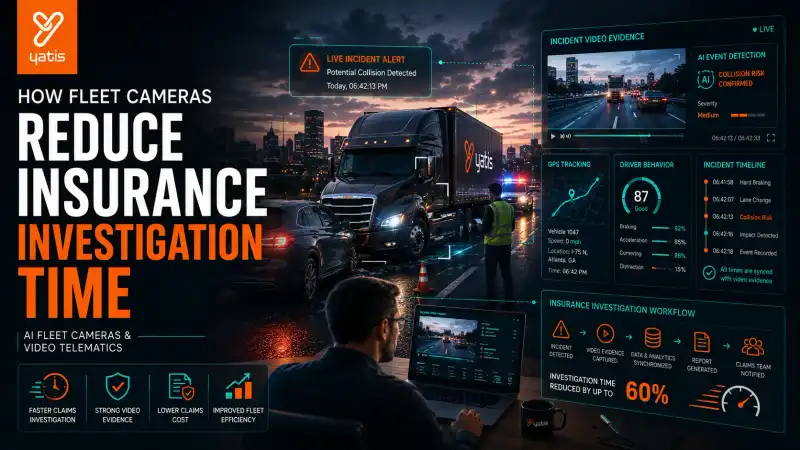
After a fleet accident, the biggest problem is often not the collision itself. It is the time spent trying to figure out what actually happened.
Insurance investigations can take days or even weeks when the evidence is incomplete. Fleet managers may need to collect driver statements, contact witnesses, retrieve footage manually, and coordinate with insurers while vehicles remain out of service.
That delay affects more than claims processing. It impacts operations, delivery schedules, driver productivity, and overall business costs.
This is one reason fleet cameras and video telematics systems are becoming more important in commercial fleet operations. They help fleets access incident evidence faster and reduce the time required to investigate claims.
Why Insurance Investigations Take So Long
Traditional accident investigations depend heavily on manual reporting. After an incident, fleets often need to collect driver accounts, review paperwork, verify timelines, locate nearby footage, communicate with insurers, and reconstruct the sequence of events.
The problem is that important details are often missing or inconsistent. Drivers may remember events differently under stress. Witness accounts may conflict. External footage may not be available. Even basic information like vehicle speed or braking behavior can be difficult to confirm without telematics data.
As a result, investigations slow down while insurers try to determine liability.
How Fleet Cameras Improve Incident Visibility
Fleet cameras provide immediate visual evidence of road events. Instead of relying only on written reports, insurers and fleet managers can review road conditions, traffic behavior, driver response, lane positioning, braking activity, and surrounding vehicles.
This creates a clearer picture of the incident much earlier in the investigation process. In many cases, footage quickly answers critical questions such as:
- Which vehicle changed lanes?
- Was the fleet driver speeding?
- Did sudden braking occur?
- Was distracted driving involved?
- Did another vehicle cause the collision?
The faster those questions are answered, the faster claims investigations can move forward.
Video Telematics Adds Operational Context
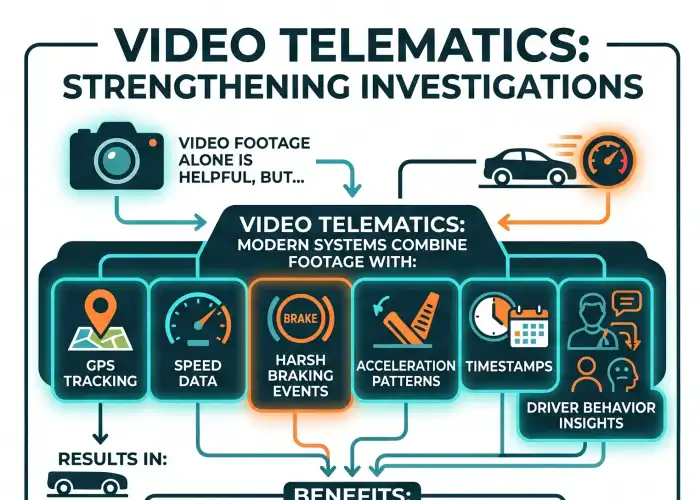
Video alone is helpful, but video telematics provides additional operational data that strengthens investigations further.
Modern systems combine footage with GPS tracking, speed data, harsh braking events, acceleration patterns, timestamps, and driver behavior insights. This extra context helps insurers and fleet teams reconstruct incidents more accurately.
For example, footage may show a sudden stop, but telematics data can also confirm exact vehicle speed, braking intensity, location, and event timing. That combination reduces uncertainty and supports faster decision-making during claims reviews.

Faster Evidence Access Reduces Downtime
One major operational challenge after accidents is delay. If incident footage is stored locally and retrieved manually, fleet teams may lose valuable time before investigations even begin.
Cloud-connected fleet camera systems solve this problem by allowing managers to access footage remotely, review incidents quickly, share evidence with insurers faster, and respond to claims immediately.
This helps reduce vehicle downtime, administrative delays, communication bottlenecks, and claim processing time. For fleets operating at scale, faster investigations can significantly improve operational continuity.
Faster Investigations Also Help Drivers
Delays during claims investigations affect drivers as well. When incidents remain unresolved for long periods, drivers may face uncertainty, liability questions remain open, stress increases, and trust in internal processes can decline.
Video evidence helps create clearer and more objective reviews. If a driver followed safety procedures correctly, footage and telematics data can help demonstrate that quickly. This supports fairer evaluations and reduces unnecessary disputes inside the organisation.
Insurance Providers Increasingly Expect Evidence
As commercial insurance costs continue to rise, insurers are placing greater importance on incident documentation and risk visibility.
Fleets that can provide accurate incident timelines, verified footage, telematics-based driving data, and faster reporting are often in a stronger position during investigations.
Some insurers also view video telematics as part of broader fleet risk-management strategies because it improves transparency and supports more consistent claims handling.
What Fleets Should Look for in a Fleet Camera System
Not every fleet camera system supports efficient investigation workflows. Fleet operators should prioritize systems that offer:
- cloud-based footage access
- real-time incident alerts
- GPS and telematics integration
- AI event detection
- secure video storage
- easy footage sharing
- centralized dashboard visibility
The goal is not just recording incidents. It is reducing the time and complexity involved in reviewing them.
Faster Investigations Mean Better Operational Control
Accidents will always be part of commercial fleet operations. But long investigations, unclear evidence, and delayed claims handling create avoidable operational strain.
Fleet cameras and video telematics help reduce that uncertainty by giving fleets immediate access to reliable incident information.
That visibility supports faster insurance investigations, better claims documentation, reduced downtime, improved driver protection, and stronger operational efficiency.
For fleets managing growing operational pressure and rising insurance exposure, faster access to evidence is becoming increasingly valuable.
Frequently Asked Questions
Speed up your insurance investigations
Contact Yatis Telematics to learn how AI-powered fleet cameras and video telematics can help your fleet shorten claims cycles and minimize vehicle downtime.
Contact Us →