

What Predictive Battery Alerts Detect Before Human Teams Notice


Battery systems generate large volumes of operational data every second, but human teams rarely review all of it in enough detail to catch early anomalies. In Battery Energy Storage Systems (BESS), small deviations often begin gradually and remain hidden inside routine dashboards until performance changes become obvious.
This is where predictive battery alerts create a major operational advantage.
Instead of waiting for threshold alarms, predictive monitoring identifies subtle patterns that indicate a battery may be moving toward imbalance, stress, or degradation before visible faults appear.
Why Human Monitoring Has Natural Limits
Battery operators usually focus on high-level indicators such as:
- State of Charge (SOC)
- Total pack voltage
- Average temperature
- Active alarm events
These metrics are useful for daily operations, but they often miss small progressive deviations happening at cell level.
A battery may still appear stable while internal voltage drift or repeated temperature variation slowly develops over time.
What Predictive Battery Alerts Detect Early
Modern battery monitoring systems use trend analysis to identify abnormal behavior before conventional alarms trigger.
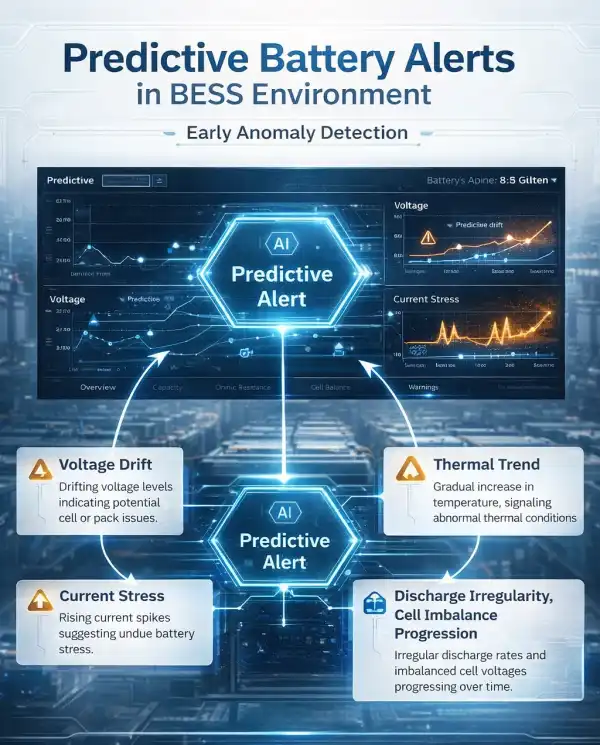
Predictive alerts commonly detect:
- Gradual cell voltage divergence
- Abnormal thermal drift
- Repeated current stress patterns
- Irregular charge-discharge behavior
- Slow efficiency loss across modules
These signals may remain below alarm thresholds for days or weeks before becoming operationally visible.

Why Early Detection Matters in BESS Operations
Early anomaly detection allows maintenance teams to act before battery efficiency declines or safety margins narrow.
For example, if one battery string repeatedly shows temperature rise during charging cycles, predictive logic can flag the trend before thermal alarms activate.
This reduces the risk of larger faults and helps operators prioritize maintenance based on actual battery behavior rather than periodic checks alone.
Predictive Alerts Improve Maintenance Accuracy
In industrial battery environments, predictive monitoring helps teams focus attention on assets that need intervention first.
Instead of responding only after alarms occur, operators gain earlier technical context for:
- Battery balancing decisions
- Cooling adjustments
- Inspection scheduling
- Degradation tracking
This improves both reliability and long-term asset planning.
Frequently Asked Questions
Conclusion
Predictive alerts improve battery visibility because they detect technical changes before human teams can easily recognize them. In modern BESS operations, earlier insight often determines long-term reliability.
When predictive alerts are integrated into daily battery operations, teams can act on subtle changes before alarms escalate. Yatis enables early anomaly detection through connected BESS monitoring intelligence.
Enable Predictive Battery Monitoring
Contact Yatis Telematics to learn how predictive alerts help your team detect battery anomalies before they become operational issues.
Contact Us →