

How to Reduce BESS Downtime in Solar Plants

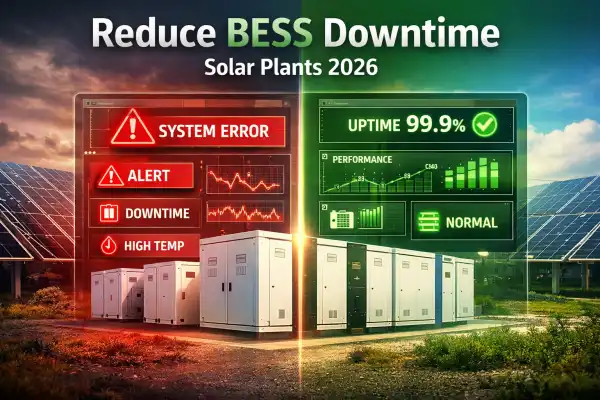
Battery Energy Storage Systems (BESS) play a critical role in solar plants by ensuring continuous power availability despite fluctuations in solar generation. However, even small operational issues can lead to downtime, affecting energy output, revenue, and grid reliability.
A single large-scale BESS outage can result in millions in monthly losses, highlighting the importance of proactive monitoring and maintenance. Reducing downtime requires a combination of real-time monitoring, predictive maintenance, and system design optimization.
What Causes BESS Downtime in Solar Plants?
BESS failures rarely occur suddenly. Instead, they develop gradually due to multiple technical factors. Common causes include:
- Thermal imbalance and overheating
- Voltage instability across cells
- Ground faults and insulation failure
- Poor relay coordination
- Lack of real-time monitoring
Many of these issues remain undetected until they escalate into major failures, as small anomalies accumulate over time.
5 Proven Ways to Reduce BESS Downtime
1. Implement Real-Time Monitoring Systems
Continuous monitoring of voltage, temperature, and current behavior helps detect early anomalies before they lead to system failure. Advanced monitoring systems can identify faults without interrupting operations, allowing faster corrective action.
2. Detect and Isolate Faults Early
Ground faults are one of the most common causes of downtime in BESS installations. If not detected early, they can escalate into short circuits, equipment damage, and safety risks. Early fault detection ensures systems remain operational while issues are resolved.
3. Optimize Thermal Management
Thermal issues are among the leading causes of BESS failure. Effective strategies include uniform cooling across battery modules, real-time temperature tracking, and redundant cooling systems. Poor thermal control can lead to cascading failures such as thermal runaway.
4. Use Predictive Maintenance Instead of Reactive Maintenance
Traditional maintenance reacts to failures. Predictive maintenance identifies trends, detects anomalies early, and prevents unexpected downtime. This approach significantly improves system reliability.
5. Design for Power Resilience
BESS systems should be designed to handle grid instability, voltage fluctuations, and load variations. Well-designed systems can prevent outages instead of reacting to them, improving overall uptime.
Why BESS Monitoring Is Critical for Solar Plants
In solar plants, energy generation is already variable due to weather conditions. BESS acts as a stabilizing layer, ensuring consistent power supply. Monitoring enables early anomaly detection, performance optimization, reduced maintenance costs, and improved asset lifespan.
It transforms BESS from a passive storage system into an actively managed energy asset. Yatis BESS monitoring systems provide real-time visibility into battery performance and early anomaly detection for solar operators.
Frequently Asked Questions
Reduce BESS Downtime with Intelligent Monitoring
Contact Yatis Telematics to explore how our BESS monitoring solutions detect anomalies early and keep solar plant operations running.
Contact Us →