

SOC vs SOH: What Matters More Operationally in Battery Monitoring?

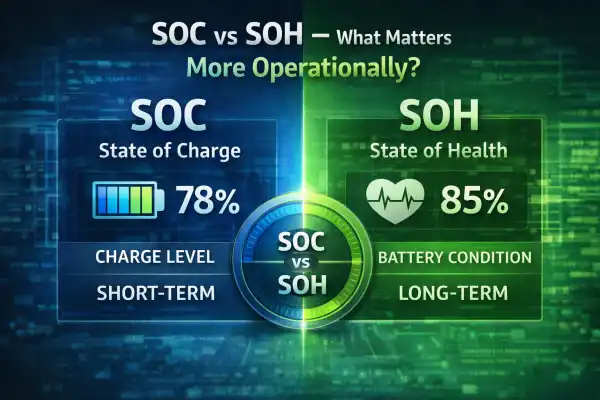
In Battery Energy Storage Systems, two of the most commonly tracked metrics are State of Charge (SOC) and State of Health (SOH). While both are essential for battery monitoring, they serve very different purposes. Understanding the difference is critical for making informed operational decisions.
Many operators rely heavily on SOC because it provides immediate visibility into available energy. However, focusing only on SOC can lead to misinterpretation of battery performance, especially in large-scale BESS deployments.
What Is SOC in Battery Monitoring?
State of Charge (SOC) indicates how much energy is currently stored in a battery. It is the percentage of available charge remaining relative to total capacity.
SOC helps operators plan charging and discharging cycles, manage energy availability, and ensure operational continuity. However, SOC reflects short-term battery status, not long-term performance.
What Is SOH in Battery Monitoring?
State of Health (SOH) measures the overall condition of a battery compared to its original state. It represents the remaining capacity and performance capability of a battery over time.
SOH helps operators understand battery degradation, remaining useful life, and long-term reliability.
SOC vs SOH: Key Differences
| Metric | SOC | SOH |
|---|---|---|
| Purpose | Energy availability | Battery condition |
| Time Horizon | Short-term | Long-term |
| Indicates | Charge level | Degradation |
| Use Case | Operations | Asset management |
Why SOC Alone Can Be Misleading
A battery may show high SOC while still experiencing internal issues such as cell imbalance, thermal stress, or capacity fade. This creates a false sense of operational stability.
SOC answers: "How much energy is available?" But it does not answer: "Is the battery healthy?"
Why SOH Matters More for Long-Term Operations
SOH provides a deeper understanding of battery performance because it reflects how the battery is aging. Tracking SOH helps predict failures, optimize maintenance, extend battery lifespan, and plan replacements. In large battery fleets, SOH is often the key metric for asset-level decision-making.
When SOC Matters More
SOC is still critical for real-time energy dispatch, load balancing, grid interaction, and daily operations. Without SOC, operators cannot manage immediate energy needs.
The Right Approach: Combine Both Metrics
The most effective battery monitoring strategy uses both SOC and SOH together. SOC → operational control. SOH → performance and longevity.
Modern monitoring systems integrate both metrics along with temperature, voltage, and cycle data to provide a complete view of battery behaviour. Yatis BESS monitoring systems track SOC, SOH, and deeper battery health indicators together.
Frequently Asked Questions
Monitor SOC and SOH Together
Contact Yatis Telematics to learn how our BESS monitoring solutions track both short-term energy availability and long-term battery health.
Contact Us →