

Why SOC Alone Can Mislead Battery Operators in BESS Monitoring

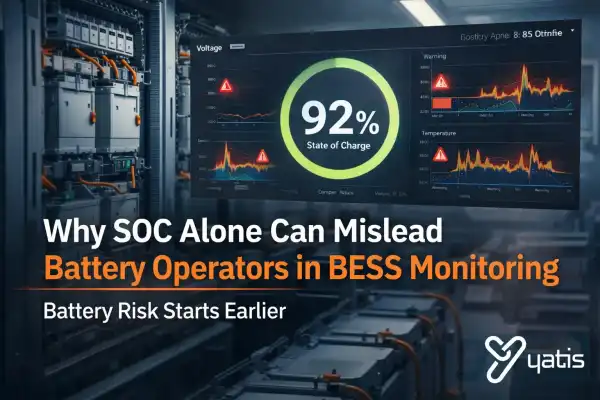
In battery energy storage systems, State of Charge (SOC) is often the first metric operators use to understand battery status. SOC shows the estimated available energy in a battery and helps teams assess charging and discharge conditions during daily operations.
However, relying on SOC alone can create blind spots in BESS monitoring, because a battery may appear healthy while hidden electrical or thermal risks continue developing inside the system.
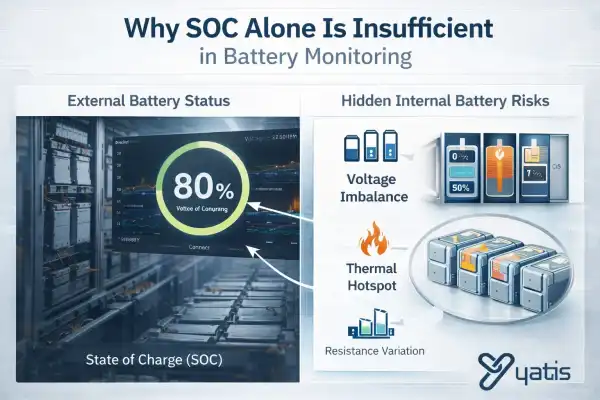
A battery showing 80% SOC may still contain early-stage cell imbalance, abnormal voltage drift, or localized heating that is not visible through charge percentage alone. This is why modern battery monitoring systems increasingly combine SOC with deeper health indicators before operators make operational decisions.
Why SOC Does Not Fully Represent Battery Health
SOC is useful for energy visibility, but it does not explain how safely a battery is functioning internally. It estimates charge availability, not full electrochemical condition.
Important battery risks that SOC cannot fully reveal include:
- Uneven cell voltage distribution
- Rising internal resistance
- Thermal variation across modules
- Repeated overcurrent stress
- Hidden degradation patterns
In large battery installations, these conditions can develop gradually while SOC still appears normal on the dashboard.
What Battery Operators Often Miss
One of the most common mistakes in battery health monitoring is assuming that stable SOC means stable battery behavior. In reality, battery cells can begin drifting long before alarms appear.
For example, a battery pack may report normal charge levels while one cell experiences persistent voltage deviation. Over time, this affects balancing efficiency and accelerates degradation.
Temperature behavior also matters. Small thermal differences between modules often indicate early stress, even when SOC remains unchanged.
Why BESS Monitoring Requires More Than Charge Data
Modern BESS monitoring platforms combine SOC with voltage, temperature, current, and trend analysis to create a fuller operational picture.
This helps operators detect:
- Abnormal charge-discharge cycles
- Early thermal anomalies
- Cell imbalance progression
- Performance decline patterns
Instead of reacting only to threshold alarms, operators can identify early warning signs before reliability drops.
The Role of Predictive Battery Analytics
Predictive analytics strengthens battery visibility because it identifies subtle changes across multiple parameters at once. This allows maintenance teams to intervene before manual checks detect visible problems.
For utility-scale and industrial battery systems, SOC remains important, but it should always be interpreted alongside deeper monitoring signals.
Frequently Asked Questions
Conclusion
SOC is a useful operating indicator, but safe battery decisions require broader monitoring. In modern battery environments, deeper visibility improves both reliability and long-term asset performance.
For battery teams that need deeper visibility beyond charge percentage, Yatis supports multi-parameter BESS monitoring that helps detect voltage, thermal, and cell-level deviations earlier in the operating cycle.
Ready to Move Beyond SOC-Only Monitoring?
Contact Yatis Telematics to learn how our BESS monitoring solutions provide deeper battery visibility across voltage, temperature, and cell-level indicators.
Contact Us →