

Buyer Comparison · India
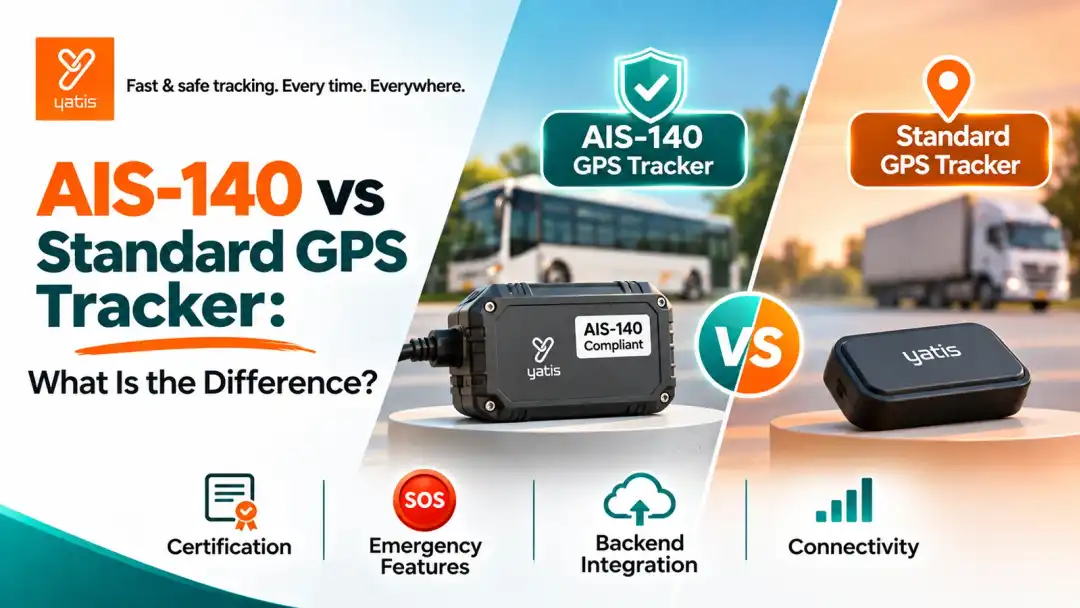
AIS-140 vs Standard GPS Tracker: What Is the Difference?
Understand how certification, emergency features, connectivity and backend integration separate an AIS-140 GPS tracker from a standard GPS tracking device—and which one your fleet actually needs.
Same broad idea. Different compliance purpose.
Both devices can locate a vehicle. The difference is the system around the tracker—and whether your vehicle is required to meet AIS-140.
Buyers often compare an AIS-140 GPS tracker with a standard GPS device because both may show a vehicle moving on a map. That similarity can be misleading. A commercial GPS tracker may be perfectly suitable for route visibility, dispatch, utilisation and operational reporting—but it may not have the model-specific certification, emergency-button system or backend registration required for a regulated deployment.
This guide compares the two device categories across certification, hardware, connectivity, emergency features, backend integration and use cases. It ends with a practical comparison matrix and decision tree to help fleet owners select the right solution without confusing live tracking with statutory compliance.

1. Certification: The Biggest Difference Between AIS-140 and Standard GPS
The most important distinction is not the GPS receiver. It is whether the exact device model has been tested and type-approved against AIS-140 under the applicable Central Motor Vehicles Rules framework.
Rule 125H of the Central Motor Vehicles Rules, 1989 requires covered public service vehicles to be fitted with a vehicle location tracking device and one or more emergency buttons. It specifies AIS-140:2016, as amended from time to time, as the basis for specifications, testing and certification until corresponding BIS specifications are notified. The rule text includes stated exceptions for two-wheelers, e-rickshaws, three-wheelers and transport vehicles for which no permit is required. Other notifications and state directions may cover additional categories, so confirm the precise applicability for the vehicle. Read MoRTH G.S.R. 1095(E).
| Certification question | Standard GPS tracker | AIS-140 GPS tracker |
|---|---|---|
| Type approval to AIS-140 | Not necessarily tested or approved to AIS-140. | Exact make/model should have applicable type approval from a Rule 126 testing agency. |
| Certificate scope | May have other certifications, but these are not equivalent to AIS-140 approval. | Certificate must match the quoted hardware model and relevant variant. |
| Conformity of Production | Depends on the product's own regulatory framework. | Check applicable CoP status and current approval records. |
| Regulatory use | Suitable for operational tracking where no AIS-140 requirement applies. | Designed for deployments where AIS-140 compliance is required, subject to installation and activation. |
Do not rely on a supplier saying that its brand is “AIS-140 certified”. Ask for the certificate number, manufacturer, exact model, testing agency and current status. ARAI publishes an approved vehicle tracking systems list with model and CoP details; verify the quoted model against the latest available list. Check ARAI's CMVR approved components and VTS list.
2. Hardware: What Is Different Inside the Device?
Both standard GPS trackers and AIS-140 VLTDs can contain a GNSS receiver, cellular modem, processor, antennas and power-management components. The difference is the specification, tested configuration, interfaces and system functions required for the intended deployment.
AIS-140 technical requirements address areas such as GNSS performance, cellular communication, device identification, secure data transmission, environmental robustness, tamper-related behaviour and emergency-system integration. The applicable device specification and approved configuration should be checked rather than assuming every AIS-140 model has identical optional features.
Receives satellite positioning signals. Check supported constellations and the approved model specification.
Transmits location and event messages to the configured platform or authorised backend.
Vehicle power, backup provisions, environmental protection and tamper requirements depend on the applicable specification.
A standard GPS tracker can be smaller, simpler or more flexible depending on the vendor and use case. An AIS-140 device must match its approved design and relevant test requirements. Do not assume that adding an SOS switch to a regular tracker turns it into an AIS-140 VLTD.

3. Connectivity: Where Does the Vehicle Data Go?
Both categories generally use cellular connectivity to send vehicle information to a server. However, the destination, message format, authentication, activation process and monitoring responsibilities can differ significantly.
Standard GPS tracker connectivity
A standard tracker commonly sends location and telemetry to the vendor's private cloud or fleet-management platform. The customer uses a web dashboard or mobile app to view vehicle position, trip history, geofences, alerts and reports. Data frequency, SIM ownership, roaming and platform integration depend on the vendor's service design.
AIS-140 connectivity
An AIS-140 VLTD must support the communication and backend requirements applicable to its approved system. The device needs to send the required information to the authorised state or monitoring backend through supported cellular connectivity. The MoRTH VLT registration and activation SOP describes device registration, unique identification, VAHAN tagging, backend activation and checking of functional status. Read MoRTH's VLT registration and activation SOP.
| Connectivity aspect | Standard GPS | AIS-140 |
|---|---|---|
| Typical destination | Vendor's tracking server or customer platform. | Authorised backend/state monitoring system, alongside any permitted vendor platform. |
| Data protocol | Vendor-defined protocol or API. | Must meet the applicable AIS-140 communication requirements. |
| Device identity | Usually linked within the vendor account. | Unique device identification must be linked with the vehicle through the prescribed registration/activation process. |
| Health monitoring | Depends on vendor feature set. | Backend/device health-check and functional status processes are part of the compliance framework. |
| Connectivity plan | Depends on subscription and reporting frequency. | Confirm SIM/eSIM, M2M provider, coverage, validity and backend acceptance for the specific deployment. |
Cellular coverage still matters. A type-approved device cannot transmit when there is no usable network, the SIM is inactive, the antenna is damaged or the unit has lost power. Ask how offline conditions are detected, whether data is buffered and how a communication failure is escalated.
4. Emergency Features: Panic Button and Alert Handling
A standard GPS tracker may offer an SOS input as an optional feature. That does not make the complete system AIS-140 compliant. Under Rule 125H, covered public service vehicles must have one or more emergency buttons as part of the VLT system.
The AIS-140 emergency function is not intended to operate as an isolated switch. The emergency request must be transmitted to the authorised backend. The technical specification describes the emergency system as integrated with the VLT system, with alert handling and deactivation through the authorised government server. The exact button count, location and installation arrangement must follow the applicable vehicle category, standard and state instructions.
| Emergency capability | Standard GPS tracker | AIS-140 system |
|---|---|---|
| SOS input | May be absent or offered as an optional input. | One or more emergency buttons required for vehicles covered by Rule 125H. |
| Alert destination | May notify a private fleet dashboard or contact. | Must follow the prescribed authorised backend alert path. |
| Vehicle/category fitment | Usually customer-defined. | Must follow the applicable installation and accessibility requirements. |
| Testing | Vendor-specific functional test. | Commissioning should verify the button, message, vehicle identity, backend receipt and authorised reset process. |
5. Backend Integration: Private Dashboard vs Authorised Monitoring System
A standard GPS tracker usually reports to a private platform that helps a business manage its fleet. AIS-140 deployments add an authorised backend or state monitoring centre that receives prescribed device information and emergency alerts.
MoRTH's February 2021 SOP explains the VLT registration and activation process in VAHAN or the state registration application. It describes how the device's make/model and unique identification details are registered, linked to vehicle details and activated on the relevant monitoring centre. It also describes functional checks by the State/UT and RTO processes. Review the official MoRTH SOP.
Two data paths, two different purposes
Illustrative architecture: the exact deployment depends on the state backend and vendor integration.
A private tracking dashboard can be useful for dispatch, trip reports, fuel monitoring and fleet productivity. But seeing a vehicle on that dashboard is not proof of statutory backend activation. Buyers should request a documented activation status and verify that the unique device identity is associated with the correct vehicle.
6. Use Cases: Which Tracker Fits Which Fleet?
When a standard GPS tracker may be enough
- A business wants live location, trip history, geofencing and route deviation alerts.
- A fleet manager needs utilisation, idling, fuel or driver-behaviour insights.
- The vehicle category and operating conditions do not require AIS-140 under applicable central/state rules.
- The buyer wants a private fleet-management platform and does not need statutory VLTD activation.
When an AIS-140 GPS tracker is the appropriate choice
- The vehicle falls within a category covered by Rule 125H or another applicable notification/order.
- The relevant state/UT or permit authority requires an AIS-140-compliant VLTD and emergency button.
- The vehicle needs device certification, backend onboarding and VAHAN/state registration or activation.
- The operator must demonstrate installation and functional status during fitness, permit or other prescribed checks.
Yatis offers fleet GPS tracking for operational visibility and AIS-140-related solutions for selected deployments. Review the Yatis GPS Tracking System and Yatis AIS-140 solution pages, then confirm the exact vehicle and state requirements with the team before selecting a device.
7. Comparison Matrix: AIS-140 vs Standard GPS Tracker
| Comparison point | Standard GPS tracker | AIS-140 GPS tracker / VLTD |
|---|---|---|
| Main objective | Fleet tracking and operational intelligence. | Prescribed vehicle location tracking and emergency alert functionality for covered vehicles. |
| AIS-140 type approval | Not inherent; verify separately. | Exact model must have applicable type approval. |
| GPS/GNSS positioning | Yes, capabilities vary by device. | Must meet the relevant AIS-140 approved specification. |
| Cellular communication | Usually sends data to a private server. | Supports required communication with authorised backend. |
| Emergency button | Optional or absent. | Required for vehicles covered by Rule 125H. |
| Backend activation | Vendor platform account activation. | Prescribed registration, tagging and activation process may apply. |
| VAHAN / state linkage | Not a standard GPS requirement. | Required within the applicable VLT registration and activation process. |
| Fleet analytics | Often includes route, trip, fuel and utilisation tools. | May include these features if provided by the vendor platform; not guaranteed by type approval alone. |
| Best fit | Operational visibility where AIS-140 is not required. | Vehicles and deployments that must meet AIS-140 requirements. |
Important: AIS-140 does not automatically mean a better fleet-management dashboard, and a feature-rich standard GPS platform does not automatically meet AIS-140. Compare compliance capability and operational features as separate requirements.
8. Decision Tree: Which GPS Tracker Should You Buy?
Question 1: Is AIS-140 legally applicable?
Check vehicle category, permit, registration and state/UT directions with the RTO or transport authority.
If yes: proceed to AIS-140 VLTD verification.
If no: assess standard GPS features and any other applicable requirements.
Question 2: Is the exact model approved?
Verify the make/model, certificate, current status and CoP record with the testing agency.
If yes: confirm state/backend onboarding.
If no: do not treat it as an AIS-140-compliant substitute.
Question 3: Is vehicle activation complete?
Check fitment, emergency button, device ID tagging, VAHAN/state record and backend reporting.
If yes: retain proof and monitor device health.
If no: complete commissioning before relying on compliance status.
Question 4: Do you also need fleet analytics?
Consider route history, geofencing, fuel, driver behaviour, alerts, APIs and reporting.
If yes: choose an AIS-140 solution with the required platform features or an integrated fleet platform.
If no: focus on compliant installation and support.
Buyer verification checklist
- Confirm vehicle category, permit type and jurisdiction before ordering.
- Obtain the exact AIS-140 model's type-approval certificate.
- Verify the certificate and applicable CoP status with the testing agency.
- Confirm state backend acceptance and the authorised installation/activation route.
- Check emergency-button quantity, placement, accessibility and alert delivery.
- Confirm SIM/eSIM, cellular coverage, service validity and data plan ownership.
- Verify device ID/IMEI is tagged to the correct vehicle record.
- Obtain VAHAN/state backend activation proof where applicable.
- Run a commissioning test for location, SOS alert and device health.
- Check warranty, replacement, local support, dashboard access and data export.
Frequently Asked Questions
What is the main difference between AIS-140 and a standard GPS tracker?
A standard GPS tracker is generally designed for fleet location and operational monitoring. An AIS-140 VLTD is designed and type-approved against applicable AIS-140 requirements and, for vehicles covered by Rule 125H, forms part of a system with emergency-button functionality and authorised backend communication.
Can a standard GPS tracker be used instead of an AIS-140 GPS tracker?
Not where AIS-140 compliance is legally required. A standard tracker does not become AIS-140 compliant simply because it reports live location. Verify the exact model's type approval and required state/backend activation.
Does every commercial vehicle in India need AIS-140?
No blanket assumption should be made. Rule 125H applies to public service vehicles as defined in the Motor Vehicles Act, subject to stated exceptions. Other notifications, permit conditions and state directions may apply to additional categories. Check the exact vehicle class and jurisdiction.
Is an AIS-140 certificate enough for vehicle compliance?
No. Type approval is device-model level. Vehicle-level compliance can also require correct fitment, emergency-button functionality, unique device identification, VAHAN or state-system tagging, activation and ongoing reporting.
Does an AIS-140 GPS tracker need a SIM card and backend connection?
AIS-140 systems use supported cellular communication to transmit required data to the authorised backend or state monitoring centre. Confirm network, SIM/eSIM, plan validity, backend compatibility and activation responsibility.
Can an AIS-140 tracker also provide normal fleet GPS tracking?
It may support operational tracking features depending on the device and platform. Statutory AIS-140 functions and private fleet-management features are separate capability sets; confirm both in the product specification.
Official References
- MoRTH G.S.R. 1095(E), 28 November 2016 — Rule 125H and AIS-140 basis.
- MoRTH VLT registration and activation SOP, February 2021 — VAHAN tagging and backend activation process.
- ARAI CMVR approved components — approved AIS-140 VTS listing.
- VLT & Emergency Alert System portal — government implementation example.
This article is a buyer's guide, not legal advice. Applicability depends on vehicle class, permit, central rules, notifications and state/UT directions. Confirm current requirements with the relevant transport authority before procurement or installation.
Need help choosing the right tracking solution?
Compare the compliance requirement and operational features before selecting a device for your vehicles.
Explore Yatis AIS-140 solutions · Explore Yatis GPS Tracking
Fast & safe tracking. Every time. Everywhere.