

How to Reduce Connected Battery Hardware Costs by 42.5%: The Yatis UART Advantage

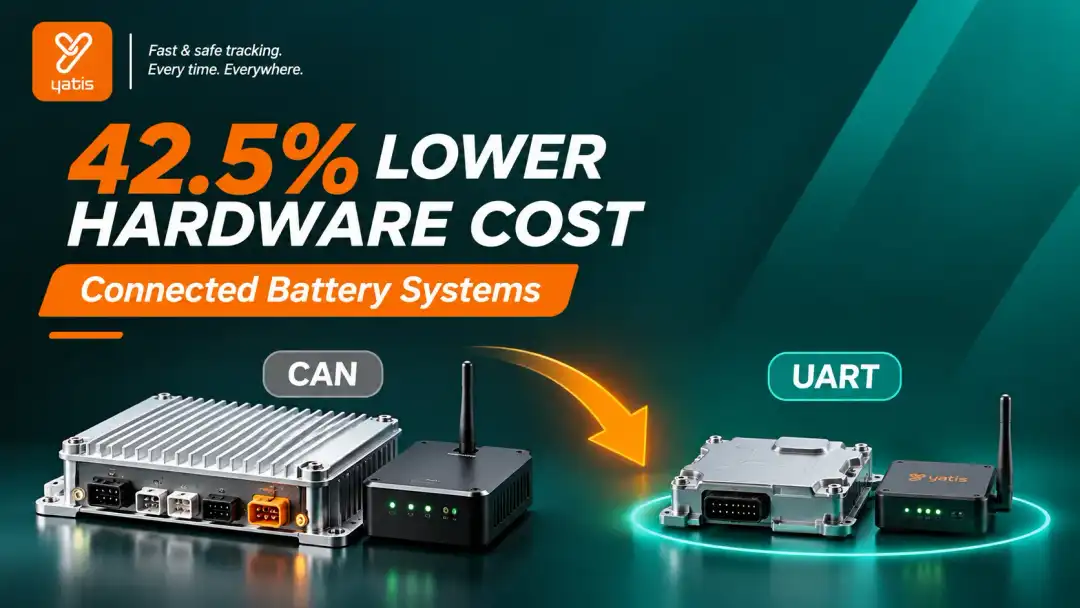
Connected battery products need more than a battery management system. Manufacturers and EV OEMs may also need battery data, vehicle visibility and remote operating capabilities. Yatis brings these capabilities together through compatible UART BMS integration—with an illustrative 42.5% lower combined BMS + IoT hardware cost than the reference CAN-based configuration shown in its product comparison.
More connected.
Less hardware spend.
Battery monitoring, GPS tracking and remote operations through compatible UART BMS integration.
The connected battery cost comparison
The central commercial difference is visible in the component-level comparison. The reference CAN-based configuration lists a BMS at ₹3,500 and an IoT device at ₹2,500. The Yatis UART configuration lists a UART BMS at ₹1,250 and an IoT device at ₹2,200.
- BMS: ₹3,500
- IoT device: ₹2,500
- UART BMS: ₹1,250
- IoT device: ₹2,200
What does the 42.5% cost difference mean at scale?
A per-deployment difference becomes more meaningful when a manufacturer or OEM plans a larger rollout. Based on the illustrative ₹2,550 difference, the potential hardware saving scales with deployment volume.
| Deployments | CAN-based reference | Yatis UART | Illustrative difference |
|---|---|---|---|
| 100 | ₹6,00,000 | ₹3,45,000 | ₹2,55,000 |
| 500 | ₹30,00,000 | ₹17,25,000 | ₹12,75,000 |
| 1,000 | ₹60,00,000 | ₹34,50,000 | ₹25,50,000 |
| 5,000 | ₹3,00,00,000 | ₹1,72,50,000 | ₹1,27,50,000 |
Illustrative arithmetic only. Actual commercial pricing, quantities, compatibility, taxes, installation, connectivity and platform fees must be confirmed for each deployment.
Estimate your deployment-level hardware difference
Change the deployment quantity to calculate the illustrative difference using ₹6,000 versus ₹3,450 per deployment.
This estimator compares the two stated hardware configurations only. It is not a quote or total cost of ownership calculator.
What does Yatis UART integration bring together?
The supplied Connected Battery Systems material presents three connected capabilities: read battery information, follow the vehicle journey and control supported battery functions remotely.
1. Read the battery
For a compatible BMS integration, the solution can make battery information such as State of Charge (SoC), individual cell voltages, temperatures and BMS settings available for monitoring. This gives the operator a view of selected battery parameters rather than relying only on vehicle location.
2. Follow the journey
GPS location and driving-behaviour insights add vehicle visibility to the connected battery proposition. Battery and vehicle information can therefore be considered together within the connected operations workflow.
3. Control remotely
The supplied material identifies battery enable/disable and supported BMS commands as remote-operation capabilities. The exact commands available depend on the BMS model, compatibility and integration. They should not be assumed to work with every battery or BMS.
How the UART-connected architecture works
The architecture shown in the product material follows a connection path: a compatible UART BMS communicates with the IoT device through a TTL serial interface; the IoT device then communicates over cellular connectivity with the Yatis platform.
The supplied material identifies the BlackRock IoT BR1201 device in the integration context. The collateral names BlackRock IoT for the device, while Yatis provides the connected platform and solution branding. For device information, refer to BlackRock IoT.
Why the price comparison needs a compatibility check
The 42.5% figure is a comparison between two specific illustrative hardware configurations. It should not be interpreted as proof that every UART implementation costs less than every CAN implementation. The appropriate interface and integration depend on the battery system and its BMS.
Before selecting a connected battery configuration, battery manufacturers and EV OEMs should confirm:
- BMS model and interface: verify that the target BMS supports the required UART communication and integration.
- Data availability: confirm which SoC, cell voltage, temperature and BMS settings can be read.
- Command support: validate which remote commands, including enable/disable, are supported for the specific BMS.
- Device and connectivity fit: check the IoT device, interface and cellular connectivity requirements.
- Full commercial scope: separately confirm taxes, installation, connectivity and platform fees.
Who should evaluate this connected battery approach?
Battery manufacturers
Battery manufacturers developing connected battery products can evaluate the combined hardware cost, supported battery data and remote-operation requirements before finalising their architecture.
EV OEMs
EV OEMs can assess whether battery monitoring and vehicle GPS visibility should be brought together in their connected vehicle proposition, subject to BMS and vehicle integration requirements.
Fleet and connected-vehicle solution teams
Teams building connected operations can assess the value of bringing battery information, vehicle location and supported remote commands into one workflow.
Frequently asked questions
How does Yatis reduce connected battery hardware cost by 42.5%?
The supplied comparison shows ₹6,000 for a reference CAN-based BMS + IoT hardware configuration and ₹3,450 for the Yatis UART configuration. The ₹2,550 difference is 42.5% of the ₹6,000 reference amount. The figures are illustrative and cover these hardware components only.
What is the price difference between the CAN-based and Yatis UART configurations?
The reference CAN-based configuration is listed at ₹6,000 per deployment: BMS ₹3,500 plus IoT ₹2,500. The Yatis UART configuration is listed at ₹3,450: UART BMS ₹1,250 plus IoT ₹2,200. The illustrative difference is ₹2,550 per deployment.
Does the ₹3,450 price include installation and platform charges?
No. The supplied product material states that the illustrative BMS + IoT hardware prices exclude taxes, installation, connectivity and platform fees.
What battery parameters can be monitored?
The supplied Yatis material identifies State of Charge (SoC), individual cell voltages, temperatures and BMS settings. Exact data availability depends on the supported BMS model and integration.
Can Yatis UART integration provide GPS tracking?
The connected battery proposition includes GPS location and driving-behaviour insights for vehicle visibility, alongside battery monitoring. The final implementation depends on the device and integration configuration.
Can the battery be controlled remotely?
The supplied material identifies battery enable/disable and supported BMS commands. Available commands depend on the BMS model and integration; compatibility must be checked before deployment.
Is UART always cheaper than CAN for battery monitoring?
No universal conclusion should be drawn from this comparison. The 42.5% figure applies to the specific illustrative configurations in the supplied Yatis collateral. Actual costs and technical suitability depend on hardware, BMS compatibility and project requirements.
How can a battery manufacturer check compatibility?
Share the BMS make and model, interface details and required monitoring or control functions with Yatis. Confirm supported data points, commands and integration requirements before finalising the configuration.
Connect your batteries. Reduce hardware cost by 42.5%.
Explore battery visibility, GPS tracking and remote operations through compatible UART BMS integration. Book a discussion with Yatis and check your BMS compatibility.
Book a demoVisit Yatissales@yatis.io · +91 95133 44858 · www.yatis.io
Explore more from Yatis
- Yatis Telematics — connected vehicle and telematics solutions
- Yatis Resources — articles and insights
- BlackRock IoT — hardware supplier website referenced in the product collateral