

Fleet Accident Investigation Workflow Using Video Telematics

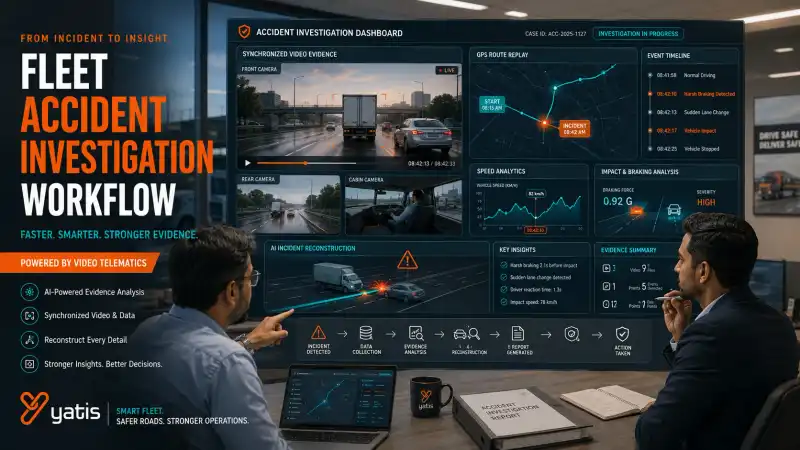
Fleet accidents create pressure fast. Within minutes, fleet operators may be dealing with driver safety concerns, insurance reporting, delivery disruption, customer communication, operational delays, and liability questions.
The problem is that many investigations still rely heavily on manual reports, incomplete evidence, delayed communication, and fragmented information. That slows down decision-making and creates uncertainty during claims investigations.
Video telematics changes this process by giving fleets faster access to incident footage, GPS tracking data, driver behavior analytics, and operational context in one centralized system. For commercial fleets, this creates a more structured and efficient accident investigation workflow.
Why Fast Accident Investigation Matters
The longer an accident investigation takes, the more operational problems fleets usually face.
Delayed investigations can lead to extended vehicle downtime, unresolved insurance claims, missing evidence, customer delivery delays, legal uncertainty, and higher administrative workload.
Fast investigation workflows help fleets secure evidence quickly, support drivers faster, reduce operational disruption, improve claims handling, and strengthen risk management.
This is especially important for fleets managing long-haul transport, logistics operations, commercial delivery, passenger transportation, and construction fleets. In high-mileage operations, even small investigation delays can create significant operational impact.
What Is a Fleet Accident Investigation Workflow?
A fleet accident investigation workflow is the structured process fleets follow after a vehicle incident to:
- collect evidence
- review operational data
- determine incident details
- coordinate internal response
- support insurance investigations
- improve future safety performance
Video telematics helps simplify this workflow by centralizing incident visibility and reducing dependence on manual reporting alone.
Step 1: Incident Detection
The investigation process begins the moment an event occurs. Traditional fleet investigations often depend on driver phone calls, delayed reporting, and manual escalation.
Video telematics systems improve this process through real-time incident alerts, AI event detection, automatic collision triggers, harsh braking notifications, and emergency event recording.
Fleet managers can receive immediate visibility into when the incident occurred, where it happened, which vehicle was involved, and what driving behavior triggered the alert. This early visibility helps fleets respond faster during critical situations.
Step 2: Securing Video Evidence
One of the biggest challenges in traditional accident investigations is evidence collection. Without reliable footage, fleets may struggle to verify timelines, confirm liability, review driver actions, and respond to disputes.
Video telematics systems automatically secure dashcam footage, timestamped recordings, event-triggered clips, and surrounding road activity. Cloud-connected systems can also prevent important footage from being overwritten, lost, damaged, or manually deleted.
This creates a more reliable evidence chain during investigations.
Step 3: Reviewing GPS and Driver Data
Video footage alone does not always explain the full situation. That is why telematics context is important.
Modern systems combine footage with GPS tracking, vehicle speed, braking intensity, route history, acceleration patterns, and driver behavior data. This allows investigators to reconstruct incidents more accurately.
For example, fleets can verify exact vehicle location, speed before impact, braking timing, route deviations, and driver response behavior. That operational context helps reduce assumptions during investigations.
Step 4: Driver and Dispatcher Coordination
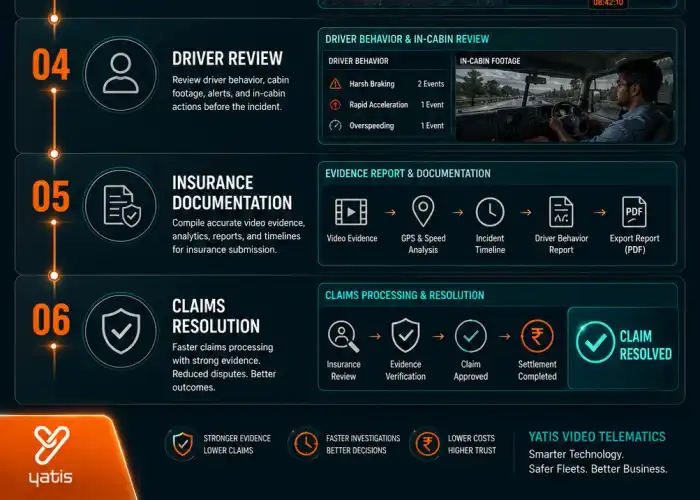
After evidence collection begins, fleets typically coordinate with drivers, dispatch teams, operations managers, and safety personnel.
Video telematics helps improve these discussions because the investigation relies on actual footage, telematics data, and verified timelines instead of incomplete recollection alone.
This often helps fleets reduce confusion, improve internal communication, document incidents consistently, and support drivers fairly. For drivers, objective evidence can also help reduce unnecessary blame during disputed situations.
Step 5: Insurance and Claims Documentation
Insurance reporting becomes significantly easier when fleets already have organized incident evidence.
Video telematics helps fleets provide timestamped footage, GPS records, speed analytics, event summaries, and driver activity data. This allows claims teams to review incidents faster, clarify liability sooner, reduce investigation delays, and strengthen documentation accuracy.
For many fleets, this is one of the most valuable operational benefits of telematics visibility.
Step 6: Root Cause Analysis
Strong investigation workflows do not stop after claims processing. Fleets also need to understand why the incident happened.
Video telematics helps safety teams identify distracted driving, harsh braking patterns, fatigue indicators, speeding trends, route-related risks, and operational blind spots. This helps fleets move beyond reactive investigations toward proactive risk reduction.
Over time, root cause analysis supports better driver coaching, stronger safety programs, reduced repeat incidents, and improved operational policies.

How Video Telematics Speeds Up Investigations
Compared to traditional investigation methods, video telematics improves incident visibility, evidence collection, response time, operational coordination, claims documentation, and investigation consistency.
Instead of searching for fragmented information, fleet managers can access centralized operational evidence from a single platform. This reduces administrative burden, reporting delays, evidence gaps, and investigation uncertainty.
For larger fleets, those efficiencies become increasingly valuable as operations scale.
Common Challenges Without Video Telematics
Fleets that rely only on manual reporting often experience delayed incident visibility, inconsistent documentation, missing footage, incomplete driver accounts, slower claims processing, and operational blind spots.
These issues create additional pressure during already stressful situations. Video telematics helps reduce those gaps by improving real-time operational awareness.
Building a Strong Fleet Investigation Process
An effective fleet accident investigation workflow should include:
- immediate incident reporting
- secure evidence retention
- centralized footage access
- telematics integration
- clear documentation procedures
- driver communication guidelines
- root cause review processes
Consistency is important. Without standardized workflows, investigations often become slower and less reliable over time.
Final Thoughts
Commercial fleet accidents are operationally complex. The speed and accuracy of an investigation can directly affect safety response, insurance handling, driver support, operational continuity, and long-term risk management.
Video telematics helps fleets create more organized and efficient investigation workflows by combining incident footage, AI event detection, GPS visibility, driver analytics, and centralized operational data.
For fleets managing increasing operational pressure and safety expectations, structured accident investigation processes are becoming an essential part of modern fleet management.
As fleet operations continue evolving toward real-time visibility and connected telematics systems, investigation workflows supported by operational data will become increasingly important for reducing risk and improving decision-making.
Frequently Asked Questions
Strengthen your accident investigation workflow
Contact Yatis Telematics to learn how our AI-powered video telematics solutions help commercial fleets investigate accidents faster, reduce claims delays, and improve safety outcomes.
Contact Us →