

FMCG Fleet Tracking: How Telematics Improves On-Time Delivery and Route Compliance

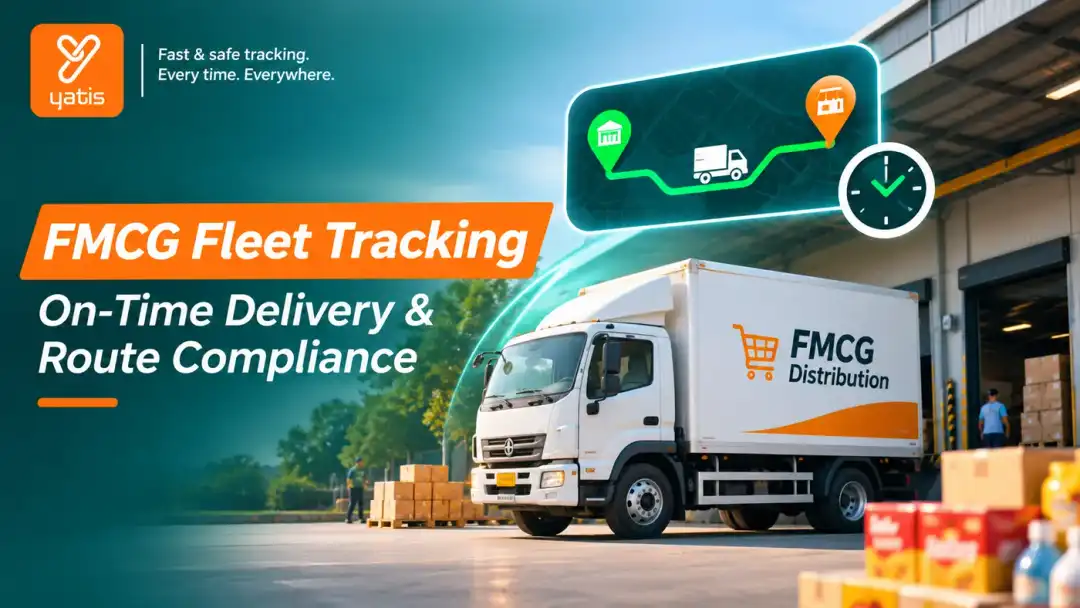
In fast-moving consumer goods (FMCG), a delivery delay can affect shelf availability, distributor commitments and the next replenishment cycle. With vehicles travelling between depots, distributors, retailers and modern trade outlets, teams need dependable visibility—not just a dispatch sheet. FMCG fleet tracking helps distribution managers monitor journeys, communicate ETAs, review route adherence and investigate delivery exceptions across the supply chain.
For FMCG businesses managing primary, secondary or direct-to-retail distribution, fleet tracking and telematics can create a shared operational view of vehicles on the road. It supports better coordination between warehouse teams, transporters, distributors, sales representatives and customer service—while keeping delivery execution and commercial records in their respective systems.
What is FMCG fleet tracking?
FMCG fleet tracking is the use of GPS-enabled devices and fleet software to monitor vehicles carrying packaged foods, beverages, personal care products, household goods and other fast-moving consumer products. It can provide vehicle location, trip history, stop duration, route progress and configured alerts.
FMCG fleet management goes beyond locating a truck. It combines vehicle visibility with dispatch planning, route compliance, delivery status, vehicle utilisation, fuel efficiency and service-level reporting. Depending on integrations, telematics events can be matched with invoices, delivery challans, order IDs or proof-of-delivery records.
Why on-time delivery and route compliance matter in FMCG
- Outlet availability: late replenishment can disrupt retailer or distributor receiving plans.
- High delivery frequency: many routes include multiple stops and tight delivery windows.
- Route discipline: planned territories and sequences can be affected by diversions or unplanned stops.
- Distribution coordination: depots, distributors, sales teams and transporters need consistent journey updates.
- Cost control: extra distance, prolonged idling and inefficient trips can increase operating costs.
- Customer communication: credible ETAs help receiving teams prepare and reduce status calls.
- Delivery evidence: teams need to reconcile vehicle arrival with actual order delivery and acceptance.
7 ways telematics improves FMCG delivery operations
1. Live distribution vehicle tracking
GPS tracking shows where delivery vehicles are during a trip and helps operations teams monitor progress from depot to distributor or outlet. Fleet dashboards can make it easier to identify vehicles approaching a receiving location, investigate delays and coordinate support. Location visibility is most useful when dispatch plans and vehicle identifiers are accurate.
2. More dependable delivery ETAs
Live position and journey progress provide a more current basis for arrival estimates than static departure-time assumptions. Dispatchers can flag likely delays, update distributors or receiving outlets and help teams prepare for vehicle arrival. ETA quality still depends on route, traffic, stop patterns and the platform’s calculation method.
3. Route compliance and deviation monitoring
Route monitoring helps compare actual vehicle movement with an approved route, territory or planned sequence. Configurable deviation alerts can highlight unexpected diversions or unplanned movement for review. A deviation may be legitimate—such as road closure, traffic restrictions or a customer-requested change—so alerts should trigger verification rather than automatic penalties.
4. Delivery stop and proof-of-delivery visibility
Geofences around depots, distributors or retail outlets can indicate vehicle entry and exit. These events support a journey timeline and can help reconcile arrival with delivery records. Vehicle arrival is not proof that goods were delivered or accepted. Proof of delivery (POD)—such as receiver acknowledgement, timestamp, quantity confirmation or signature—should be captured in a delivery app or order-management workflow and linked to the vehicle trip where possible.
5. Temperature monitoring for sensitive products (optional)
For chilled, frozen or otherwise temperature-sensitive FMCG, compatible sensors and a suitable monitoring workflow may capture temperature readings and threshold alerts. This is an optional capability, not a standard outcome of GPS tracking. Validate sensor placement, calibration, sampling frequency, alert escalation and product-specific handling requirements before relying on the data.
6. Reduced idle time and better fuel visibility
Idle reports can help identify avoidable engine-on stationary periods, while trip distance and compatible fuel data can support fuel-efficiency reviews. Use clear definitions: stationary time, engine-on idle and delivery dwell are different operational events. A vehicle may be stationary because it is unloading, waiting for a receiving slot or following safety instructions.
7. Outlet service and distribution performance analysis
When GPS events are connected to order and delivery records, managers can analyse delivery punctuality, route adherence, stop duration, failed delivery reasons and outlet service patterns. These insights can support route redesign, receiving-window coordination and better distributor communication. Telematics complements sales and order systems; it does not independently confirm stock availability or sales at the outlet.
FMCG fleet tracking KPIs to monitor
Choose metrics that reflect the distribution model and delivery promise. Define the numerator, denominator, time window and exception rules before comparing regions, transporters or routes.
| KPI | What it measures | Data required |
|---|---|---|
| On-time delivery (OTD) | Deliveries completed within agreed time window | Planned window + actual delivery/POD timestamp |
| Route compliance | Adherence to approved route or sequence | Planned route + GPS trace + exception rules |
| ETA accuracy | Difference between communicated and actual arrival | ETA snapshots + arrival event |
| Delivery dwell time | Time spent at receiving locations | Geofence entry/exit + stop definition |
| Proof-of-delivery completion | Share of orders with valid delivery evidence | POD records + order IDs |
| Distance per delivery | Travel distance allocated to delivered orders/stops | Trip distance + stop/order mapping |
| Idle time | Defined engine-on stationary duration | Ignition and movement signals |
| Fuel efficiency | Fuel consumed per distance or delivery unit | Reliable fuel data + distance/volume |
| Failed delivery rate | Orders not delivered as planned | Delivery outcome + reason codes |
Use consistent definitions across depots and transport partners. GPS data alone cannot establish order acceptance, product condition or sales at the outlet.
How to implement FMCG fleet tracking in India
- Map the distribution network. Document depots, distributor points, territories, outlet clusters, delivery windows and vehicle types.
- Set a baseline. Measure current OTD, route exceptions, delivery dwell, fuel/idle patterns and status-call volume where data exists.
- Equip and identify vehicles. Install suitable GPS devices and maintain a clean mapping of vehicle, transporter, route and delivery identifiers.
- Configure geofences and alerts. Create depot, distributor and selected outlet geofences; tune route deviation and after-hours alerts to avoid noise.
- Connect dispatch and POD. Link trip events to order IDs, delivery challans or ePOD records through an app, API or operational process.
- Train stakeholders. Define who monitors journeys, communicates delays, handles route changes and verifies exceptions.
- Pilot by route or region. Test representative urban, semi-urban and longer-haul routes; validate location accuracy, network coverage and workflow adoption.
- Review and optimise. Use weekly scorecards to improve route plans, receiving slots, vehicle allocation and exception handling.
FMCG distribution tracking checklist
- ☐ Vehicle and transporter master data is accurate
- ☐ Routes, stop sequence and delivery windows are documented
- ☐ Depot, distributor and outlet geofences are validated
- ☐ ETA update and delay escalation owners are assigned
- ☐ Route deviation exceptions include a verification process
- ☐ POD is captured in a delivery workflow—not inferred from GPS
- ☐ Temperature sensors are specified for products that require them
- ☐ Idle and fuel KPI definitions are standardised
- ☐ Driver and transporter tracking policies are communicated
- ☐ Dashboard access, retention and data security are governed
- ☐ Pilot results are reviewed against baseline metrics
FMCG fleet tracking vs. delivery management software
| Fleet telematics | Delivery / order management |
|---|---|
| Vehicle location, trip history and movement alerts | Orders, invoices, delivery tasks and quantities |
| GPS-based ETA and route visibility | Customer receiving windows and delivery status |
| Geofence arrival/departure events | Receiver confirmation, signature, quantity and POD |
| Vehicle, route, idle and fuel reports | Order fulfilment, returns, shortages and commercial reconciliation |
| Journey exceptions and vehicle utilisation | Delivery outcomes and customer/order-level performance |
These systems are complementary. A telematics platform explains vehicle movement; delivery software records what was delivered and accepted. Integration connects the two views for stronger operational reporting.
Frequently asked questions
What is FMCG fleet tracking?
FMCG fleet tracking uses GPS and telematics to monitor vehicles delivering fast-moving consumer goods. It provides journey visibility, route progress, ETAs, trip history and alerts that support distribution operations.
How does fleet tracking improve on-time delivery?
Live vehicle location and journey progress help dispatchers spot delays earlier, communicate updated ETAs and coordinate receiving teams. Measuring OTD requires planned delivery windows and actual delivery or POD timestamps.
What is route compliance in FMCG distribution?
Route compliance measures how closely a delivery vehicle follows an approved route, territory or stop sequence. GPS traces and planned route data can identify exceptions, which should be reviewed for legitimate diversions.
Does GPS tracking provide proof of delivery?
No. GPS or geofence data can indicate vehicle arrival or departure. Proof of delivery requires a separate record such as receiver acknowledgement, signature, quantity confirmation or an ePOD entry.
Can FMCG fleet tracking monitor temperature?
Temperature monitoring is possible with compatible sensors and a configured monitoring system. It is an optional capability and must be validated for sensor accuracy, placement, calibration and product handling needs.
Which FMCG delivery KPIs should be tracked?
Start with on-time delivery, route compliance, ETA accuracy, delivery dwell time, POD completion, distance per delivery, idle time, fuel efficiency and failed delivery rate. Define each metric consistently.
Can fleet tracking work with distributors and transporters?
Yes, subject to vehicle/device coverage, data permissions and operational agreements. Clear vehicle mapping, monitoring policies and escalation ownership are important when third-party fleets are involved.
Improve visibility across every FMCG delivery journey
Connect fleet movement with distribution workflows to support better ETA communication, route reviews and delivery performance reporting.
Explore YatisTalk to the teamRelated resources
- Yatis Telematics — fleet tracking and visibility solutions
- Yatis Resources — guides and insights
- Logistics — explore logistics fleet use cases
- GPS Tracking — explore vehicle tracking capabilities
External references: Review the GS1 EPCIS standard for supply-chain event visibility concepts, the GS1 barcode standards overview for identification context.