

Beyond Battery Monitoring: Combining GPS Tracking and Remote Battery Control in One Solution

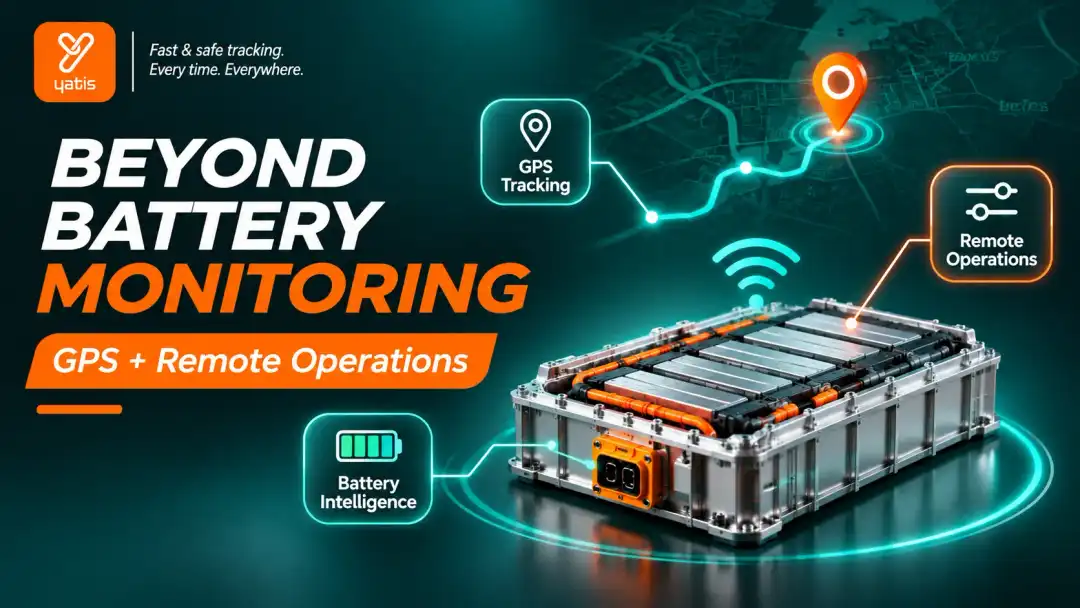
Battery data tells you about the battery. GPS tells you where the vehicle is. Supported remote commands add another layer: the ability to initiate specific battery operations through a compatible BMS integration. Bringing these capabilities together can give battery manufacturers, EV OEMs and connected-vehicle teams a more joined-up view of battery and vehicle operations.
Why combine battery monitoring with GPS tracking?
Battery monitoring and GPS tracking answer different operational questions. Battery monitoring provides access to selected information reported by the BMS. GPS tracking provides vehicle-location context. When these data streams are available through a connected solution, an authorised team can consider battery information alongside the vehicle’s location and journey context.
For example, a battery reading viewed on its own may show a reported SoC value. GPS information can add where the vehicle is located. Driving-behaviour insights may provide additional context about vehicle use. These are complementary views; one does not replace the other, and the usefulness of the combined view depends on the quality and availability of each data source.
Three capability layers in a connected battery solution
1. Battery monitoring: understand reported battery status
The supplied Yatis product material identifies State of Charge (SoC), individual cell voltages, temperatures and BMS settings as information that can be monitored for a compatible integration. The BMS remains the source of the data it exposes. The connected device transfers supported information; it does not independently create every battery measurement.
2. GPS tracking: add vehicle location context
GPS location adds a view of where the vehicle is. The supplied material also identifies driving-behaviour insights as part of the connected battery proposition. Together, these can help an authorised team review battery information in the context of vehicle movement and usage.
3. Remote battery operations: send supported commands
The supplied product collateral identifies battery enable/disable and supported BMS commands as remote-operation capabilities. These functions are not universal commands that can be issued to every battery. They depend on the BMS model, firmware, protocol support, integration design, user permissions and the battery maker’s operating rules.
How the connected architecture works
For the UART-based configuration described in Yatis product material, the compatible BMS communicates with the IoT device through a TTL serial interface. The IoT device then uses cellular connectivity to communicate with the Yatis platform. GPS data is provided through the tracking device’s supported positioning capability. Remote battery commands require a supported, correctly integrated command path back to the BMS.
- Battery information is exposed by the BMS. The BMS supplies the parameters and status fields supported by its hardware and firmware.
- The IoT device receives supported data. A compatible UART/TTL interface and documented protocol are required for the integration described here.
- Vehicle location is made available. GPS capability adds vehicle-position information to the connected view.
- Cellular connectivity links the device and platform. Data transmission depends on device configuration and network availability.
- Authorised users review information and supported operations. Any remote command must be supported by the BMS and governed by defined permissions and operating rules.
What can an operations team understand from the combined view?
| Information or capability | Question it helps answer | Important limitation |
|---|---|---|
| SoC and other supported BMS data | What battery information is currently being reported? | SoC is an estimate; available fields depend on BMS support. |
| Individual cell voltages | What are the readings for monitored cells or cell groups? | Interpret against battery-specific limits and operating context. |
| Temperature readings | What temperatures are reported by the connected BMS? | Sensor position and count determine what each reading represents. |
| GPS location | Where is the tracked vehicle? | Depends on GPS reception, device configuration and reporting. |
| Driving-behaviour insights | What vehicle-use context is available? | Depends on supported device data and configured analytics. |
| Supported remote commands | Can an authorised operation be requested remotely? | Only commands supported by the BMS and approved integration are available. |
Remote battery control: capability, not a blanket promise
Remote battery control can sound broad, so it is important to define exactly what is meant. The supplied Yatis material identifies battery enable/disable and supported BMS commands. It does not establish that every BMS supports the same command set, that all commands can be issued in every operating state, or that the function is designed as a certified safety control.
Before enabling a remote command, the integrator and battery manufacturer should agree on:
- the exact command name and function;
- the BMS models and firmware versions that support it;
- the conditions under which the command is permitted;
- the identity and permissions of users who may request it;
- confirmation, acknowledgement and failure handling;
- event logging and audit requirements;
- the safe recovery procedure if connectivity is lost or a command is not acknowledged.
Where can the combined approach be relevant?
Battery manufacturers
Battery manufacturers can evaluate whether their connected battery offering should expose selected BMS data alongside GPS location and supported remote operations. The integration should begin with the target BMS model and a documented list of supported parameters and commands.
EV OEMs
EV OEMs can assess the value of combining battery status and vehicle location in their connected-vehicle architecture. Interface selection, vehicle electronics, BMS protocol and command permissions need to be validated together.
Fleet and asset operators
Fleet teams may benefit from considering vehicle location and available battery information in one operational workflow. The actual usefulness depends on the vehicle application, reporting frequency, network availability and the data exposed by the battery system.
Implementation checklist
- ☐ Confirm BMS make, model, firmware and supported communication interface.
- ☐ Validate UART/TTL electrical levels, pinout, baud rate and protocol documentation.
- ☐ Confirm the available SoC, cell voltage, temperature and BMS settings fields.
- ☐ Confirm GPS capability, antenna/device placement and expected coverage.
- ☐ Document each supported remote command and its operating constraints.
- ☐ Define user permissions, command acknowledgement, logging and audit trail.
- ☐ Specify cellular connectivity, reporting frequency and offline behaviour.
- ☐ Bench-test data accuracy, command response and failure scenarios.
- ☐ Complete controlled field validation with the battery and vehicle teams.
- ☐ Confirm commercial scope, installation, connectivity and platform requirements.
Frequently asked questions
Can GPS tracking and battery monitoring work in one connected solution?
Yes, where the IoT device and integration support both data paths. The Yatis connected battery proposition combines supported BMS information with GPS location and driving-behaviour insights.
What battery information can be monitored remotely?
The supplied Yatis product material identifies SoC, individual cell voltages, temperatures and BMS settings. Actual fields depend on the compatible BMS model and integration.
What does remote battery control mean?
In the supplied product material, it refers to battery enable/disable and supported BMS commands. It does not mean every battery function can be controlled remotely.
Can Yatis remotely switch any battery on or off?
No universal compatibility should be assumed. The specific BMS must support the command, and the command path, permissions and operating constraints must be validated for the integration.
Does remote battery disablement work as an anti-theft immobiliser?
The supplied material does not establish that. Do not treat battery enable/disable as an anti-theft or safety-rated immobilisation feature unless the specific system is expressly designed and validated for that use.
How does the BMS connect to the Yatis platform?
The supplied UART configuration describes a compatible BMS connected to an IoT device through a TTL serial interface, with cellular connectivity linking the device to the Yatis platform.
What happens if cellular connectivity is unavailable?
Offline buffering, retry behaviour and command handling depend on the IoT device and implementation. These behaviours should be documented and tested before deployment; the product material does not specify universal offline behaviour.
Who should consider a connected battery solution?
Battery manufacturers, EV OEMs and fleet or asset operators can evaluate it when they need a combination of supported battery information, vehicle location and specific remote BMS operations.
Bring battery data and vehicle visibility into one connected view.
Explore compatible UART BMS integration for battery monitoring, GPS tracking and supported remote operations. Share your BMS make and model to validate the available functions.
Discuss your integrationVisit Yatissales@yatis.io · +91 95133 44858
Explore more from Yatis
- Yatis Telematics
- Yatis Resources
- BlackRock IoT — device supplier website referenced in the supplied product material