

GPS Tracking System Cost in India: What Determines the Total Cost?

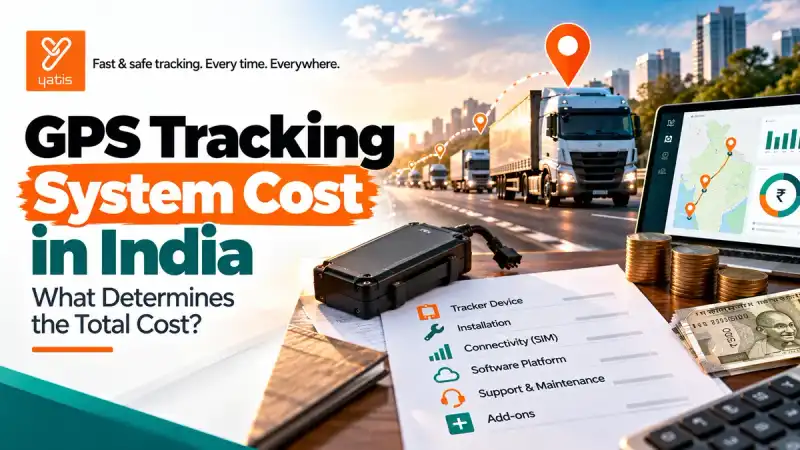
What makes up the total cost?
Then add optional sensors, video, integration, training, replacement and exit costs where relevant.
Why GPS Tracking Prices Vary in India
Two products both described as “GPS trackers” can offer very different capabilities. One may be a basic location device; another may include vehicle-data interfaces, driver-behaviour events, fuel monitoring, tamper alerts, richer reporting or regulated-use certifications. The software and service model can differ just as much as the hardware.
Price also varies with fleet size, vehicle type, installation complexity, connectivity needs, support expectations and whether you need a simple tracker or a broader fleet management platform. That is why a single headline price can be misleading.
Start by defining your use case, then compare quotes against the same list of requirements. Explore the Yatis GPS Tracking System and the broader Yatis fleet and IoT solutions as part of your evaluation.
1. Hardware: What Are You Paying For?
Hardware cost depends on the device's capability, supported vehicle interface, durability, installation requirements and any certification required for your use case.
| Hardware consideration | Why it affects cost | What to ask |
|---|---|---|
| Basic location tracking | Core location reporting may require fewer inputs than richer telematics. | Which location, trip and alert features are included? |
| Vehicle data access | CAN/OBD or other vehicle interfaces can change device and integration needs. | Which vehicle signals are supported on our exact models? |
| Ruggedness and power | Environmental protection, wiring and power design affect suitability. | What are the operating limits and warranty conditions? |
| Special sensors | Fuel probes, temperature sensors, panic buttons or other accessories add cost. | Are sensors included, optional or separately installed? |
| Regulatory suitability | Some deployments require a specific approved device or configuration. | Can you document suitability for our vehicle category and jurisdiction? |
2. Installation: Include the Real Deployment Cost
Installation may be charged per vehicle, per site or as part of a bundled package. The work can vary with vehicle wiring, access to power, device placement, sensor installation and the number of vehicles being deployed.
- Is installation included in the hardware quote?
- Are travel, site visits or multi-location rollout fees extra?
- Does installation require vehicle downtime?
- Are sensor calibration and testing included?
- What is the cost of relocation, reinstallation or device replacement?
- Will you receive an installation report and device/vehicle mapping?
For a large fleet, request a phased rollout plan and a written definition of what “installation complete” means. It should include a successful data check, not just a device mounted in the vehicle.
3. Connectivity: SIM and Data Charges
GPS devices often transmit location and telematics records over a mobile network. Connectivity cost depends on the SIM arrangement, coverage, reporting frequency, data volume, roaming needs and whether the system uploads richer data such as images or video.
| Question | Why it matters |
|---|---|
| Is SIM/data included? | A low device price may exclude recurring connectivity charges. |
| Which networks are supported? | Coverage on your routes matters more than a generic coverage claim. |
| What is the reporting interval? | More frequent updates can affect data use and battery/power behaviour depending on device design. |
| What happens offline? | Local buffering and later upload can reduce data gaps, if supported. |
| Are video uploads included? | Video can materially change data and storage requirements. |
Test connectivity on representative routes, including depots, industrial areas, highways and rural stretches relevant to your operation. Ask for the last-reported timestamp and an explanation of how the platform presents stale data.
4. Platform: The Software Subscription
A tracker provides data; the platform makes that data useful. Software charges may be priced per vehicle, per user, by module or through a bundled subscription. Check exactly what the quoted package includes.
Ask whether the plan includes historical data, report exports, user roles, mobile access, scheduled reports, API access and dashboard customisation. A feature listed on a website may be an optional module rather than part of the base price.
For broader context, read about GPS tracking capabilities and consider how the platform fits into your overall fleet management workflow.
5. Support: Service Has a Cost Too
Support quality matters when a device goes offline, an installation fails or a critical report is needed. Confirm the service model rather than assuming it is included.
- What are the support hours and escalation channels?
- Are response targets documented in an SLA?
- Who handles device diagnostics and replacement?
- Is onboarding and user training included?
- Are software updates and maintenance included?
- Is there a charge for site visits or out-of-warranty service?
6. Add-ons: Sensors, Integrations and Video
Add-ons should be priced against a defined business need. Avoid buying modules just because they are available; estimate what data or workflow each one improves.
| Add-on | Potential use | Cost items to check |
|---|---|---|
| Fuel sensor or fuel integration | Fuel-level trends, refuelling records and exceptions where supported. | Sensor, installation, calibration, data integration and platform module. |
| Temperature sensor | Cold-chain or temperature-sensitive cargo monitoring. | Sensor, calibration, alerts and retention. |
| Driver behaviour | Supported speeding, harsh braking, acceleration or cornering events. | Device support, configuration, reporting and coaching workflows. |
| Video telematics / AI dashcam | Visual context and supported safety-event footage. | Camera, installation, data, cloud storage, AI features and review effort. |
| API / custom integration | Connect fleet data with ERP, TMS or BI. | Setup, development, testing, ongoing support and API limits. |
7. Calculate Total Cost of Ownership (TCO)
The fairest way to compare GPS tracking system price in India is to calculate total cost over the same period, with the same fleet size and comparable features.
TCO formula
For a per-vehicle view, divide the total cost for the selected period by the number of vehicles. Keep one-time and recurring costs separate so the quote is easy to audit.
Cost per vehicle per month = total cost over the evaluation period ÷ vehicle count ÷ number of months.
For a fair comparison, ask every vendor to quote the same fleet size, subscription duration, reporting needs, data retention, installation scope and add-ons.
8. Sample Scenarios: How to Compare Quotes
The following examples are illustrative cost structures, not market-price estimates or Yatis quotations. They show how to organise a quote when vendor pricing varies. Replace the placeholder amounts with actual written quotes before making a decision.
Scenario A: Small fleet with basic tracking
Use case: A small business mainly needs live location, trip history and basic alerts.
Cost lines: tracker hardware + installation + SIM/data + base platform + standard support.
Watch-out: Confirm whether the monthly platform and SIM charges are separate and whether device replacement is included.
Scenario B: Medium fleet with reporting and driver events
Use case: An operator needs location, geofencing, route deviation alerts, driver-event reports and scheduled exports.
Cost lines: hardware suited to vehicles + installation + connectivity + platform tier + driver-event module if separately priced + training.
Watch-out: Confirm event definitions, historical data access, reporting limits and who configures alerts.
Scenario C: Larger fleet with sensors or video
Use case: A fleet requires fuel sensors, temperature monitoring, video evidence or integration with business systems.
Cost lines: base tracking + sensors/cameras + installation/calibration + higher data/storage allowance + platform modules + API/integration + additional review/support.
Watch-out: Include storage, connectivity, maintenance and staff time—not just the sensor or camera price.
9. TCO Calculator: A Simple Quote Comparison Template
Use the following structure in a spreadsheet to compare vendors. Add taxes and agency or procurement fees separately according to your company's accounting process.
| Cost line | One-time amount (₹) | Monthly amount (₹) | Notes |
|---|---|---|---|
| Hardware | Enter quote | — | Per device or bundled |
| Installation | Enter quote | — | Include travel/site costs |
| Connectivity / SIM | — | Enter quote | Per device or pooled |
| Platform subscription | — | Enter quote | Per vehicle/user/module |
| Support / warranty | Enter quote | Enter quote | Clarify included coverage |
| Add-ons and sensors | Enter quote | Enter quote | Hardware plus recurring module |
| Integration / training | Enter quote | Enter quote | Setup and ongoing maintenance |
| Replacement / exit costs | Estimate from contract | — | Include contractual fees |
10. Questions to Ask Before Signing
GPS tracking cost checklist
- Is the hardware purchase, rental or bundled?
- What is included in the quoted device price?
- Are installation and calibration included?
- Are SIM and data charges separate?
- What platform features are included in the base plan?
- Which reports, APIs or add-ons cost extra?
- How long is historical data retained?
- What are support hours and replacement terms?
- Are there minimum vehicle counts or contract terms?
- What are the renewal, cancellation and data-export terms?
- Which certifications or approvals are applicable to our use case?
- Can the vendor provide a written TCO quote for the full term?
How to Choose the Right Option for Your Fleet
The right option is the one that meets your actual operating requirements at a transparent and sustainable cost. Start with essential tracking and reporting needs, then add sensors, integrations or video when they solve a defined problem. Test device reliability and data quality on your routes before committing to a large rollout.
When comparing providers, assess the Yatis GPS Tracking System against the same hardware, service, feature and TCO criteria used for other shortlisted vendors. A written quote should specify device model, installation scope, subscription inclusions, support, add-ons, taxes and contract terms.
Frequently Asked Questions
External Sources & Further Reading
- Ministry of Road Transport and Highways (MoRTH) — consult for current vehicle and transport requirements relevant to your application.
- Telecom Regulatory Authority of India (TRAI) — telecom-sector information and regulation.
- MeitY Data Protection Framework — review data-protection information relevant to your deployment.
Regulatory requirements change and vary by vehicle category and use case. Confirm current applicability with official sources or qualified advisers.
Ready to get started?
Contact Yatis Telematics for a written quote covering hardware, installation, connectivity, platform, support and add-ons for your fleet.
Contact Us →