

GPS Tracking System vs Mobile Tracking Apps: Which Is Better for Fleet Tracking?

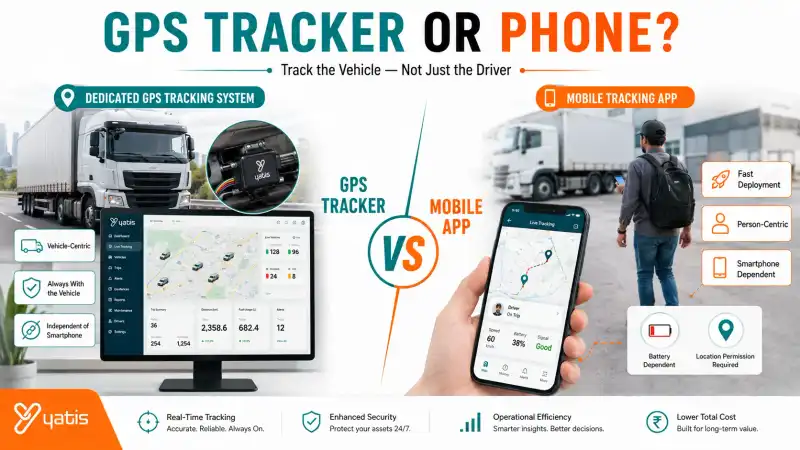
There are two fundamentally different ways to track vehicles today. One approach uses a dedicated GPS tracking device installed in the vehicle. The other uses a mobile application installed on a driver's or employee's smartphone.
At first glance, both can show a vehicle or person moving on a map. But the underlying technology — and therefore the reliability, operational control, and business use cases — can be very different. The right choice depends on an important question: do you need to track the vehicle continuously, or do you primarily need to track the person carrying the phone?
Quick Takeaways
- Dedicated GPS hardware operates independently of a driver's phone
- Mobile apps use smartphone location services
- Apps are easier to deploy
- Smartphones introduce battery and permission dependencies
- Dedicated hardware is better suited to permanent vehicle tracking
- Mobile tracking can work well for field personnel and temporary use cases
- The right option depends on whether you're tracking the vehicle or the person carrying the phone
Comparison Snapshot
| Factor | GPS Tracking System | Mobile Tracking App |
|---|---|---|
| Tracking Source | Dedicated vehicle hardware | Smartphone |
| Installation | Hardware installation | App installation |
| Phone Required | No | Yes |
| Phone Battery Dependency | Low / none | High |
| Background Tracking Dependency | Low | High |
| Vehicle Permanence | High | Low |
| Easy Deployment | Moderate | Excellent |
| Tamper Resistance | Higher | Lower |
| Temporary Tracking | Good | Excellent |
| Commercial Fleet Suitability | Excellent | Limited / use-case dependent |
What Is a GPS Tracking System?
A GPS tracking system uses dedicated hardware installed in a vehicle to collect location data and transmit it to a tracking platform. Because the hardware operates independently of a driver's smartphone, it can provide continuous vehicle visibility without requiring the driver to carry or operate a specific phone.
A dedicated tracking device typically has its own GNSS/GPS receiver, cellular connectivity, power connection, device identity, and communication hardware. The device collects location information and transmits it to the associated tracking platform, which makes the vehicle itself the tracked asset.
For businesses managing commercial vehicles, this distinction is significant. A driver can change phones, switch apps, lose battery power, or leave the vehicle — while the installed tracker remains associated with the vehicle.
What Is a Mobile Tracking App?
A mobile tracking app uses a smartphone's built-in location capabilities to determine and transmit the phone's location. It can be deployed quickly without dedicated vehicle hardware, but tracking continuity depends on the smartphone, its battery, permissions, operating system, and network connectivity.
A smartphone can determine location using combinations of GPS/GNSS, cellular networks, Wi-Fi, and other location technologies depending on the device and operating system. The tracking application then uses those location services to send information to a cloud platform or another user, making the smartphone the tracking device.
That can be highly practical for certain use cases, but it introduces dependencies that don't exist in the same way with dedicated vehicle hardware.
What Are You Actually Tracking?
This is the most important distinction. A dedicated GPS tracking system follows the path Vehicle → GPS Hardware → Tracking Platform, and the tracker remains with the vehicle. A mobile tracking app typically follows Person/Phone → Smartphone Location → Tracking Platform, and the tracking point moves with the smartphone.
If Driver A leaves Vehicle 101 and Driver B takes over, a dedicated tracker continues identifying the vehicle as Vehicle 101. With a smartphone-based system, the tracked location follows whichever phone is running the application. Dedicated hardware is vehicle-centric; mobile tracking is generally user- or device-centric.
Installation and Deployment
Mobile tracking apps are faster to deploy because they only require app installation and location permissions. Dedicated GPS systems require physical hardware deployment but provide a permanent tracking mechanism associated with the vehicle.
Mobile App
Typical deployment: Download App → Sign In → Grant Location Permission → Start Tracking. Advantages include minimal hardware, rapid deployment, easy onboarding, and no vehicle installation.
Dedicated GPS Hardware
Typical deployment: Install Device → Connect Power → Activate Device → Configure Platform → Track. Advantages include permanent vehicle association, independent operation, and less dependence on driver devices.
The choice depends on whether deployment speed or permanent vehicle tracking is the priority.
Battery Dependency
Mobile tracking apps depend on smartphone battery availability for continued tracking. Dedicated GPS hardware connected to the vehicle's power system operates independently of the driver's phone battery.
This is one of the biggest practical differences. A smartphone running location services continuously can consume significant battery power — high-accuracy and background location increase energy use, and mobile operating systems impose background location limits specifically to reduce battery consumption.
A driver may run out of battery, switch off the phone, enable battery-saving restrictions, close or restrict the app, or leave the phone behind. Any of these can affect app-based tracking. A dedicated vehicle tracker avoids dependence on the driver's smartphone battery.
Background Tracking and Operating-System Dependency
Mobile GPS tracking depends on how the smartphone operating system handles background location. Android and iOS both provide mechanisms for background tracking, but permissions, battery optimization, and system behaviour affect how continuously an app receives location updates.
On Android, background applications can face restrictions on how frequently they receive location updates — under certain conditions, background apps may receive updates only a few times per hour. iOS similarly suspends most background apps, requiring specific mechanisms for apps that need continuous background location updates.
A mobile tracking app therefore isn't simply equivalent to having a dedicated GPS device. The application must operate within the rules of the smartphone's operating system.
Tracking Continuity
Dedicated GPS tracking hardware generally provides more consistent vehicle tracking because it remains installed in the vehicle and operates independently of the driver's smartphone. Mobile tracking depends on the phone remaining powered, connected, permitted to share location, and available with the tracking app functioning correctly.
With dedicated hardware, the chain is Vehicle → GPS Device → Network → Tracking Platform, and the device remains associated with the vehicle regardless of who is driving. With a mobile app, the chain is Driver → Smartphone → Mobile Network → Tracking Platform. If the phone leaves the vehicle, the tracking point leaves with it.
What Happens When the Driver Changes?
A dedicated GPS tracker continues tracking the same vehicle when drivers change because the hardware is assigned to the vehicle. A mobile tracking app generally follows the smartphone or user account, making additional driver assignment processes necessary when tracking needs to remain vehicle-specific.
Consider a delivery vehicle used by three drivers during different shifts. With dedicated GPS tracking, Vehicle A is always mapped to Tracker A and driver changes do not change the tracking device. With mobile tracking, Driver A/Phone A is replaced by Driver B/Phone B — the tracking identity changes unless the software includes a separate vehicle-driver assignment process.
This makes dedicated hardware particularly useful where vehicle-level visibility matters more than knowing the location of a particular employee.
Phone Availability and Dependency
Mobile tracking apps depend on the availability of the smartphone running the application. A smartphone-based tracking solution can be affected when:
- The phone is switched off
- The battery is depleted
- The phone is left at home
- Location permission is disabled
- The application is removed
- The user changes devices
- Connectivity is unavailable
- Operating-system restrictions affect background activity
A dedicated tracker removes many of these human-device dependencies from the tracking process, which is particularly important for businesses that require persistent asset visibility rather than occasional location sharing.
Vehicle Tracking vs Driver Tracking
Vehicle-Centric Tracking
Dedicated GPS hardware answers the question "Where is my vehicle?" This is useful for logistics fleets, transport companies, service vehicles, delivery fleets, commercial fleets, and asset-intensive businesses.
Person-Centric Tracking
A mobile application answers "Where is my employee or smartphone?" This is useful for field sales teams, delivery personnel, service technicians, temporary workers, field-force coordination, and employee location sharing.
Neither approach is inherently wrong. The important question is what the business needs to track.
Security and Tamper Considerations
Dedicated GPS trackers can be installed in concealed locations and remain associated with the vehicle, while smartphone tracking is more exposed to user actions such as disabling location permissions, closing the application, switching devices, or removing the app.
A smartphone is designed to be controlled by its user. That flexibility is useful, but it also creates tracking dependencies. Dedicated vehicle hardware is designed differently: when professionally installed, it can remain concealed and continuously associated with the vehicle. For businesses where tracking continuity and asset visibility are critical, this is a major consideration.
Connectivity Dependency
Both approaches require some form of communication connectivity to transmit location information to a remote platform, but the connectivity model differs.
A mobile tracking app typically relies on mobile data, Wi-Fi where available, and smartphone location services. A dedicated GPS tracker typically has its own GNSS/GPS positioning capability, cellular communication, and a vehicle power connection. Dedicated hardware therefore doesn't require the driver to provide a separate smartphone data connection. The exact connectivity behaviour depends on the device and network configuration.
Deployment Flexibility
Mobile Apps Are Useful When:
- Tracking needs to begin immediately
- No hardware installation is practical
- Employees already carry smartphones
- The tracking requirement is temporary
- The business primarily tracks people
Dedicated GPS Hardware Is Useful When:
- Vehicles need permanent tracking
- Tracking must continue across driver changes
- The business manages a large vehicle fleet
- Vehicle-level reporting is required
- Dependence on personal smartphones is undesirable
Cost Considerations
Mobile tracking apps can have lower initial deployment costs because they use smartphones that employees already own. Dedicated GPS tracking requires hardware and installation investment, but it provides independent vehicle tracking and is more appropriate for long-term commercial fleet operations.
At first glance, mobile tracking can appear significantly cheaper — there may be no dedicated tracker purchase, vehicle installation, or hardware replacement. However, businesses should evaluate total cost of ownership, not simply initial deployment cost.
| Cost Factor | GPS Tracking System | Mobile Tracking App |
|---|---|---|
| Dedicated Hardware | Required | Usually not required |
| Installation | May be required | No vehicle installation |
| Smartphone | Not required for tracking | Required |
| Phone Data | Not required for device | Required |
| Phone Battery | Low dependency | High dependency |
| Device Replacement | Tracker-dependent | Smartphone-dependent |
| Long-Term Vehicle Tracking | Strong fit | Use-case dependent |
The cheaper deployment model isn't necessarily the better operational solution.
Scalability for Commercial Fleets
Dedicated GPS tracking systems are generally better suited to scaling vehicle-centric tracking across commercial fleets because each vehicle can have an independently identified tracking device. Mobile apps can scale users quickly but remain dependent on smartphone ownership, usage, and management.
As a fleet grows from 10 to 50 to 500 to 5,000 vehicles, operational consistency becomes increasingly important. With dedicated tracking hardware, each vehicle has a defined tracking identity supporting a model such as Vehicle → Device → Platform → Fleet Dashboard. Mobile tracking introduces another layer: Employee → Smartphone → App → Platform. That works well for field personnel but becomes less straightforward when the business needs vehicle-level tracking independent of drivers.
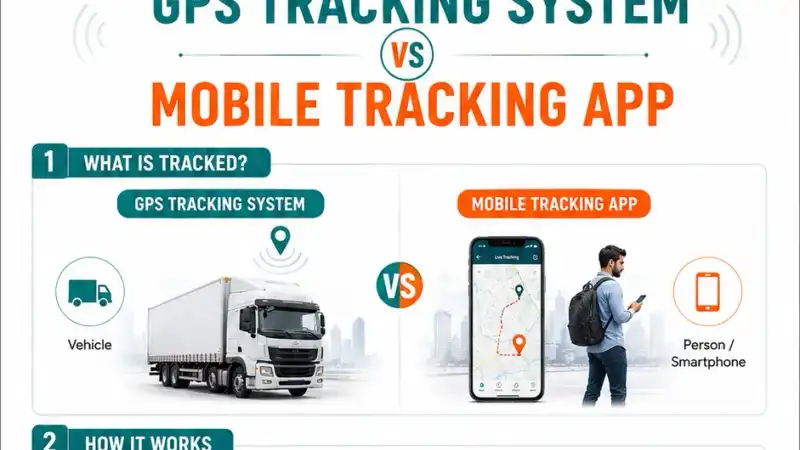
Core Comparison
| Factor | Dedicated GPS Tracking System | Mobile Tracking App |
|---|---|---|
| Tracking Asset | Vehicle | Smartphone / user |
| Dedicated Hardware | Yes | No |
| Smartphone Required | No | Yes |
| Vehicle Installation | Usually required | Not required |
| Driver Change Impact | Low | Higher |
| Phone Battery Dependency | Low | High |
| Background OS Dependency | Low | Higher |
| Vehicle Permanence | High | Low |
| Deployment Speed | Moderate | Very fast |
| Relocation | Hardware-dependent | Easy |
| Tamper Resistance | Higher with concealed installation | Lower |
| Vehicle-Centric Tracking | Excellent | Limited / workflow dependent |
| Person-Centric Tracking | Limited | Excellent |
| Commercial Fleet Suitability | Excellent | Use-case dependent |
| Temporary Tracking | Good | Excellent |
Which Businesses Should Choose a Mobile Tracking App?
Mobile tracking apps are best suited to businesses that primarily need person-based location tracking, temporary field visibility, or rapid deployment without installing dedicated vehicle hardware. Typical use cases include:
- Field sales teams
- Service technicians
- Temporary workforce tracking
- Delivery personnel
- Employee location sharing
- Short-term projects
- Businesses testing location-based workflows
For these scenarios, requiring dedicated hardware in every vehicle may add unnecessary complexity. The smartphone already provides the required location capability, making deployment significantly faster.
Which Businesses Should Choose a Dedicated GPS Tracking System?
Dedicated GPS tracking systems are better suited to businesses that need persistent vehicle-level visibility independent of the driver's smartphone. Typical use cases include:
- Logistics fleets
- Transport companies
- Delivery fleets
- Service fleets
- Construction vehicles
- Corporate fleets
- Rental and commercial vehicles
- Large multi-vehicle operations
The key advantage is continuity. A driver can change. A driver can change phones. A phone can lose power. But the tracking device remains associated with the vehicle. For businesses looking for centralized vehicle visibility, a GPS tracking system provides the underlying infrastructure required for continuous fleet tracking.
Use-Case Comparison
| Business Requirement | Mobile Tracking App | Dedicated GPS Tracking |
|---|---|---|
| Track employees | Excellent | Limited |
| Track field workers | Excellent | Limited |
| Temporary tracking | Excellent | Good |
| Fast deployment | Excellent | Moderate |
| Track vehicle independently | Limited | Excellent |
| Track across driver changes | Requires workflow | Excellent |
| Permanent vehicle monitoring | Limited | Excellent |
| Large commercial fleet | Use-case dependent | Excellent |
| Smartphone-independent tracking | No | Yes |
| Vehicle-level identity | Limited | Yes |
| Minimal hardware investment | Yes | No |
Common Mistakes When Choosing Between Mobile Apps and GPS Trackers
The most common mistake is choosing a smartphone tracking app simply because it is cheaper or easier to deploy. Businesses should first determine whether they need to track people or vehicles, then evaluate battery dependency, device availability, tracking continuity, and long-term fleet requirements.
Mistake 1: Tracking the Driver Instead of the Vehicle
If the business needs to know where a vehicle is, tracking the driver's smartphone creates unnecessary dependencies. In the morning Driver A uses Vehicle 1; in the afternoon Driver B uses Vehicle 1. The vehicle hasn't changed, but the smartphone being tracked has. Dedicated hardware keeps the tracking identity attached to the vehicle.
Mistake 2: Ignoring Smartphone Battery Dependency
A mobile application cannot transmit location indefinitely if the smartphone is unavailable. Consider what happens if the phone battery dies, the employee forgets the phone, location permission changes, the app is restricted in the background, or the phone is replaced. This matters considerably for operations that require continuous tracking.
Mistake 3: Assuming Both Solutions Work the Same Way
Seeing a vehicle icon moving on a map does not mean the underlying tracking architecture is identical. Dedicated GPS follows Vehicle → Dedicated Device → Network → Platform; a mobile app follows Person/Phone → Smartphone → Network → Platform. The operational implications are different.
Mistake 4: Choosing Based Only on Initial Cost
A smartphone-based solution can have a lower initial deployment cost, but businesses should also consider device management, smartphone replacement, battery management, data usage, user compliance, application permissions, and long-term operational reliability. The correct comparison is total operational value, not initial price.
Decision Matrix
| Question | If Yes, Choose |
|---|---|
| Do you primarily need to track employees? | Mobile App |
| Do employees already carry smartphones? | Mobile App |
| Is tracking temporary? | Mobile App |
| Do you need rapid deployment? | Mobile App |
| Do you need to track the vehicle regardless of driver? | GPS Tracking System |
| Do drivers frequently change vehicles? | GPS Tracking System |
| Do you require permanent vehicle visibility? | GPS Tracking System |
| Is smartphone independence important? | GPS Tracking System |
| Are you managing a large commercial fleet? | GPS Tracking System |
| Is vehicle-level reporting essential? | GPS Tracking System |
Final Thoughts
A mobile tracking application and a dedicated GPS tracking system can both put a location on a map. But the location on the map isn't the whole story. The more important question is what is being tracked — and how reliably that tracking must continue.
If the objective is to track employees, field workers, or temporary personnel, a mobile application can be an efficient and cost-effective solution. If the objective is to track commercial vehicles continuously, a dedicated GPS tracking system provides a stronger operational foundation because the tracking device stays with the vehicle rather than depending on the driver's smartphone.
For businesses managing a growing fleet, dedicated GPS hardware also provides a more consistent vehicle identity across drivers, shifts, and operational changes. At Yatis, the GPS Tracking System is designed around this vehicle-centric model, giving businesses persistent visibility into their fleet while enabling centralized monitoring and operational reporting.
Frequently Asked Questions
Ready to get started?
Contact Yatis Telematics to learn how a dedicated GPS tracking system delivers persistent vehicle visibility across your fleet.
Contact Us →