

Mixed Fleet Management: How to Track EVs and ICE Vehicles Together

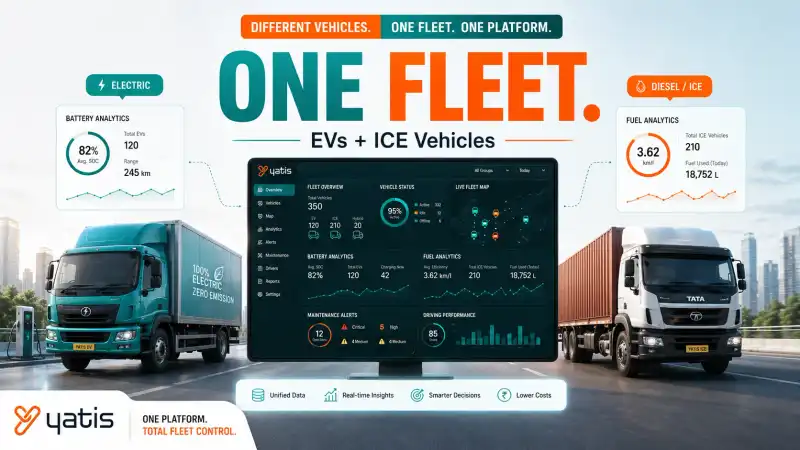
The transition to electric vehicles is already underway across commercial transportation. But for most businesses, the future is not fully electric—at least not yet.
Instead, many fleet operators are managing a combination of Internal Combustion Engine (ICE) vehicles, Electric Vehicles (EVs), and hybrid vehicles. This creates what is commonly known as a mixed fleet.
While mixed fleet management offers flexibility during the transition to electrification, it also introduces new operational challenges. Fleet managers now need visibility into fuel consumption, battery health, charging behavior, route performance, driver activity, and maintenance requirements—all across different vehicle types. Without the right telematics platform, managing a mixed fleet can quickly become complicated.
What Is Mixed Fleet Management?
Mixed fleet management refers to the process of operating and monitoring both electric and conventional vehicles within the same fleet.
Rather than managing separate systems for EVs and ICE vehicles, fleet operators use a unified platform to monitor:
- Vehicle location
- Driver activity
- Route performance
- Energy consumption
- Fuel usage
- Charging status
- Maintenance requirements
- Fleet utilization
The goal is simple: create a single source of operational visibility regardless of vehicle type.
Why Mixed Fleets Are Becoming Common
Many organizations want to reduce emissions and operating costs, but replacing an entire fleet overnight is rarely practical. Commercial fleets often adopt EVs gradually because of vehicle replacement cycles, charging infrastructure limitations, budget planning, operational requirements, and route suitability.
As a result, fleets frequently operate both EVs and ICE vehicles simultaneously. Examples include:
- Logistics companies
- Field service fleets
- Utility providers
- Municipal fleets
- Delivery operations
- Construction support vehicles
For these businesses, mixed fleet management has become an operational necessity.
The Biggest Challenges of Managing Mixed Fleets
While mixed fleets provide flexibility, they also create complexity.
Different Energy Sources
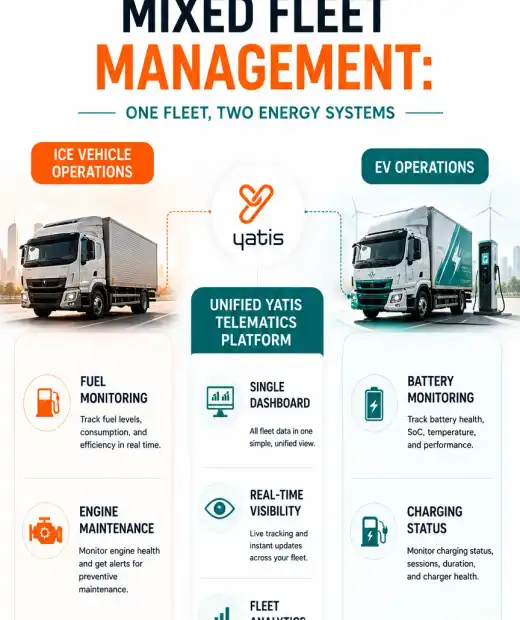
Traditional vehicles depend on fuel. Electric vehicles depend on battery charge. Fleet managers must monitor fuel consumption, engine health, and refueling activity for ICE vehicles, while tracking state of charge, charging sessions, battery performance, and energy efficiency for EVs. Without centralized visibility, comparing performance becomes difficult.
Different Maintenance Requirements
EVs generally have fewer moving parts than conventional vehicles. However, they introduce new monitoring requirements such as battery health, charging system performance, thermal management, and energy efficiency. At the same time, ICE vehicles still require monitoring for engine performance, oil changes, fuel systems, and mechanical wear. Managing both maintenance workflows separately can create operational inefficiencies.
Route Planning Differences
Route planning for EVs and ICE vehicles is not identical. For ICE vehicles, managers must consider fuel availability and distance requirements. For EVs, they must consider available charge, charging station access, range limitations, and charging schedules. Without telematics visibility, assigning the wrong vehicle to the wrong route can affect productivity.

Why Telematics Is Essential for Mixed Fleet Management
Telematics acts as the operational bridge between EVs and ICE vehicles. Instead of using separate tools, fleet managers can access data from both vehicle types through a unified dashboard.
Modern fleet telematics platforms provide real-time GPS tracking, driver behavior analytics, vehicle utilization reports, maintenance alerts, energy monitoring, charging visibility, and route analytics. This allows managers to compare fleet performance consistently across all assets.
Real-Time Visibility Across Vehicle Types
One of the biggest advantages of mixed fleet management is centralized visibility. Fleet operators can monitor active vehicles, route progress, driver status, vehicle utilization, and operational efficiency from a single platform.
This improves decision-making and reduces operational blind spots. For dispatch teams, having a unified view of the fleet simplifies day-to-day operations considerably.
Better Resource Allocation
Not every vehicle is suited for every task. Telematics helps fleet managers determine which routes are EV-friendly, which jobs require ICE vehicles, which assets are underutilized, and which vehicles deliver the best efficiency.
This improves overall fleet productivity while supporting gradual electrification goals.
Driver Performance Still Matters
Whether a vehicle runs on fuel or electricity, driver behavior continues to impact operational efficiency. Telematics helps identify harsh acceleration, excessive idling, aggressive braking, speeding, and inefficient driving patterns.
These insights help improve fuel economy, battery efficiency, vehicle longevity, and fleet safety. For mixed fleets, consistent driver monitoring creates a fair performance benchmark across all vehicle types.
Using Data to Support Electrification Decisions
Many organizations view mixed fleets as a stepping stone toward larger EV adoption. Telematics data helps answer important questions such as which routes are suitable for EVs, how much fuel could be replaced by electricity, which vehicles should be replaced next, and where charging infrastructure should be installed.
Instead of making assumptions, fleet managers can use operational data to guide investment decisions. This reduces risk and improves planning accuracy.
Best Practices for Mixed Fleet Management
Organisations managing EVs and ICE vehicles together should focus on:
Centralised Fleet Visibility
Use one platform whenever possible to monitor all vehicle types.
Route Optimization
Match vehicle capabilities to route requirements.
Driver Coaching
Encourage efficient driving behaviour across the fleet.
Maintenance Monitoring
Track EV and ICE maintenance schedules separately while maintaining centralised oversight.
Data-Driven Decision Making
Use telematics insights to support long-term electrification planning.
The Future of Mixed Fleet Operations
For most commercial fleets, the transition to full electrification will happen gradually. During that transition, mixed fleet management will remain a critical operational strategy.
Organizations that successfully manage both EVs and ICE vehicles today will be better positioned to improve efficiency, reduce operating costs, support sustainability goals, scale electrification initiatives, and improve fleet visibility. The key is having the right operational data available at the right time.
Final Thoughts
Mixed fleet management is becoming increasingly common as businesses balance traditional vehicles with growing EV adoption. While managing multiple vehicle technologies can introduce complexity, telematics platforms help simplify operations through centralized visibility and actionable insights.
By monitoring EVs and ICE vehicles together, fleet operators can improve efficiency, optimize resources, and make more informed decisions about future fleet investments. For organizations navigating the transition toward electrification, visibility is no longer optional—it is essential.
Solutions like Yatis help fleet operators bring vehicle tracking, operational visibility, and performance monitoring together in one place, making mixed fleet management more practical and scalable.
Frequently Asked Questions
Ready to unify your mixed fleet?
Contact Yatis Telematics to learn how our unified telematics platform helps you track EVs and ICE vehicles together with centralized visibility.
Contact Us →