

How Battery Degradation Can Be Predicted Before Failure in BESS

What Actually Happens in Real BESS Systems
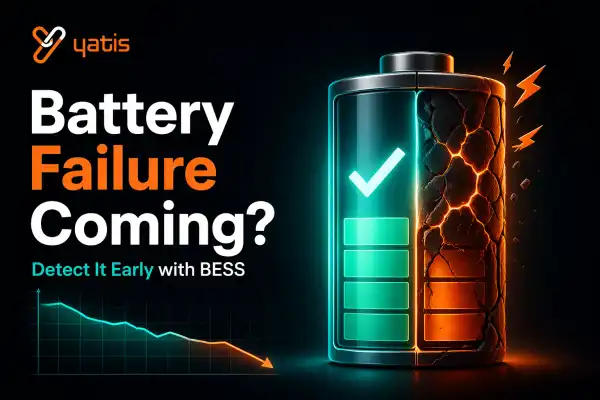
In real deployments, battery failure is rarely sudden.
Operators typically experience a gradual progression:
- gradual drop in discharge efficiency over weeks or months
- inconsistent voltage readings under the same load conditions
- unexplained thermal variations that appear intermittently
The problem is that these signals are often dismissed as normal variation until performance drops significantly.
By the time degradation is visible operationally, capacity loss has already occurred. The intervention window — where proactive action would have preserved capacity — has closed.
The Early Signals Most Systems Miss
Before failure, batteries consistently show predictable warning patterns:
- declining State of Health (SOH) tracked over time
- voltage drift across cells or strings under consistent conditions
- rising internal resistance that increases energy losses
- localized temperature anomalies that indicate stressed cells
These are not isolated events — they are patterns over time.
Traditional monitoring systems fail to catch them because they:
- focus on real-time snapshots rather than trend analysis
- lack historical correlation between metrics
- don't flag slow deviations that develop gradually
Why This Directly Impacts Operations
Unpredicted degradation has cascading operational consequences:
- unexpected downtime that disrupts energy delivery commitments
- reduced usable capacity that affects revenue from energy storage
- inefficient charge-discharge cycles that accelerate further degradation
- increased stress on healthy cells adjacent to degraded ones
In utility-scale systems, even small degradation mismatches can reduce overall system output and accelerate failure across connected strings.
How Predictive Monitoring Changes the Outcome
This is where platforms like Yatis Telematics become operationally relevant.
Instead of just tracking battery status, advanced monitoring:
- identifies degradation trends early through historical correlation
- correlates temperature, voltage, and usage data simultaneously
- detects anomalies before they escalate to threshold violations
This allows operators to:
- intervene before failure by adjusting dispatch and load patterns
- optimize maintenance cycles based on actual degradation rates
- extend battery lifespan by preventing compounding degradation
Final Insight
Battery degradation is not hidden — it's uninterpreted over time. The difference between reactive and efficient operations is simple: whether you detect degradation before it impacts performance.
Frequently Asked Questions
Start predicting degradation before it affects performance
Contact Yatis Telematics to learn how our BESS monitoring platform identifies degradation trends early enough to act.
Contact Us →