

7 Signs Your Fleet Has a Visibility Problem

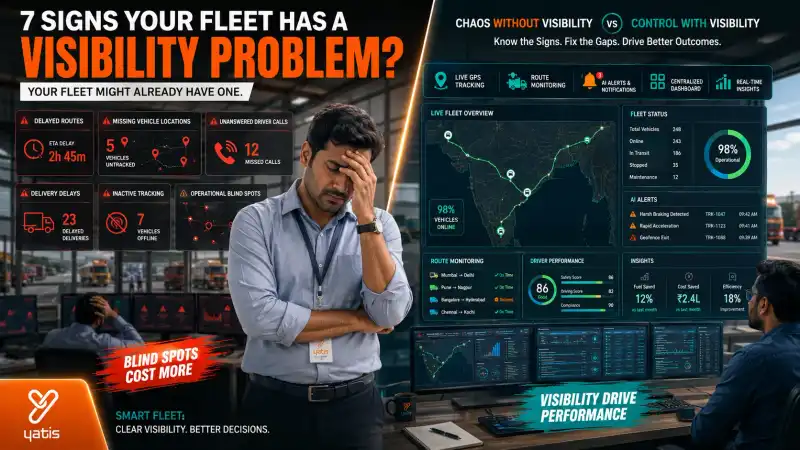
Fleet operations depend on visibility.
When fleet managers can clearly monitor vehicle activity, driver behavior, route movement, incident reporting, and operational performance, decision-making becomes faster and more reliable.
But many commercial fleets still operate with limited real-time visibility. Information arrives late, operational updates depend on phone calls, and critical incidents are discovered only after they create larger problems.
Over time, these visibility gaps affect operational efficiency, customer communication, driver accountability, safety management, and claims investigations. The challenge is that fleet visibility problems are not always obvious at first. In many cases, they slowly appear through everyday operational friction.
What Fleet Visibility Actually Means
Fleet visibility is the ability to monitor fleet operations in real time using connected telematics systems and operational data.
Strong fleet visibility helps operators track:
- vehicle location
- driver activity
- route progress
- incident alerts
- delivery timelines
- operational risks
Without reliable visibility, fleet decisions often depend on delayed communication, assumptions, incomplete reporting, and manual coordination. As fleet operations scale, these blind spots become harder to manage.
1. Drivers Frequently Give Delayed Updates
One of the most common signs of poor fleet visibility is delayed or inconsistent communication between drivers and operations teams.
Fleet managers often hear things like “I’m almost there,” “Network issue tha,” “Traffic mein hoon,” or “Reached in 10 minutes.”
But without real-time visibility, dispatch teams may have no reliable way to verify actual vehicle location, estimated arrival time, route progress, or operational delays. This creates uncertainty across fleet operations.
Over time, dispatch teams spend more effort making follow-up calls, requesting manual updates, and handling customer ETA questions instead of managing operations proactively.
2. Incident Reporting Takes Too Long
When fleets lack real-time operational visibility, incidents are often discovered late. This may include accidents, harsh braking events, unsafe driving behavior, route deviations, and unauthorized stops.
Without telematics visibility, managers may depend entirely on drivers to report incidents manually. The problem is that delayed reporting slows down emergency response, evidence collection, insurance communication, and operational coordination.
Real-time telematics systems help reduce these delays by automatically detecting and reporting critical events as they happen.
3. Dispatch Teams Lack Real-Time Vehicle Visibility
Many fleets still rely heavily on phone-based coordination for basic operational tracking.
Dispatch teams constantly ask: “Where is the truck?”, “Has the delivery started?”, “Why is the vehicle delayed?”, and “What route is the driver taking?”
When visibility depends entirely on manual communication, operations become reactive instead of proactive. Real-time fleet visibility helps dispatch teams monitor active routes, delays, stoppages, route deviations, and estimated arrival times without continuously contacting drivers.
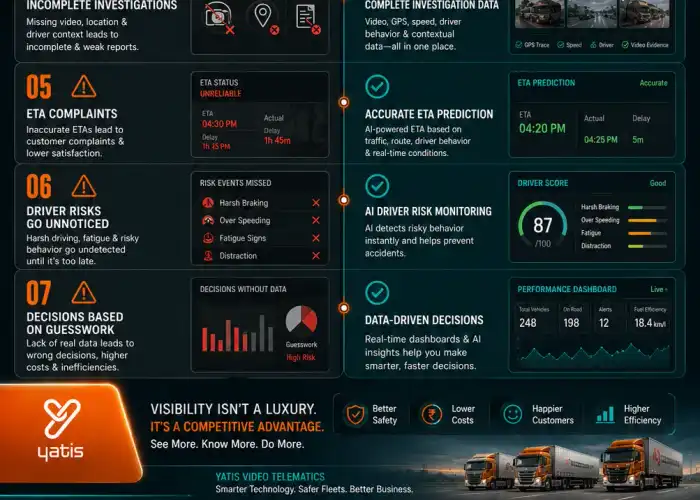
4. Accident Investigations Feel Incomplete
Incomplete investigations are another strong indicator of poor operational visibility.
Without integrated telematics systems, fleets often struggle to collect reliable footage, GPS timelines, speed data, braking analytics, and accurate incident context.
As a result, investigations may rely heavily on written reports, verbal explanations, assumptions, and fragmented evidence. This slows down claims processing, liability review, and internal decision-making.
Video telematics improves investigation visibility by centralizing operational evidence and incident data.
5. Customer ETA Complaints Keep Increasing
Customers expect accurate delivery visibility. When fleets cannot provide reliable ETAs, operational trust begins to decline.
Frequent customer complaints about late deliveries, inaccurate arrival times, missing updates, and route uncertainty often indicate deeper visibility problems inside fleet operations.
Without connected telematics systems, customer communication becomes harder because operations teams lack reliable real-time tracking information.
Improved fleet visibility helps operators provide more accurate ETAs, proactive delay updates, route visibility, and faster response during disruptions.
6. Driver Behavior Risks Go Unnoticed
Many safety issues develop gradually. Without telematics visibility, fleets may not identify distracted driving, speeding patterns, harsh braking, fatigue-related behavior, or aggressive acceleration until an accident occurs.
Traditional reporting methods rarely provide continuous operational insight into daily driving behavior.
Video telematics systems help fleets monitor safety trends proactively through AI event detection, driver behavior analytics, real-time alerts, and centralized safety dashboards. This allows fleets to coach drivers earlier and reduce preventable operational risk.
7. Operational Decisions Depend on Guesswork
One of the clearest signs of poor visibility is when operational decisions rely more on assumptions than data.
Fleet managers may struggle to answer:
- Which vehicles are delayed?
- Which drivers create the most risk?
- Where are recurring route inefficiencies happening?
- Why are fuel costs increasing?
- Which incidents require immediate attention?
Without centralized operational visibility, management teams often operate reactively. This creates slower decisions, inconsistent coordination, operational inefficiency, and reduced accountability.
Real-time telematics visibility helps fleets make more informed operational decisions using actual fleet data instead of assumptions.

How Video Telematics Improves Fleet Visibility
Modern video telematics systems help fleets improve visibility by combining AI dashcams, GPS tracking, driver analytics, route monitoring, incident alerts, and operational dashboards.
This allows fleets to monitor vehicle movement, driver safety, operational disruptions, incident response, and delivery progress from a centralized platform.
Better visibility helps fleets reduce operational blind spots, improve communication, strengthen safety management, speed up investigations, and improve customer experience. As fleet operations become more complex, centralized visibility becomes increasingly important for long-term operational efficiency.
Why Visibility Matters More as Fleets Grow
Small fleets can sometimes manage operations manually for a period of time. But as fleets scale, visibility challenges increase rapidly.
More vehicles create more routes, more drivers, more operational variables, more safety exposure, and more communication pressure. Without connected visibility systems, operational coordination becomes harder to maintain consistently.
That is why many growing fleets eventually adopt telematics systems to improve operational awareness, dispatch efficiency, incident management, and safety oversight.
Final Thoughts
Fleet visibility problems rarely appear all at once. They usually develop gradually through delayed updates, incomplete reporting, customer complaints, investigation gaps, and operational uncertainty.
Over time, these issues create larger operational inefficiencies and increase overall fleet risk.
Video telematics helps fleets improve visibility by combining real-time tracking, AI-powered monitoring, incident visibility, driver analytics, and centralized operational data.
For commercial fleet operators, visibility is no longer only about tracking vehicles. It is becoming a core part of operational control, safety management, customer communication, and long-term fleet efficiency.
As fleet operations continue becoming more data-driven, real-time operational visibility is increasingly becoming an essential part of modern fleet management.
Frequently Asked Questions
Ready to improve fleet visibility?
Contact Yatis Telematics to learn how our AI-powered video telematics and GPS tracking solutions can help your fleet eliminate operational blind spots.
Contact Us →