

How Often Should SOH Be Recalculated in Utility-Scale BESS?

What Happens When SOH Is Not Updated Frequently
In many BESS deployments, SOH is:
- calculated periodically — monthly, quarterly, or at commissioning
- treated as a fixed reference throughout operation
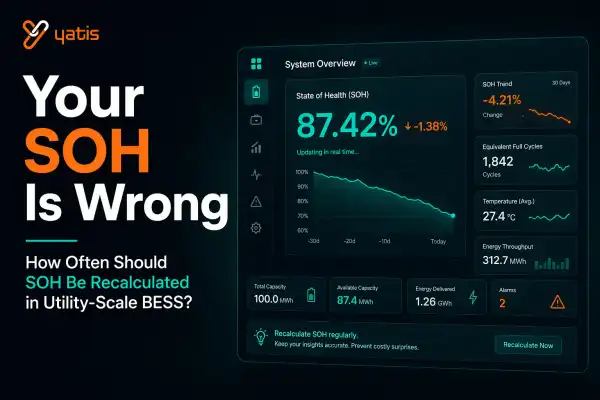
This creates a disconnect between actual battery condition and reported system health. Operators may believe systems are performing normally, while degradation is already progressing.
Why SOH Is a Dynamic Metric
SOH is continuously influenced by operating conditions:
- charge-discharge cycles accumulating over time
- temperature exposure during each cycle
- depth of discharge patterns
- load variation and dispatch patterns
These variables change continuously — which means SOH must also evolve continuously to remain accurate.
Static SOH values lead to:
- inaccurate capacity estimates used for dispatch planning
- inefficient energy dispatch decisions
- unexpected performance drops that weren't anticipated
Recommended SOH Recalculation Frequency
For utility-scale BESS, the recommended approach:
| Frequency | Use Case |
|---|---|
| Continuous recalculation | Ideal — provides always-accurate SOH visibility |
| Daily recalibration | Minimum acceptable threshold for operational accuracy |
| Event-based updates | Critical after heavy cycles, thermal events, or anomalies |
This ensures accurate system visibility, better performance optimization, and early degradation detection before it impacts operations.
Operational Impact of Poor SOH Accuracy
When SOH is outdated, system behavior becomes imbalanced:
- Degraded batteries are overused beyond their actual capacity
- Healthy batteries compensate excessively, accelerating their own degradation
- System imbalance increases, compounding degradation across all strings
This accelerates degradation across the entire system — turning a monitoring gap into an operational and financial liability.
Monitoring platforms like Yatis Telematics ensure SOH reflects real-time conditions, not outdated estimates.
Final Insight
SOH is not a static metric — it's a real-time indicator of system reliability. The accuracy of your operations depends on how often you update it.
Frequently Asked Questions
Ready to implement continuous SOH monitoring?
Contact Yatis Telematics to learn how our BESS monitoring platform delivers real-time SOH recalculation for utility-scale operations.
Contact Us →