

UART vs CAN-Based BMS: Understanding the Hardware Cost Difference in Connected Batteries

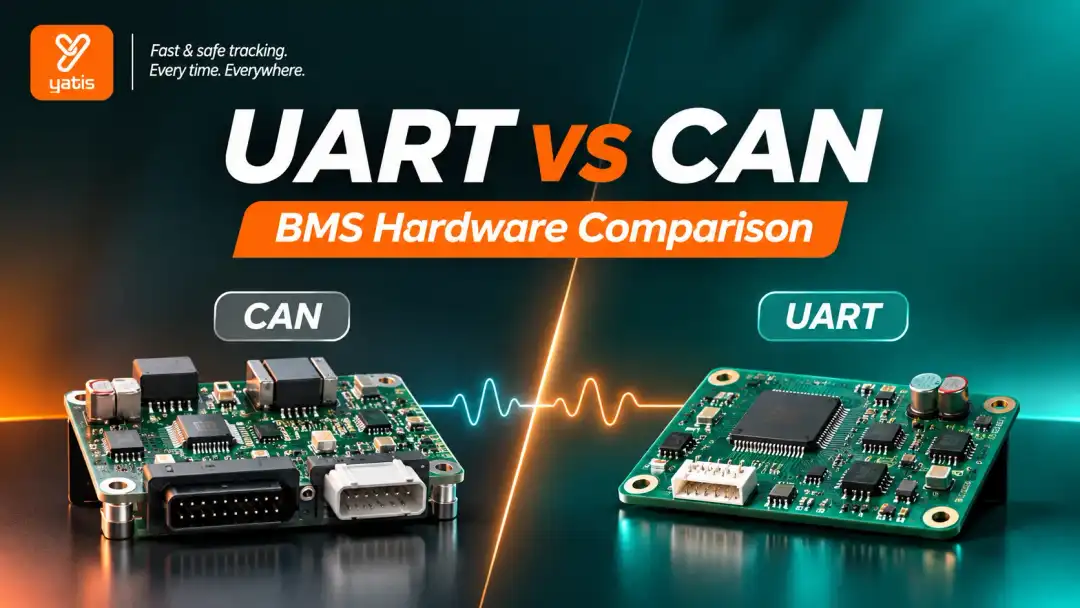
UART and CAN are two different communication approaches used in embedded and vehicle electronics. When connecting a battery management system (BMS) to an IoT device, the right interface depends on the BMS design, communication requirements and deployment environment. Yatis’s supplied product comparison shows an illustrative hardware-cost difference between one reference CAN-based configuration and its compatible UART-based connected battery configuration.
ILLUSTRATIVE HARDWARE COST DIFFERENCE PER DEPLOYMENT
UART or CAN?
Start with BMS compatibility.
Choose the interface that fits the battery architecture, data needs, operating environment and integration scope.
What is the difference between UART and CAN?
UART and CAN both support serial communication, but they organise communication differently. UART generally provides a point-to-point transmit/receive connection between devices. CAN uses a shared bus on which multiple nodes can exchange identified messages. This difference affects system architecture, wiring, network topology, integration design and the kind of communication problem each interface is intended to solve.
UART: direct asynchronous serial communication
UART stands for Universal Asynchronous Receiver/Transmitter. It handles serial data transmission and reception without a separate clock line between the communicating devices. The two ends must agree on serial settings such as baud rate and data format. A typical UART link uses transmit (TX), receive (RX) and a common ground reference, subject to the electrical interface and hardware design.
UART is often practical for a direct connection between a compatible BMS and an IoT controller when the BMS exposes the required serial interface and protocol. The electrical signalling level, pinout, baud rate, message format and command set still need to match.
CAN: a shared, message-based bus
CAN stands for Controller Area Network. It is designed for communication among multiple electronic control units on a shared bus. Messages carry identifiers, and nodes use those identifiers to determine which messages are relevant. A CAN implementation typically requires suitable CAN controller/transceiver hardware and correct bus design, including termination where required.
CAN is widely used in automotive and industrial embedded systems. Its bus architecture and differential signalling make it suitable for networked control environments where multiple nodes need to exchange messages. The exact CAN variant, bit rate, physical layer and network design must be established for the application.
UART vs CAN BMS: a practical comparison
| Comparison area | UART | CAN |
|---|---|---|
| Communication model | Typically direct asynchronous serial communication between two interfaces | Shared, message-based bus for multiple nodes |
| Network topology | Commonly point-to-point | Multi-node bus architecture |
| Data organisation | Serial data frames; application protocol defines message structure | Messages use identifiers; nodes filter/process relevant messages |
| Electrical interface | Depends on the UART electrical level and board design; TTL-level UART is common in embedded links | Normally uses a CAN transceiver and differential bus wiring |
| Configuration needs | Matching baud rate, data bits, parity, stop bits, pinout and protocol | Matching CAN variant/bit rate, identifiers, message definitions, transceiver and bus topology |
| Typical integration fit | A compatible direct BMS-to-IoT serial connection | A BMS or vehicle system that communicates over a CAN network, especially where multiple nodes exchange data |
| Key design checks | Voltage levels, grounding, framing, packet format, timing and command support | Transceiver compatibility, termination, wiring, bit timing, message IDs and bus loading |
| Cost implication | Can be economical for a supported direct interface; total cost depends on hardware and integration | Can be appropriate where a CAN network is required; total cost depends on controllers, transceivers, network and integration |
This is a high-level engineering comparison, not a substitute for the relevant BMS, MCU and transceiver datasheets. Product-specific implementation details take precedence.
Understanding the Yatis hardware cost comparison
Yatis’s supplied product collateral compares two specific combined BMS + IoT hardware configurations. The figures below are the values shown in that collateral.
Combined BMS + IoT hardware per deployment
- CAN BMS: ₹3,500
- CAN IoT: ₹2,500
Combined BMS + IoT hardware per deployment
- UART BMS: ₹1,250
- UART IoT: ₹2,200
Illustrative hardware comparison—not a universal market price comparison between UART and CAN.
At larger volumes, the same illustrative per-deployment difference scales as follows:
| Deployments | CAN-based reference | Yatis UART | Illustrative difference |
|---|---|---|---|
| 100 | ₹6,00,000 | ₹3,45,000 | ₹2,55,000 |
| 500 | ₹30,00,000 | ₹17,25,000 | ₹12,75,000 |
| 1,000 | ₹60,00,000 | ₹34,50,000 | ₹25,50,000 |
When may a UART-based BMS integration be suitable?
A UART-based approach may be worth evaluating when the BMS already exposes a compatible UART interface and the required data and commands can be exchanged over that interface. It can be a practical architecture for a direct BMS-to-IoT device connection, provided the electrical and protocol requirements match.
- The selected BMS has a documented UART port or supported serial interface.
- The BMS protocol and message definitions are available to the integration team.
- The required data points—such as SoC, cell voltages, temperatures and BMS settings—are exposed by the BMS.
- The required commands, if any, are supported and authorised by the BMS firmware.
- The physical connection, logic voltage, grounding, baud rate and serial settings are compatible.
- The communication link and data rate are adequate for the use case.
In this scenario, the Yatis product proposition is to connect a compatible UART BMS to an IoT device through a TTL serial interface, then connect the device to the Yatis platform over cellular communication.
When may CAN be the better fit?
CAN may be more suitable when the battery or vehicle architecture is already built around a CAN network, when multiple electronic control units need to communicate over a shared bus, or when the BMS supplier specifies CAN as the supported interface. A working CAN network may already provide the message definitions, diagnostics and integration structure required by the wider system.
Do not replace a CAN-based design with UART solely because one illustrative hardware comparison is less expensive. If the target BMS only exposes CAN, moving to UART may require a different BMS, additional hardware or a redesign. That can change the project economics and technical risk.
Integration checklist: what to verify before choosing
- ☐ BMS manufacturer, model, firmware version and interface documentation
- ☐ UART or CAN electrical interface and connector pinout
- ☐ Voltage levels, grounding and any required transceiver or level conversion
- ☐ Serial settings for UART or bit rate and bus parameters for CAN
- ☐ Message format, data identifiers/registers, scaling, units and update frequency
- ☐ Required battery parameters and their availability in the BMS
- ☐ Supported remote commands, permissions and safe operating conditions
- ☐ Error handling, timeout behaviour, reconnection and diagnostic visibility
- ☐ IoT device compatibility, cellular coverage and platform integration
- ☐ Total commercial scope: hardware, installation, connectivity, platform and support
- ☐ Bench validation and controlled vehicle/battery testing before rollout
How Yatis connects compatible UART BMS hardware
The product material describes this connection flow:
The supplied material identifies battery monitoring (SoC, cell voltages, temperatures and settings), GPS location and driving-behaviour insights, plus battery enable/disable and supported commands. The collateral also identifies the BlackRock IoT BR1201 device. Hardware attribution should remain clear: BlackRock IoT is named for the device in the product material; Yatis presents the connected platform and solution.
Frequently asked questions
What is the main difference between UART and CAN in a BMS?
UART is commonly used for direct asynchronous serial communication between two devices. CAN is a message-based shared bus designed to connect multiple electronic nodes. The appropriate choice depends on the BMS and system architecture.
Is UART better than CAN for battery management systems?
Not universally. UART may suit a compatible direct BMS-to-IoT connection. CAN may suit a networked system with multiple electronic control units or a BMS that specifies CAN. Compatibility and system requirements should decide.
What is the illustrative cost difference in the Yatis comparison?
The supplied comparison lists ₹6,000 for the reference CAN-based BMS + IoT hardware and ₹3,450 for the Yatis UART BMS + IoT hardware. The illustrative difference is ₹2,550 per deployment, or 42.5% of the reference amount.
Does the Yatis UART price include installation or platform charges?
No. The supplied material states that the illustrative hardware prices exclude taxes, installation, connectivity and platform fees.
Can a CAN-based BMS be connected to a UART IoT device?
Not by assuming the interfaces are interchangeable. A compatible interface, bridge or protocol-conversion design may be required, and message formats must be translated correctly. The actual solution depends on the specific hardware and BMS documentation.
What should be checked before UART BMS integration?
Confirm the BMS model, electrical levels, pinout, serial settings, message protocol, available battery data, supported commands and IoT device compatibility. Validate the connection with the BMS supplier before deployment.
What information can Yatis monitor through compatible UART BMS integration?
The supplied product material identifies SoC, individual cell voltages, temperatures and BMS settings, along with GPS location and driving-behaviour insights. Actual data availability depends on BMS compatibility and integration.
Not sure whether your BMS supports UART?
Share your BMS make and model with Yatis. Check compatibility, supported data points and commands before finalising your connected battery configuration.
Check BMS compatibilityVisit Yatissales@yatis.io · +91 95133 44858
Further technical reading
- Analog Devices: UART — A Hardware Communication Protocol
- Texas Instruments: Bridge Design Between CAN and UART
- Texas Instruments: CAN overview and bus termination
- Yatis Telematics · Yatis Resources