

Vehicle Location Tracking System (VLTS): How It Works in India
From a GPS signal inside a moving vehicle to a live fleet dashboard or an authorised government monitoring centre, a Vehicle Location Tracking System connects devices, networks and software. Here is how the complete VLTS ecosystem works in India—and where AIS-140 fits into it.

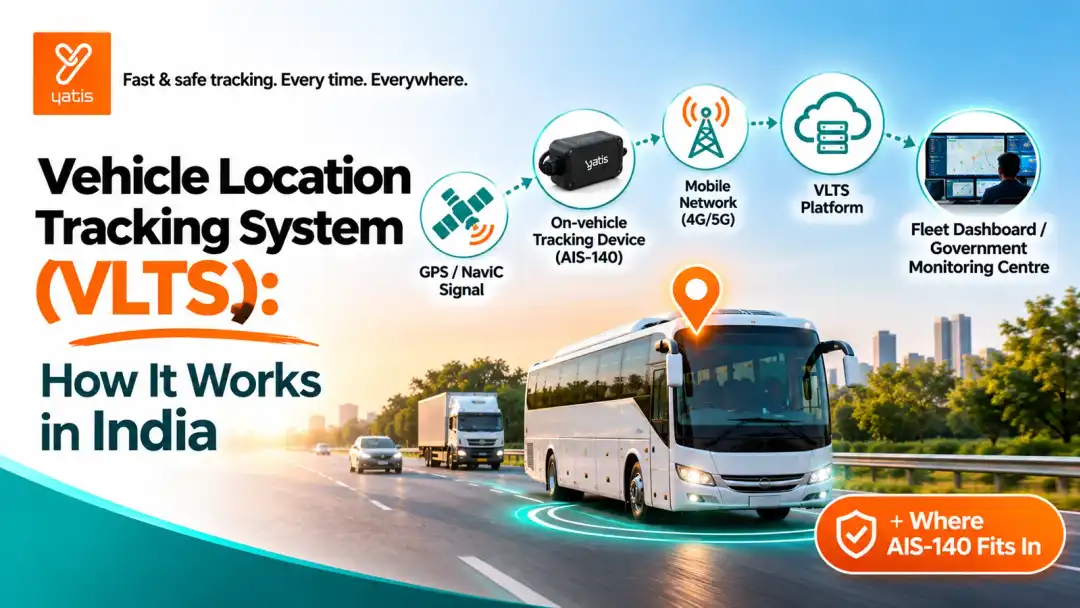
A Vehicle Location Tracking System (VLTS) is an integrated arrangement of in-vehicle tracking hardware, satellite positioning, wireless communication and backend software. It determines where a vehicle is, transmits location and related data, and makes that information available through maps, reports, alerts and monitoring dashboards. In regulated Indian deployments, an AIS-140-compliant Vehicle Location Tracking Device (VLTD) may also communicate with the relevant state monitoring platform.
Searches for VLTS India, vehicle location tracking system India and vehicle location tracking system often lead to overlapping terms: GPS tracking, VLT, VLTD, AIS-140 and fleet management. They are connected, but they do not mean exactly the same thing. Understanding the layers helps an operator select the right technology and complete the correct compliance steps.
1. What Is a Vehicle Location Tracking System (VLTS)?
A Vehicle Location Tracking System is the complete technology setup used to identify, transmit, display and manage a vehicle's location. It normally combines a tracking device installed in the vehicle, a positioning source such as GNSS, a mobile communication link and a software platform that interprets incoming data.
In everyday fleet operations, VLTS can help a business answer practical questions: Where is each vehicle? Is it moving or stopped? Which route did it take? Has it entered or left a defined area? Is it late? Is a device offline? Depending on the tracker, sensors and software, the system may also capture ignition status, speed, power status, panic-button events or selected vehicle parameters.
VLTS, GPS tracking, VLTD and AIS-140: the difference
| Term | What it means | How it relates |
|---|---|---|
| VLTS | Vehicle Location Tracking System: the end-to-end system. | The broad system comprising hardware, connectivity, backend and users. |
| GPS tracking | Using satellite positioning to determine a vehicle's location. | A core capability within many VLTS deployments. |
| VLTD | Vehicle Location Tracking Device: the in-vehicle hardware. | The device collects position and supported status data and sends it onward. |
| AIS-140 | An Indian automotive industry standard for specified vehicle tracking devices and emergency-button systems. | Relevant to regulated deployments under the applicable central and state framework. |
| Fleet management platform | Software used to monitor and manage vehicles, trips, drivers and operations. | May use VLTS data and add business workflows and analytics. |
2. VLTS Architecture: The Main Components and Data Flow
The simplest way to understand a vehicle location tracking system architecture is to follow one location update. A device installed in the vehicle receives satellite signals, calculates a position, packages the available data and sends it over a communication network. A server receives the packet, validates and processes it, then makes it available to the relevant dashboard or authorised monitoring centre.
VLTS Architecture Diagram
Typical end-to-end flow for a connected vehicle. The exact interfaces and data fields depend on device capability, deployment design and regulatory requirements.
Read the flow: positioning → transmission → processing → visualisation → action.
What each layer does
Positioning layer
Satellite signals help the tracker calculate latitude, longitude, speed, direction and timestamp. Accuracy depends on signal conditions, antenna placement and device design.
Device and vehicle layer
The VLTD packages location with supported inputs such as ignition, power status, emergency-button state or sensor events.
Communication layer
A cellular connection transmits data to the configured server. Coverage gaps can delay live updates even when the device has stored data locally.
Application and backend layer
The platform authenticates and processes messages, stores records, plots vehicles on maps and evaluates alert rules.
For regulated deployments, the architecture may include a separate government-facing path in addition to the operator's own fleet dashboard. A state backend is not simply another name for a private tracking app: it serves the transport authority's monitoring and emergency-response workflows.

3. The Vehicle Tracking Device: What Is Installed in the Vehicle?
The in-vehicle unit is often called a GPS tracker, VLT device or Vehicle Location Tracking Device (VLTD). Its job is to collect positioning information and supported vehicle events, then communicate those records to a server. A device selected for a regulated installation must meet the applicable technical and certification requirements; a generic tracker should not be assumed to be an acceptable substitute.
Typical hardware elements
- GNSS receiver and antenna: receives satellite signals to calculate the vehicle's position and movement.
- Cellular modem and SIM/eSIM: provides the data connection to the configured backend.
- Controller and memory: manages data collection, message creation and, where supported, temporary storage during connectivity interruptions.
- Vehicle power interface: supplies operating power and may monitor main-power status.
- Emergency button interface: connects the panic or emergency button where required by the applicable installation.
- Additional inputs: may include ignition, tamper, sensor or vehicle data interfaces, depending on the model and use case.
What should an operator verify before choosing a VLTD?
Ask the supplier for the exact make and model, applicable type-approval documentation, current conformity-of-production status where relevant, supported network bands, backend compatibility, installation process, warranty and service arrangements. For an AIS-140 deployment, verify the device against the relevant authority's current approved or enlisted process rather than relying on a generic claim that a tracker is “government approved”.
4. VLTS Backend: How Location Data Becomes Useful Information
The backend is the software and server environment that receives messages from tracking devices. It is where a stream of device packets becomes a usable vehicle record. A private fleet platform and an authorised government VLT backend may have different users, access controls, data requirements and operational responsibilities.
Core functions of a vehicle tracking backend
- Device communication: receives messages from connected trackers and identifies the sending device.
- Data validation: checks message structure, timestamps, device identity and data quality.
- Location processing: interprets coordinates and plots the vehicle on a digital map.
- Data storage: maintains current status and historical records according to the platform's retention policy.
- Event and rule engine: evaluates conditions such as overspeeding, geofence entry/exit, power disconnection or emergency-button activation where supported.
- User access and reporting: presents information to authorised fleet managers, control-room teams or other permitted users.
- Integration: may connect with VAHAN/state systems, emergency response systems or enterprise software where the deployment and authority support it.
For applicable AIS-140 implementations, MoRTH's VLT registration and activation SOP describes device details being uploaded with vehicle details, a unique device identification number being linked to the vehicle and the relevant monitoring centre receiving data. The SOP also assigns verification responsibilities during vehicle fitness checks. Operators should follow the current instructions issued by the concerned state or Union Territory.
Useful official references: MoRTH VLT registration and activation SOP · NIC eTransport Mission Mode Project.
5. VLTS Alerts: From a Location Update to an Operational Response
Tracking becomes more valuable when the platform can identify an event and notify the right person. An alert is usually generated when incoming device data matches a configured rule. The event may be sent to a dashboard, mobile application, control room or integrated response system, depending on the deployment.
| Alert / event | What it can indicate | Typical operational response |
|---|---|---|
| Overspeed | Vehicle speed has crossed a configured threshold. | Review the event, route and driver coaching requirements. |
| Geofence entry / exit | Vehicle has crossed a defined virtual boundary. | Confirm arrival, departure or route compliance. |
| Ignition / movement | Vehicle has started, stopped or moved, if the device supports the input. | Compare activity with dispatch or duty schedules. |
| Main power / tamper event | Power supply or device wiring may have been interrupted. | Check the vehicle and arrange technical inspection. |
| Emergency / panic button | An emergency button event has been triggered in a supported installation. | Follow the configured control-room and emergency-response SOP. |
| Device offline / stale data | No recent communication has reached the platform. | Check network coverage, power, SIM and device health. |
Not every VLTS device supports every event, and alert availability depends on the installed hardware, wiring, configuration and backend integration. A dashboard notification by itself does not prove that emergency services have been dispatched. The response chain must be defined, tested and monitored.
6. VLTS in India: AIS-140 and the Compliance Framework
India's regulatory framework uses the term Vehicle Location Tracking Device (VLT/VLTD) in connection with specified vehicle categories and safety requirements. Central Motor Vehicles Rules (CMVR) Rule 125H provides for vehicle location tracking devices and one or more emergency buttons in public service vehicles as defined under the Motor Vehicles Act, subject to the exemptions stated in the rule. The rule links the relevant device specifications, testing and certification to AIS-140, as amended, until corresponding BIS specifications are notified.
This is a category-specific regulatory framework—not a safe basis for claiming that every vehicle in India, every private car or every commercial vehicle automatically has the same AIS-140 obligation. The vehicle definition, permit status, registration date, central notifications, state directions and later amendments all matter. Operators should confirm the position with the relevant State Transport Department or RTO before procurement or installation.
What does the compliance journey generally involve?
- Confirm applicability: identify the vehicle category, permit, registration details and current central/state requirements.
- Select an eligible device: check the exact model's type approval and current certification/enlistment status with the relevant testing agency and state authority.
- Install correctly: fit the device and emergency button as required, with correct wiring and functional checks.
- Link device and vehicle: complete the required device identification, vehicle tagging or registration workflow.
- Activate the backend connection: ensure the device communicates with the authorised monitoring platform as prescribed.
- Test and maintain: check location reporting, emergency-button operation, power status, connectivity and renewal or inspection requirements.
Central rules and state implementation are both important
MoRTH's published VLT SOP explains the national registration and activation process in VAHAN/state registration applications. State transport departments may publish additional procedures for manufacturer onboarding, device enlistment, installation, tagging, renewal and emergency-alert handling.
- Central Motor Vehicles (Twentieth Amendment) Rules, 2016 – Rule 125H text
- MoRTH: Standard Operating Procedure for VLT registration and activation
- West Bengal Transport Directorate: VLTD (AIS-140) fitment and tagging SOP
- West Bengal Vehicle Location Tracking System portal
- Vehicle Location Tracking & Emergency Alert System portal
7. Where Is VLTS Used in India? Key Fleet Use Cases
VLTS is useful wherever knowing a vehicle's location and movement can improve safety, service delivery, utilisation or accountability. The value comes from matching the device and platform to the actual operating requirement—not from installing a tracker without a defined workflow.
Public and passenger transport
Supports vehicle visibility and, in applicable regulated deployments, safety monitoring and emergency-button workflows.
School buses
Helps transport teams monitor routes, vehicle movement and arrival status, with parent or school visibility where configured.
Logistics and trucking
Improves dispatch visibility, route history, delivery coordination, geofence monitoring and exception management.
Mining and construction
Provides visibility into vehicles and equipment operating across large, remote or restricted work areas.
FMCG and distribution
Helps teams review vehicle progress, delivery routes, stops and fleet utilisation across distribution networks.
Enterprise and service fleets
Supports field operations, asset movement, duty monitoring and centralised reporting across locations.
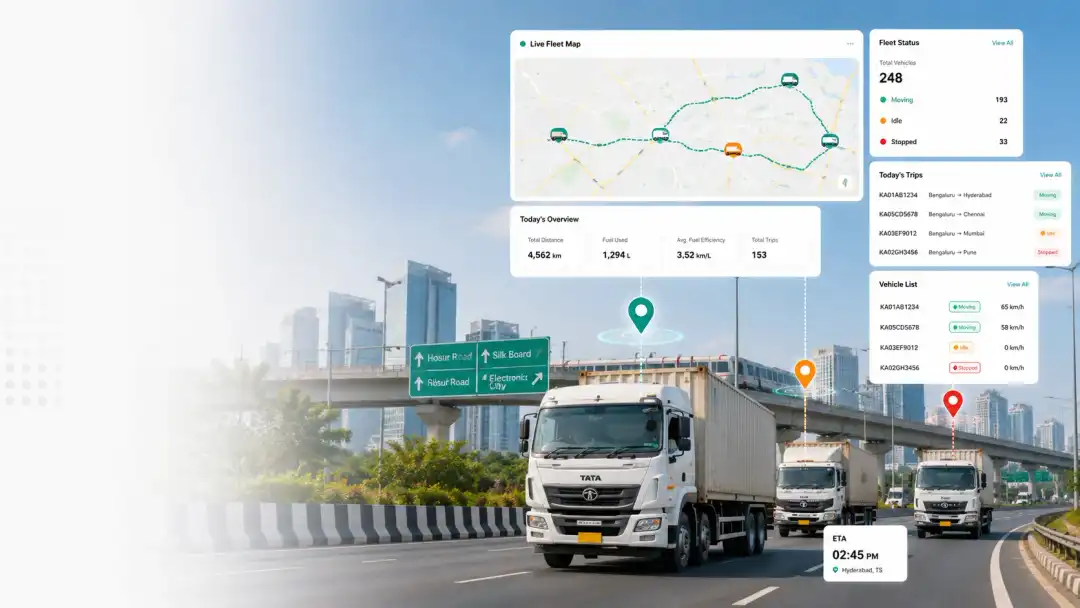
For fleet operators who need more than a location pin, a connected platform can combine live tracking with trip playback, geofencing, fuel information, driver-behaviour events and operational reporting. The available features depend on the hardware, vehicle interfaces and selected software modules.
How to Choose a Vehicle Location Tracking System in India
Before choosing a VLTS provider, separate regulatory requirements from operational requirements. A system that is excellent for route visibility may not meet the technical or backend requirements of a regulated AIS-140 installation. Conversely, a compliant device installation may not provide the analytics or workflow tools a logistics business needs.
| Evaluation area | Questions to ask the provider |
|---|---|
| Regulatory fit | Does this vehicle category require AIS-140 or another state-specific approval? Is the exact device model accepted for the intended deployment? |
| Device capability | Which GNSS, cellular, power, emergency-button and sensor functions are supported? |
| Backend connection | Which private or government backend does it communicate with? Who completes tagging and activation? |
| Data quality | What location update frequency is configured? How are stale data, offline periods and stored records handled? |
| Alerts and workflow | Which events are supported? Who receives critical alerts and what is the documented escalation process? |
| Platform usability | Can managers view live maps, route history, geofences, reports and role-based access? |
| Support and lifecycle | Who handles installation, SIM/network issues, repairs, firmware, renewals and device replacement? |
Frequently Asked Questions About VLTS India
1. What is VLTS in India?
VLTS means Vehicle Location Tracking System. It combines an in-vehicle tracking device, satellite positioning, wireless communication and backend software to report vehicle locations and supported events. Regulated deployments may also connect to an authorised state monitoring platform.
2. Is VLTS the same as AIS-140?
No. VLTS describes the broader system. AIS-140 is an Indian automotive industry standard relevant to specified vehicle tracking devices and emergency-button systems under the applicable regulatory framework.
3. How does a vehicle location tracking system work?
The tracker receives satellite signals, calculates the vehicle's position and sends a data packet through a cellular network. Backend software processes the packet and displays location, history, alerts and reports to authorised users.
4. Is AIS-140 mandatory for every vehicle in India?
No. Rule 125H refers to public service vehicles as defined under the Motor Vehicles Act and includes stated exemptions. Other notifications or state requirements may also apply. Check the current rules for the specific vehicle category, permit and state.
5. Does installing a GPS tracker complete AIS-140 compliance?
No. The exact device approval, installation, emergency-button fitment where applicable, vehicle-device linking, backend activation and state procedures may all need to be completed.
6. What happens if a VLTS device loses network connectivity?
The platform may stop receiving fresh location updates until connectivity returns. Some devices support local storage and later transmission, but this depends on the model and configuration. Operators should ask how offline data and device-health alerts are handled.
7. Can a VLTS platform track multiple vehicles together?
Yes. Fleet platforms are designed to display multiple connected vehicles on a shared map and provide route history, alerts and reports, subject to the subscription, device configuration and user permissions.
8. What is the difference between VLTD and VLTS?
VLTD is the in-vehicle Vehicle Location Tracking Device. VLTS is the complete Vehicle Location Tracking System, including the device, connectivity, backend software and user or monitoring interfaces.
Build Better Visibility Across Your Fleet
Yatis brings GPS tracking and fleet intelligence together to help businesses monitor vehicles, review routes, configure alerts and understand fleet operations. If your deployment also has AIS-140 requirements, confirm the applicable vehicle category, device approval and state activation process before proceeding.
Explore Yatis GPS Tracking