

How Fleet Telematics Reduces Fuel Costs: A Practical ROI Framework

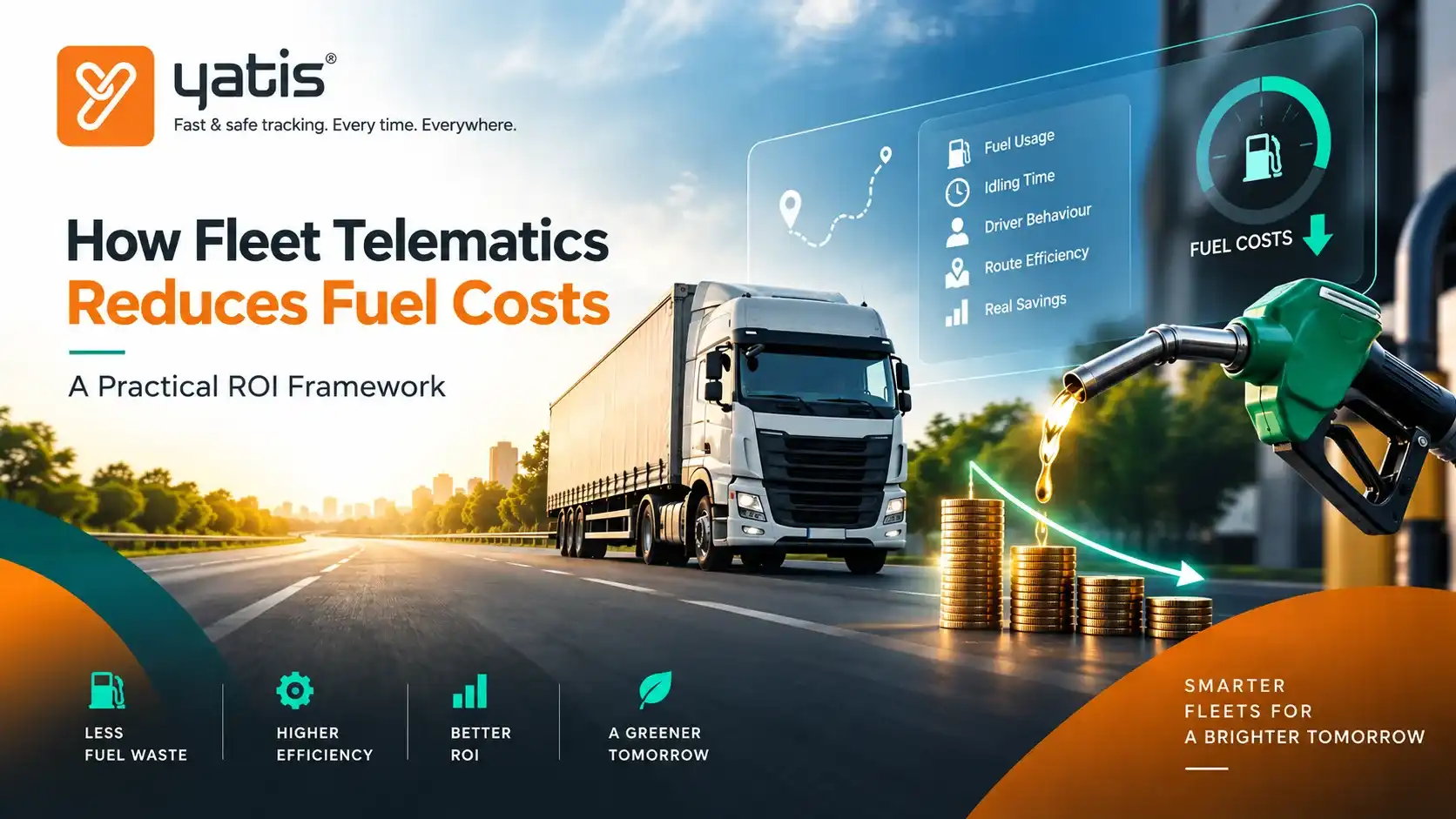
Move beyond generic fuel-saving claims. Learn how idling, route deviation, driving behaviour and fuel-loss controls translate into measurable savings.
Fuel is one of the largest variable expenses in many commercial fleets. Fleet telematics helps reduce that expense by turning vehicle movement, engine activity, fuel-level signals and driver events into measurable operational actions.
Quick answer: Fleet telematics can support fuel savings by reducing unnecessary idling, identifying route deviations, improving driving behaviour, detecting abnormal fuel-level changes and measuring the financial impact of corrective action. Results depend on the fleet baseline, data quality and management follow-through.
Start With the Fuel Cost Equation
A fuel-saving programme should begin with a baseline. Lower fuel spend alone does not prove better efficiency because kilometres, fuel prices, trip volume and seasonality may have changed.
Fuel cost = Distance travelled ÷ Mileage × Fuel price
Use consistent units: kilometres, km/litre and ₹/litre.
Track distance, route design, load, idling, driving behaviour, fuel losses, tyre pressure, maintenance and operating conditions together.
Five Operational Levers That Create Fuel Savings
- Excessive idling: Identify recurring idle locations, durations, time bands and vehicles with abnormal engine-on patterns.
- Route deviation: Compare planned and actual distance, while allowing for justified detours caused by traffic, safety or customer requirements.
- Driving behaviour: Use repeat overspeeding, harsh braking, rapid acceleration and idling patterns to guide coaching.
- Fuel theft and leakage: Use compatible fuel sensors or integrations to flag sudden drops and suspicious refuelling patterns.
- Vehicle condition: Connect fuel data with tyre pressure, engine faults, maintenance and load-related context.
- Management discipline: Assign owners, set thresholds, review exceptions and verify whether corrective actions changed the baseline.
From Vehicle Data to Fuel Savings
The Fuel-Savings Operating Loop
Use this loop to turn raw signals into action:
- Vehicle and GPS data: Collect location, engine activity, fuel-level signals and driver events.
- Detect exceptions: Flag excessive idling, route deviation, harsh driving and sudden fuel-level changes.
- Quantify cost: Convert exceptions into litres and cost using a documented baseline.
- Take action: Coach drivers, correct routes, investigate fuel events and address vehicle issues.
- Measure baseline: Compare fuel indicators before and after intervention.
Repeat weekly or monthly to verify sustained improvement.
1. Reducing Fuel Waste From Idling
Segment idle data by vehicle, depot, driver, route, location, shift and reason.
Useful measures include:
- Total idle minutes
- Idle minutes per engine hour
- Top idle locations
- Repeated excessive-idle patterns
Illustrative estimate: if a vehicle idles unnecessarily for 45 minutes per day and assumed idle consumption is 1.5 litres per hour, the estimated volume is 1.125 litres per day. This is a planning assumption, not a universal rate. Validate it with vehicle-specific evidence.
2. Identifying Route Deviation
Compare planned and actual distance, trip duration, unplanned stops and repeated deviation locations.
Do not label every deviation as waste: road closures, traffic, safety and customer requests may justify it.
Use route history and geofencing from the Yatis GPS Tracking System to investigate exceptions.
3. Improving Driving Behaviour
Driving style can influence fuel efficiency, component wear and safety. Review repeat patterns, segment by vehicle and route, coach drivers and compare fuel indicators after intervention.
See the Yatis driver safety solution for behaviour monitoring and coaching workflows.
4. Detecting Fuel Theft and Refuelling Discrepancies
Fuel theft detection generally requires a compatible fuel-level sensor, CAN source or other integration.
Useful controls include:
- Sudden-drop alerts
- Timestamp and location evidence
- Refuelling records
- Measured volume versus claimed volume
Review the Yatis Fuel Tracking solution. Accuracy depends on tank design, calibration, sensor quality and event validation.
5. Build a Formula-Based ROI Model
Support gross savings with a documented baseline and assumptions.
Net monthly benefit = Gross monthly fuel savings - Monthly technology cost
Payback period = Implementation cost ÷ Net monthly benefit
Use payback only when net monthly benefit is positive and reasonably stable.
Include hardware, installation, sensors, connectivity, subscriptions, calibration, maintenance, integrations, training and internal implementation effort.
Illustrative ROI Example: 50-Vehicle Diesel Fleet
This example is illustrative, not a customer result.
| Input | Assumption |
|---|---|
| Vehicles | 50 |
| Monthly fuel spend | ₹18,00,000 |
| Estimated gross saving | 4% |
| Gross monthly saving | ₹72,000 |
| Monthly technology cost | ₹25,000 |
| Net monthly benefit | ₹47,000 |
| Implementation cost | ₹1,40,000 |
| Illustrative payback | About 3 months |
The 4% assumption must be tested against actual baseline data and normalised for kilometres, fuel price, vehicle mix, seasonality, route changes and operating volume.
How to Validate Whether Savings Are Real
- Record baseline consumption for an adequate period.
- Normalise by kilometres, trips, tonne-kilometres or operating hours where appropriate.
- Track fuel price and operating volume separately.
- Document interventions such as coaching, route changes or sensor installation.
- Review results over multiple reporting periods.
| Metric | Purpose |
|---|---|
| Fuel cost per kilometre | Shows fuel cost relative to distance. |
| Litres per 100 km | Supports comparable consumption analysis. |
| Idle minutes per engine hour | Separates idling from total operating time. |
| Fuel variance per trip | Highlights unusual consumption. |
| Fuel loss events | Tracks suspected theft or unexplained changes. |
| Net savings per vehicle | Compares benefit with deployment cost. |
Common Mistakes
- Promising fixed savings without a baseline.
- Confusing lower fuel spend with better efficiency.
- Assuming every fuel-level change is theft.
- Treating GPS distance as perfect without calibration.
- Ignoring load, terrain, traffic and vehicle condition.
- Collecting data without assigning operational owners.
A credible fuel-saving programme connects every claimed saving to a baseline, an operational intervention and a measurable change.
Choosing the Right Fleet Telematics Setup
The right configuration depends on the operating model of the fleet. Location visibility may need a basic device. Fuel-loss monitoring may require dedicated sensors and calibration. Construction and mining fleets may also need engine load, work-hour and maintenance data.
Explore Yatis fleet and IoT solutions and find more practical guides in Yatis resources.
Frequently Asked Questions About Fleet Telematics Fuel Savings
Turn Fuel Data Into Measurable Fleet Efficiency
Yatis helps fleet teams connect fuel tracking, driver insights, alerts and analytics to support better operating decisions and measurable efficiency gains.
Get Started Today →