

ADAS and AI Dashcams: How Fleet Safety Technology Actually Works

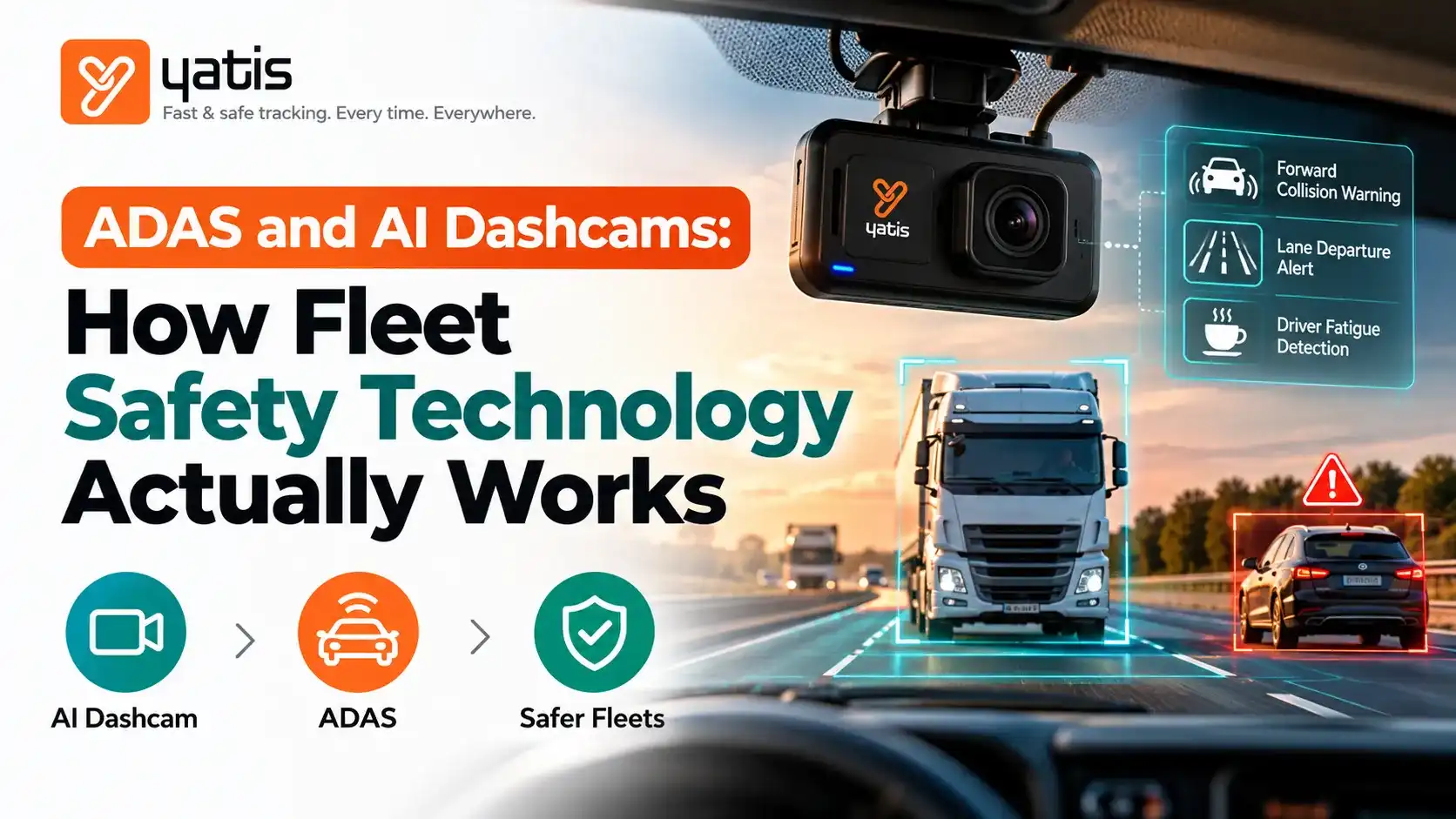
A practical guide to ADAS, driver monitoring, cameras, edge AI, event detection, alerts, human review and governance — plus the limitations fleet managers should understand before deployment.
The Fleet Safety Technology Stack
Fleet video safety is not a single feature. It is a stack of sensing, processing, detection, workflow and governance layers working together.
01. Camera & Sensors
Road and cabin views, GNSS and motion signals.
02. Edge Processing
Local filtering and fast event detection.
03. AI / Rules
Models and thresholds interpret signals.
04. Event Detection
Supported events become structured records.
05. Real-Time Alert
The right severity reaches the right role.
06. Human Review
Evidence plus context before action.
07. Action & Governance
Coaching, incident handling, retention, access and policy.
What Is ADAS?
ADAS stands for Advanced Driver Assistance Systems. It is a group of technologies designed to assist the driver by detecting selected driving or collision risks and providing warnings or, for some functions, interventions.
Examples include forward collision warning, automatic emergency braking, lane departure warning, lane keeping assistance, blind-spot warning, adaptive cruise control and lane-centering assistance. These range from warning-only systems to systems that can intervene under defined conditions, such as automatic emergency braking.
For fleets, the important question is not simply whether a device says “ADAS.” The real questions are: Which event can it detect? Under what conditions? What sensor is used? What happens when the event is detected? Can the fleet manager review evidence?
ADAS vs AI Dashcam: What Is the Difference?
ADAS and AI dashcams overlap, but they describe different layers of the safety system. Use the table below to keep the distinction clear during procurement.
| Layer | Primary purpose | Typical examples |
|---|---|---|
| ADAS | Assist the driver with selected road/vehicle-risk situations. | Forward collision warning, lane departure, following-distance warning, selected braking or steering interventions. |
| DMS | Monitor supported driver-state or distraction signals. | Drowsiness, distraction, phone use, seat-belt violations where supported. |
| AI Dashcam | Combine video capture with AI detection and fleet workflows. | Road events + cabin events + event clips + alerts + incident review. |
| Fleet platform | Turn events into operational decisions. | Alerts, driver coaching, incident records, reports, trends and escalation. |
Yatis’ AI Dash Cam platform describes live HD road and cabin monitoring, real-time risk alerts, driver behaviour coaching, GPS-backed incident detection and event-based cloud uploads.
How the Technology Works: From Camera to Decision
Every AI dashcam workflow follows the same logical path, even when hardware and software architectures differ.
01. Capture
Camera, GNSS, motion and supported vehicle signals generate data.
02. Edge Processing
Selected data is processed locally for fast event detection and filtering.
03. AI + Rules
Models and thresholds interpret visual, motion or vehicle signals.
04. Event Workflow
The system creates an event, sends an alert and links available evidence for review.
This is consistent with the broader telematics architecture. Learn more in how fleet telematics works.
1. ADAS: Road-Facing Safety Intelligence
ADAS is primarily concerned with what is happening around the vehicle. Depending on the system, cameras and other sensors can identify lane position, vehicles ahead, pedestrians, blind spots or other relevant objects and conditions.
Common driver-assistance technologies include forward collision warning, lane departure warning, automatic emergency braking, pedestrian automatic emergency braking, blind-spot warning, adaptive cruise control, lane-centering assistance and lane-keeping assistance.
Common ADAS Event Types
Forward Collision Warning
Potential forward collision risk detected; system warns the driver.
Lane Departure
Vehicle movement toward or across detected lane markings.
Unsafe Following
Following-distance risk detected under supported conditions.
Pedestrian Risk
Potential pedestrian collision detected where supported.
Blind-Spot Risk
Vehicle detected in an adjacent blind-spot area where supported.
Automatic Intervention
Selected systems may brake or steer when their conditions for intervention are met.
2. DMS: Driver Monitoring System
DMS means Driver Monitoring System. Instead of looking mainly at the road ahead, DMS uses a cabin-facing camera and algorithms to analyse selected driver-state or distraction signals.
Depending on the hardware and model, a fleet DMS may identify:
- Drowsiness indicators
- Visual distraction
- Mobile-phone use
- Seat-belt violations
- Eyes-off-road or head-position signals
These are system-detected signals, not medical diagnoses. The exact events depend on camera placement, model capability, lighting, driver position and configuration.
3. Camera: Why Image Quality Alone Is Not Enough
A fleet camera is the sensing layer. Resolution matters, but fleet safety value also depends on field of view, low-light performance, camera position, lens condition, storage, connectivity, AI capability and event workflows.
| Camera consideration | Why it matters |
|---|---|
| Road-facing view | Provides visual context for road and ADAS events. |
| Cabin-facing view | Provides context for selected driver-behaviour events. |
| Night / low-light performance | Detection quality can change with lighting conditions. |
| Field of view | Determines what the model can see and what may remain outside the frame. |
| Mounting position | Affects the geometry of road and driver views. |
| Connectivity | Determines how alerts and evidence reach the cloud platform. |
4. Edge AI: Why Processing Near the Vehicle Matters
Edge AI means running selected AI processing close to the source of the data — for example, on the dashcam or an onboard computing device.
Instead of uploading every frame for cloud processing, an edge-enabled system can evaluate supported signals locally and send event metadata, snapshots or clips when a configured event occurs.
For fleets, this architecture can reduce unnecessary video transfer and make time-sensitive alerts possible. The actual processing split varies by product architecture, connectivity and configuration.
5. Event Detection: From Pixels and Signals to an Alert
Event detection is where sensor data becomes an operational signal. A simplified detection pipeline looks like this:
01. Raw Signal
Video frames, motion and vehicle data enter the pipeline.
02. Pre-process
Data is cleaned, aligned and prepared for analysis.
03. Model / Rule
AI models and rules interpret the prepared signals.
04. Confidence / Threshold
Scores are checked against configured thresholds.
05. Event Created
A structured event record is generated.
06. Evidence Linked
Clips, snapshots and telematics context are attached.
07. Alert / Workflow
Severity, escalation and review rules determine what happens next.
Not every detected event should be treated identically. A robust fleet workflow can assign severity, confidence, evidence requirements and escalation rules.
6. Alerts: Real-Time Does Not Mean Alert Everything
A fleet can have hundreds or thousands of vehicles generating events. Sending every event to every manager creates alert fatigue. A better approach is to define what deserves immediate attention and what belongs in periodic reporting.
| Alert tier | Example | Suggested workflow |
|---|---|---|
| Critical | Collision/impact, severe forward-risk event, selected high-severity safety event. | Immediate notification + evidence + escalation. |
| High | Repeated distraction, severe speeding, recurring unsafe following. | Manager review + coaching workflow. |
| Medium | Recurring harsh manoeuvres or route/policy exceptions. | Trend review + targeted intervention. |
| Low / analytical | Aggregated trends and non-urgent patterns. | Weekly/monthly dashboard analysis. |
The exact severity matrix should be defined by the fleet’s safety policy rather than copied from a generic template.
7. Human Review: Why AI Should Not Be the Final Decision-Maker
AI can identify patterns quickly, but a fleet safety process still benefits from human review. A video clip may show a harsh event, but the reviewer can investigate traffic conditions, road geometry, emergency manoeuvres, vehicle type and other context.
This is especially important when an event could lead to disciplinary action, an insurance claim, a safety investigation or a driver dispute.
8. Governance: The Missing Layer in Many AI Dashcam Projects
Technology deployment should include a governance model from the beginning. Fleet video creates operational value, but it also creates responsibilities around access, retention, security and communication.
| Governance area | Questions to define |
|---|---|
| Purpose | Why is video/AI being collected? Safety, incident review, coaching, claims or other defined purposes? |
| Access | Who can view live video, event clips and historical footage? |
| Retention | How long should routine and incident footage be retained? |
| Security | How is data protected in transit, storage and user access? |
| Driver communication | Are drivers informed about the system, monitored events and relevant policies? |
| Incident handling | Who reviews events and what evidence is retained? |
Yatis’ fleet-video guidance recommends clear retention policies, secure cloud storage, role-based access and transparent communication. See fleet video data storage & privacy.
ADAS and AI Dashcams: What They Can and Cannot Detect
| Technology | Can support | Important limitation |
|---|---|---|
| ADAS | Selected road-risk warnings/interventions. | Works only within the system’s sensing capability and operating conditions. |
| DMS | Selected distraction/drowsiness/driver-state signals. | Camera angle, lighting, occlusion and model capability can affect detection. |
| Road camera | Visual evidence and event context. | A camera records what is within its field of view; it does not automatically understand every road situation. |
| Edge AI | Fast local inference and event filtering. | Models and hardware have finite compute and detection capabilities. |
| Cloud analytics | Fleet-wide review, reporting, trends and workflows. | Depends on connectivity, data quality and correct configuration. |
| Human review | Contextual interpretation and policy decisions. | Requires trained reviewers and consistent procedures. |
How Fleet Managers Should Evaluate an AI Dashcam
- List the actual safety events you need. Do not buy based on “AI” as a generic feature.
- Separate ADAS from DMS. Ask which road-facing and cabin-facing events are independently supported.
- Ask where inference happens. Understand edge versus cloud processing.
- Test false positives. Run a controlled pilot across different roads, lighting conditions and vehicle types.
- Inspect evidence quality. An alert without useful video context may have limited operational value.
- Design escalation before deployment. Decide who receives critical, high, medium and analytical events.
- Measure post-deployment outcomes. Track event rates, coaching completion, repeat events and incident trends.
- Define governance. Establish retention, access, security and driver communication policies.
How ADAS + AI Dashcam Fits Into Fleet Management
ADAS and video intelligence become more useful when connected to the broader fleet-management workflow. The Yatis GPS tracking system combines live tracking, route history, geofencing, fuel monitoring, driver behaviour insights, alerts and video telematics within a central fleet environment.
For broader fleet-management capabilities, see Yatis fleet management & IoT solutions.
ADAS Event Library — Recommended Linkable Asset
A useful downloadable ADAS Event Library should explain each event in plain language and make the technical limitations visible to fleet managers, operations teams and procurement teams.
| Event | Detection layer | Typical output | Review question |
|---|---|---|---|
| Forward collision risk | Road-facing ADAS | Alert + event clip where supported | Was the risk genuine and what was the driver response? |
| Lane departure | Road-facing camera / ADAS | Lane event + alert | Were lane markings visible and was the movement intentional? |
| Unsafe following | Road-facing ADAS | Distance-risk alert | Was traffic density or road geometry relevant? |
| Distraction | DMS | Cabin event + clip | Was the driver actually visually distracted? |
| Phone use | DMS / AI | Cabin event + clip | Does the evidence meet the fleet’s review standard? |
| Drowsiness signal | DMS / AI | Driver-state alert | Does the event require a break or safety intervention? |
| Harsh braking | Telematics / motion | Event + location + speed context | Was emergency braking justified by traffic conditions? |
| Impact | Motion / vehicle / video | Incident alert + evidence | What happened immediately before and after the impact? |
Common Misconceptions About ADAS and AI Dashcams
“ADAS Means the Vehicle Can Drive Itself”
No. Driver-assistance technologies have different capabilities and responsibilities. Level 1 and Level 2 driver-assistance systems require the driver to remain fully engaged and attentive.
“A High-Resolution Camera Automatically Means Better AI”
Resolution is only one input. Detection quality also depends on model capability, field of view, mounting, lighting, compute, calibration and event definitions.
“Every Alert Should Trigger a Phone Call”
That can create alert fatigue. Severity-based escalation is generally more operationally manageable.
“AI Can Make the Disciplinary Decision”
AI can support event detection and evidence collection. A human-led policy process should determine consequential actions.
“If an Event Was Not Detected, It Did Not Happen”
Detection systems have operating boundaries. Absence of an alert is not proof that no risk occurred.
Conclusion
ADAS and AI dashcams work best as a layered safety system, not as a single “AI camera” feature.
ADAS focuses on selected road and vehicle risks. DMS adds driver-state and distraction signals. Cameras provide visual context. Edge AI enables local event processing. Cloud platforms turn events into alerts, evidence, reports and trends. Human review adds context, while governance determines how the resulting data should be used.
For a fleet, the objective is therefore not to maximise the number of AI alerts. It is to build a reliable loop: detect → understand → intervene → coach → measure → improve.
Explore Yatis fleet solutions and related guides in resources to connect video safety data with better fleet decisions.
External Sources & Further Reading
- NHTSA — Driver Assistance Technologies
- NHTSA — Automated Vehicle Safety
- IIHS — Advanced Driver Assistance
- IIHS — Partial Automation Safeguards
Frequently Asked Questions About ADAS and AI Dashcams
Build a Safer Fleet With Video Intelligence
Deploy ADAS and AI dashcams with Yatis telematics — combine road-facing safety events, driver monitoring, event evidence and coaching workflows to reduce risk and improve fleet safety.
Get Started Today →