

Affordable Transport Management Apps for Delivery Companies — and When It's Time to Move Beyond Them

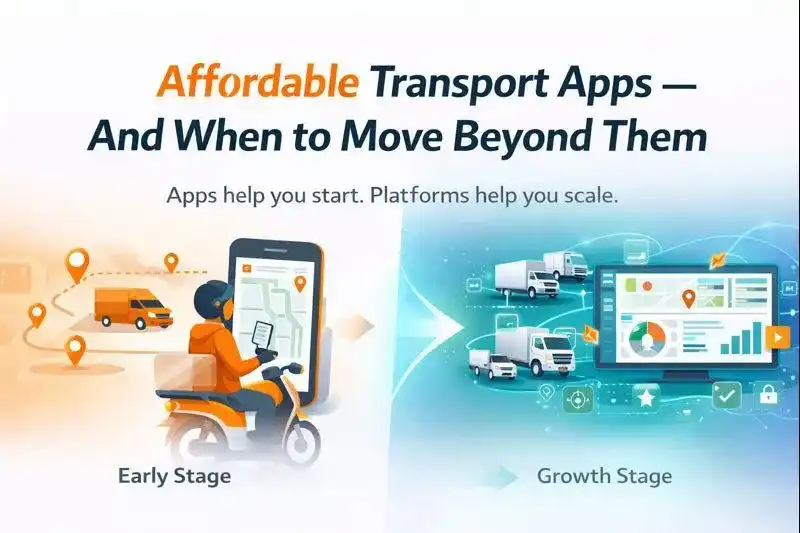
Affordable transport management apps help early-stage delivery companies manage routing, tracking, and proof of delivery at low cost. However, as delivery volumes grow, app-only logistics often breaks down due to limited visibility, poor integrations, and compliance gaps. Growing delivery companies eventually need a transport management platform that connects vehicles, drivers, data, and operations end to end.
Why Delivery Companies Start with Transport Management Apps
For most delivery businesses in India — hyperlocal delivery, D2C brands, small logistics operators — the first challenge is getting organised quickly and affordably.
Transport management apps are attractive because they:
- Are easy to deploy
- Require little to no technical setup
- Work on smartphones drivers already have
- Solve immediate pain points
At an early stage, apps feel like the fastest path to control.
What Delivery Companies Look for in Affordable Transport Apps
When budgets are tight, delivery teams usually prioritise:
✓ Route Planning & Navigation
Basic route optimisation using Google Maps or similar services.
✓ Live Location Tracking
Knowing where drivers are — even if accuracy is limited.
✓ Proof of Delivery (POD)
Photo capture, OTP confirmation, or digital signatures.
✓ Driver Communication
In-app tasks, WhatsApp-style messaging, or call buttons.
✓ Low Monthly Cost
Affordable per-user or per-driver pricing.
At this stage, simplicity matters more than depth.
Common App-Based Tools Used in India
Most affordable transport management apps fall into these categories:
- Routing & navigation apps
Focused on shortest path, not operational constraints. - Delivery tracking apps
Provide basic live location and status updates. - POD-focused apps
Emphasise delivery confirmation over vehicle data. - Standalone driver apps
Rely entirely on smartphones for data capture.
These tools are widely used because they're quick to adopt and require minimal training.
Where App-Based Logistics Works Well (Small Scale)
App-only logistics performs reasonably well when:
- Delivery volume is low to moderate
- Fleet size is small (few vehicles or riders)
- Operations are limited to one city or zone
- Compliance requirements are minimal
- Manual intervention is still manageable
In this phase, apps help teams:
- Reduce chaos
- Replace spreadsheets and calls
- Gain basic visibility
For early-stage delivery companies, this is often good enough.
Where Transport Management Apps Start Breaking Down
As delivery operations grow, cracks begin to show.
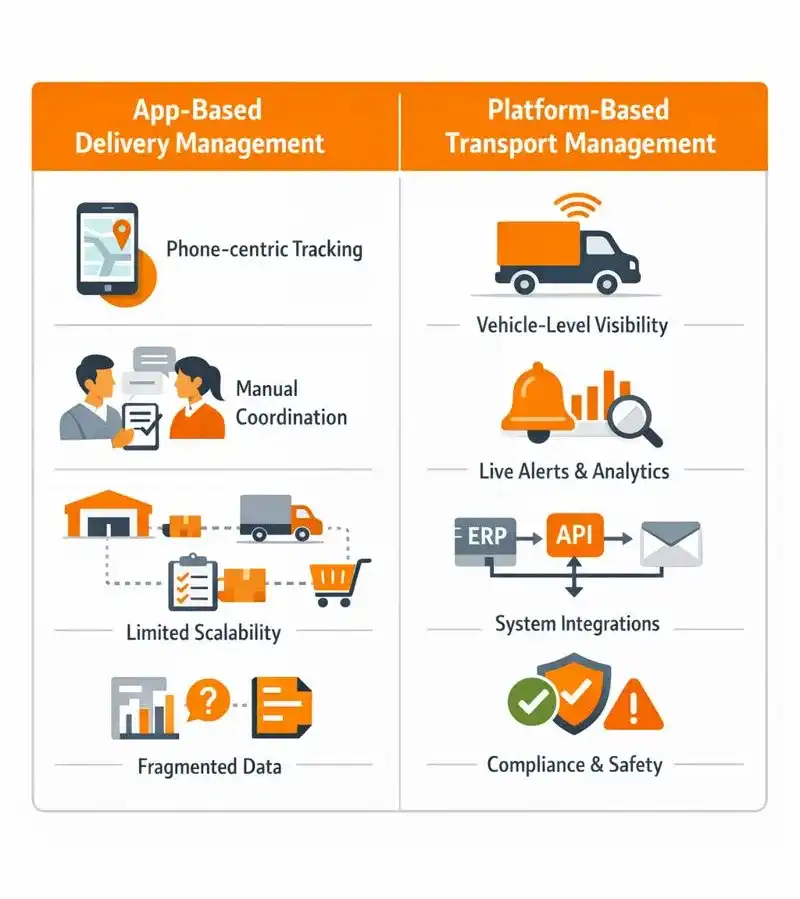
1️⃣ Limited Operational Visibility
Apps track drivers, not vehicles, assets, or utilisation patterns.
2️⃣ No Real Vehicle Intelligence
No data on fuel usage, tyre health, idling, or driving behaviour.
3️⃣ Poor Integrations
Apps don't integrate well with:
- ERPs
- Order management systems
- Compliance or safety systems
4️⃣ Scalability Issues
What worked for 10 drivers becomes unmanageable at 100.
5️⃣ Compliance & Risk Gaps
Apps are not designed for:
- Fleet safety
- Regulatory compliance
- Audit trails
At this point, teams start firefighting instead of optimising.

How Growing Delivery Companies Transition from Apps to Platforms
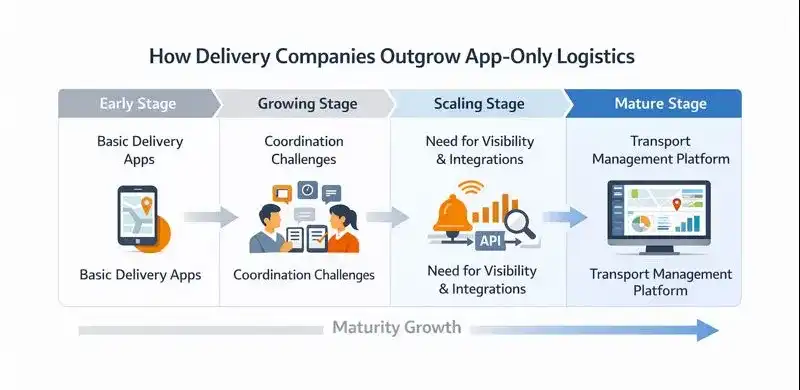
The transition usually happens when delivery leaders ask:
- Why do issues get noticed too late?
- Why is data scattered across apps and spreadsheets?
- Why does scaling increase stress instead of efficiency?
A transport management platform addresses this by:
- Connecting vehicles, drivers, routes, and orders
- Providing real-time operational intelligence
- Enabling integrations with existing systems
- Supporting compliance and safety by design
This is not a sudden switch — it's a maturity step.

Where Yatis Fits into This Journey (Without Replacing Apps Overnight)
Yatis is not positioned as "another app".
Yatis is built for organisations that have outgrown app-only logistics and now need:
- Reliable, vehicle-level data
- Predictable operations at scale
- Actionable insights instead of raw tracking
- A platform that grows with their delivery network
Apps help teams start.
Platforms help teams scale sustainably.
Frequently Asked Questions
Are transport management apps enough for delivery companies?
Transport management apps work well for early-stage delivery companies with small fleets and limited operations. As delivery volumes grow, apps often lack vehicle-level visibility, integrations, and compliance capabilities, making a platform-based transport management system necessary.
What are the limitations of app-based delivery management?
App-based delivery management is limited by fragmented data, lack of vehicle intelligence, poor scalability, minimal integrations, and weak compliance support. These limitations become critical as delivery operations expand.
When should a delivery company move beyond transport apps?
A delivery company should move beyond transport apps when fleet size increases, operational issues are detected too late, manual coordination grows, or compliance and reporting become important. This usually signals the need for a transport management platform.
What is the difference between a transport app and a transport management platform?
A transport app focuses on task execution such as routing and proof of delivery, while a transport management platform connects vehicles, drivers, data, and systems to provide real-time visibility, analytics, integrations, and scalable control.
How does a platform-based transport management system help scale delivery operations?
Platform-based transport management systems help scale operations by providing real-time visibility, automated alerts, system integrations, and historical insights. Instead of manually tracking issues, teams can identify patterns, prevent delays, and make informed decisions. This shift reduces operational stress as delivery volumes increase.
Where does Yatis fit in the delivery company growth journey?
Yatis supports growing delivery companies by providing a scalable transport management platform that offers vehicle-level visibility, real-time insights, integrations, and operational intelligence for safer and more predictable delivery operations.
Final Thoughts
Affordable transport management apps play an important role in helping delivery companies take their first steps toward organisation and control.
But as operations mature, the question shifts from "Which app should we use?" to "How do we run this reliably at scale?"
That's where platforms matter — not to replace what works, but to bring structure, visibility, and intelligence to growing delivery networks.
At Yatis, we believe transport technology should evolve with the business — quietly supporting better decisions, safer operations, and smoother journeys as complexity increases.
Ready to Move Beyond App-Only Logistics?
Get expert guidance on transitioning from delivery apps to a scalable transport management platform for your growing operations.
Contact Yatis Today →