

GPS Tracking Accuracy Explained: Why Your GPS Location Isn't Always Exact

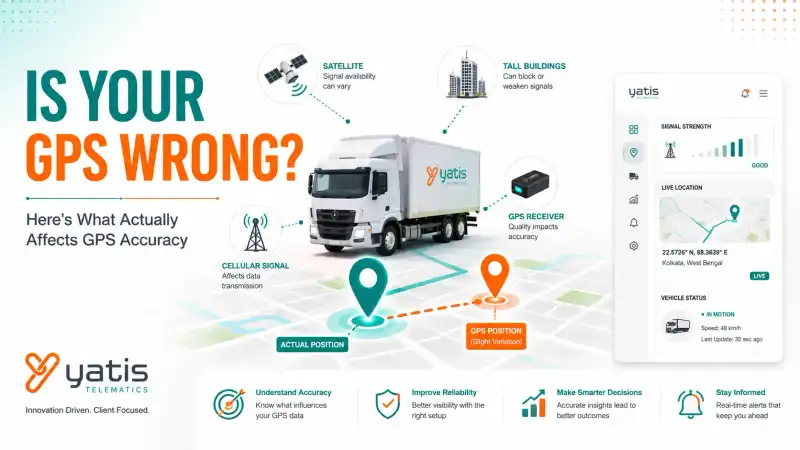
One of the most common questions fleet managers ask after installing a GPS tracking system is: "Why isn't my vehicle always shown at the exact location?"
Perhaps the vehicle appears a few metres away from where it's actually parked. Or maybe the location updates seem delayed while travelling through a busy city. For many businesses, these situations create uncertainty about whether the GPS tracker is working correctly.
In reality, small variations in GPS tracking accuracy are normal. Even the most advanced commercial GPS tracking systems can experience temporary changes in location precision due to environmental conditions, satellite visibility, network connectivity, and installation quality.
In this guide, we'll explain what GPS tracking accuracy actually means, what influences it, and how businesses can improve the reliability of their fleet tracking systems.
Why GPS Tracking Accuracy Matters
For commercial fleets, GPS isn't simply about knowing where a vehicle is. Location data influences everyday operational decisions.
Fleet managers rely on accurate positioning to:
- Dispatch the nearest vehicle
- Monitor deliveries
- Verify customer visits
- Analyse completed trips
- Improve driver accountability
- Protect valuable assets
When location information is inaccurate, even by a small margin, it can affect customer communication, operational planning, and confidence in the tracking system. However, it's important to understand that accuracy is not the same as perfection. The goal is consistent, reliable location information that supports better operational decisions.
How Accurate Is a Modern GPS Tracking System?
Modern commercial GPS tracking systems are generally accurate enough for fleet operations, logistics, field services, public transportation, and asset tracking. Under normal operating conditions, a high-quality GPS tracking device can typically determine a vehicle's location within a few metres.
The exact accuracy depends on several factors, including:
- Number of visible satellites
- Quality of the GPS receiver
- Installation location
- Signal obstruction
- Cellular network performance
- Update frequency
Many fleet managers assume that if a vehicle appears a few metres away from its actual location, the GPS tracker is faulty. In most cases, this isn't true. Small positional variations are expected because GPS receivers continuously calculate location based on signals received from multiple satellites, and those signals can be influenced by the surrounding environment.
What Causes GPS Tracking Inaccuracy?
When fleet managers notice slight changes in vehicle location, they often assume there's a problem with the GPS device itself. In reality, the tracker is only one part of the positioning process. Let's look at the most common factors.
1. Limited Satellite Visibility
A GPS receiver determines location by communicating with multiple satellites orbiting the Earth. The more satellites it can communicate with, the more accurate the calculated position is likely to be. Problems occur when the receiver has a restricted view of the sky, such as in:
- Underground parking
- Tunnels
- Covered loading bays
- Dense tree cover
- Multi-level parking structures
2. The Urban Canyon Effect
Tall buildings can block or reflect satellite signals before they reach the GPS receiver. This phenomenon is commonly known as the Urban Canyon Effect. Instead of receiving a direct satellite signal, the receiver may process signals that have bounced off nearby buildings, so the displayed vehicle location may shift slightly even though the vehicle hasn't moved.
3. Signal Reflection (Multipath)
Sometimes satellite signals reach the GPS receiver after reflecting off surfaces such as glass buildings, metal structures, warehouses, and bridges. This is known as multipath interference. Because the reflected signal travels a longer path than the direct signal, the receiver may calculate a slightly different location. These shifts are usually temporary and correct themselves as the vehicle continues moving.

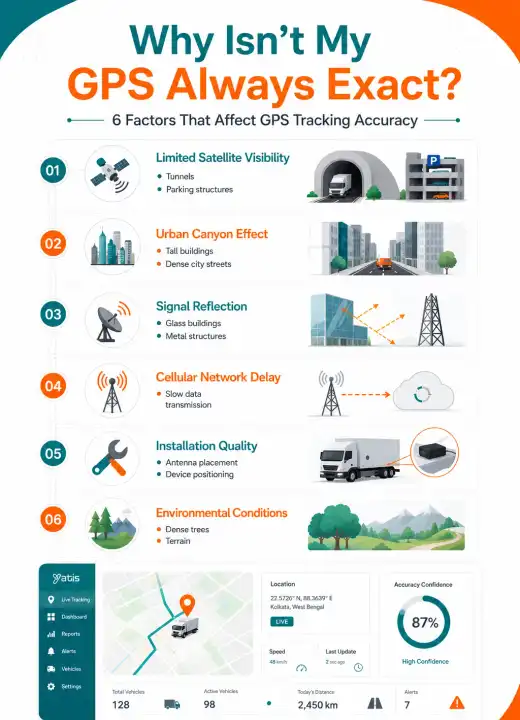
4. Cellular Network Delays
A common misconception is that delayed vehicle updates always indicate poor GPS accuracy. The GPS receiver may calculate the correct location immediately, but if the mobile network experiences temporary latency, the location update may reach the fleet dashboard a few seconds later. This affects when the data is displayed—not where the vehicle actually is. To understand the difference between live updates and recorded journey data, read our guide on Real-Time GPS Tracking vs Historical Tracking.
5. Poor GPS Device Installation
Even the most advanced GPS tracker cannot deliver consistent performance if it has been installed incorrectly. Common installation issues include:
- Antenna positioned beneath metallic surfaces
- Loose power or communication connections
- Incorrect antenna orientation
- Installation inside enclosed compartments that obstruct signals
Professional installation and regular system health checks help ensure the tracker performs as intended throughout its lifecycle.
Does Weather Really Affect GPS Accuracy?
This is one of the biggest misconceptions surrounding GPS technology. Many fleet operators believe heavy rain automatically causes GPS tracking to become inaccurate. The reality is more nuanced.
Normal Weather
Under everyday conditions—including light rain, moderate rainfall, cloud cover, and fog—GPS accuracy is generally not affected enough to impact fleet operations. Commercial GPS receivers are designed to function reliably in a wide range of weather conditions.
Extreme Atmospheric Conditions
In rare cases, severe atmospheric disturbances or intense solar activity can slightly affect satellite signals. However, for most businesses, these events have little practical impact compared to everyday operational factors such as high-rise buildings, underground parking, dense tree cover, and multipath interference. In other words, weather is rarely the primary reason a GPS location appears slightly different.
Update Frequency vs GPS Accuracy
Fleet managers often confuse update frequency with GPS accuracy. Although they work together, they are not the same thing.
GPS accuracy answers: "How close is the reported location to the vehicle's actual position?"
Update frequency answers: "How often does the tracking platform receive a new location?"
A GPS tracker configured to send updates every 60 seconds can still provide highly accurate location data. Similarly, a tracker transmitting updates every 5 seconds is not automatically more accurate—it simply reports its position more frequently.
Expectation vs Reality
Fleet managers often expect GPS technology to behave differently from how it actually works. The table below addresses some of the most common misconceptions.
| Expectation | Reality |
|---|---|
| GPS should always show the exact parking spot. | Small positional variations of a few metres are normal, especially in complex environments. |
| Heavy rain causes GPS failures. | Buildings, signal obstruction, and multipath interference typically have a greater impact than weather. |
| Every location shift means the GPS tracker is faulty. | Temporary environmental conditions often explain minor location changes. |
| Faster updates mean higher accuracy. | Update frequency determines how often data is reported, not how precisely the location is calculated. |
| GPS tracking should work equally well everywhere. | Underground parking, tunnels, and dense urban environments can temporarily reduce positioning accuracy. |
How Fleet Managers Can Improve GPS Tracking Accuracy
Although some environmental factors cannot be controlled, businesses can significantly improve tracking performance by following a few best practices.
Choose High-Quality GPS Hardware
Commercial-grade GPS tracking devices typically offer better receiver sensitivity and more stable performance than low-cost consumer trackers.
Ensure Professional Installation
Correct antenna placement and proper installation reduce the likelihood of signal obstruction and communication issues.
Keep Device Firmware Updated
Manufacturers periodically release firmware updates that improve satellite acquisition, communication stability, and overall device performance.
Maintain Reliable Network Connectivity
A strong cellular connection ensures location updates are transmitted promptly to the fleet management platform.
Review Tracking Settings
Configure reporting intervals according to operational requirements rather than assuming more frequent updates always provide better business outcomes.
Educate Fleet Teams
Drivers and operations teams should understand that minor location variations are a normal characteristic of satellite navigation systems and not necessarily signs of equipment failure.
What to Look for in an Accurate GPS Tracking System
When evaluating GPS tracking solutions, accuracy should be considered alongside overall platform capabilities. A reliable commercial GPS tracking system should offer:
- Stable satellite connectivity
- High-sensitivity GPS receiver
- Consistent live tracking
- Reliable historical trip records
- Intelligent reporting
- Fast location updates
- Fleet analytics
- System health monitoring
Accuracy is important—but consistency, reliability, and operational visibility ultimately determine the value of a GPS tracking platform. If you're new to GPS technology, our article on How GPS Tracking Systems Work provides a detailed explanation of how satellites, receivers, and communication networks work together to deliver location information. To see how these factors translate into day-to-day fleet visibility, explore the Yatis GPS vehicle tracking system.
Final Thoughts
GPS tracking has become an essential part of modern fleet management, but expecting perfect accuracy in every environment can lead to unrealistic expectations. Small location variations are a normal part of satellite-based positioning.
What matters most is whether your GPS tracking system delivers consistent, reliable, and actionable location data that helps your business make better operational decisions. By understanding the factors that influence GPS accuracy—such as satellite visibility, urban environments, signal reflection, installation quality, and network connectivity—fleet managers can interpret tracking data more effectively.
At Yatis, we design GPS tracking solutions that combine reliable positioning, real-time visibility, and actionable fleet intelligence to help businesses manage vehicles with greater confidence and efficiency.
Frequently Asked Questions
Ready to improve fleet visibility?
Contact Yatis Telematics to learn how our GPS tracking solutions deliver consistent, reliable location intelligence for your fleet.
Contact Us →