

Real-Time GPS Tracking vs Historical Tracking: Which Is Better for Fleet Management?

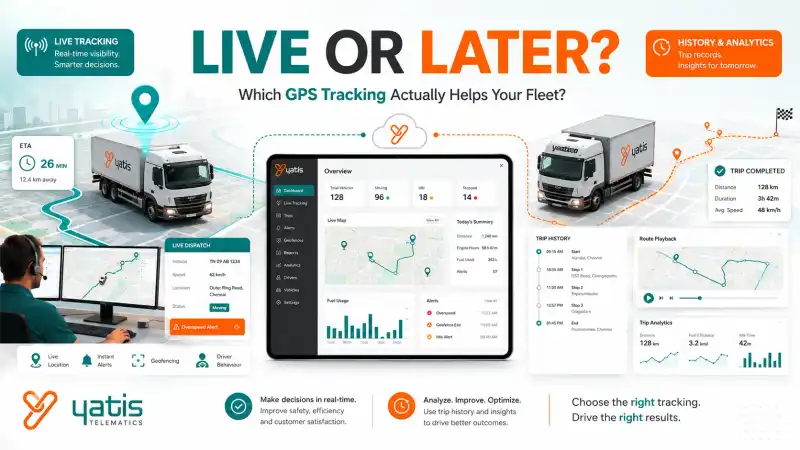
Fleet managers today have access to more vehicle data than ever before. A GPS tracking system can tell you where a vehicle is, where it has been, how long it stayed at a location, and how efficiently it completed its journey. But not all tracking data is delivered in the same way.
Some businesses require live visibility to make operational decisions as events unfold. Others rely on trip history to analyse performance after the journey is complete. This often leads to an important question: should you choose real-time GPS tracking or historical GPS tracking?
The answer isn't as straightforward as choosing one over the other. Each serves a different operational purpose, and understanding that difference can help fleet managers improve efficiency, respond faster to unexpected situations, and make more informed business decisions.
What Is Real-Time GPS Tracking?
Real-time GPS tracking allows fleet managers to monitor the current location and status of a vehicle as it moves. Location updates are transmitted at regular intervals—often every few seconds or minutes—depending on the tracking device, network connectivity, and system configuration.
Instead of waiting until a journey is complete, dispatchers and fleet operators can view vehicle movement directly on a live dashboard. A real-time GPS tracking system typically provides information such as:
- Live vehicle location
- Current speed
- Direction of travel
- Ignition status
- Vehicle stoppages
- Estimated arrival time (ETA)
Unlike historical reports, this information changes continuously throughout the trip, making it particularly useful for day-to-day fleet operations. If you'd like to understand the technology that enables vehicles to transmit location data, read our guide on How GPS Tracking Systems Work.
When Is Real-Time GPS Tracking the Better Choice?
Not every fleet operates the same way. A courier company managing same-day deliveries has very different visibility requirements than a construction company tracking equipment between sites. If your business depends on live operational decisions, real-time GPS tracking provides a clear advantage.
1. Dispatching Vehicles Efficiently
Dispatch teams need to know which vehicle is closest to a customer, which driver is available, and who can reach the destination fastest. With real-time GPS tracking, dispatchers can make decisions using live vehicle locations, helping reduce response times and improve resource allocation.
2. Improving Customer Experience
Customers increasingly expect accurate delivery updates. Instead of saying, "Your driver should arrive soon," businesses can provide realistic ETAs based on the vehicle's current location. This improves customer confidence while reducing inbound support calls.
3. Responding to Unexpected Events
Traffic congestion, road closures, vehicle breakdowns, or route deviations can disrupt operations. Real-time GPS tracking allows fleet managers to identify these issues as they happen and take corrective action, such as rerouting another vehicle or updating delivery schedules.
4. Monitoring High-Value Assets
Businesses transporting expensive equipment, pharmaceuticals, or sensitive cargo often require continuous visibility throughout the journey. Live tracking enables immediate action if a vehicle stops unexpectedly, deviates from its planned route, or enters an unauthorized area.
What Is Historical GPS Tracking?
Historical GPS tracking records and stores a vehicle's journey so it can be reviewed later. Rather than focusing on what is happening now, historical tracking helps businesses understand what happened during a completed trip. Every recorded journey becomes part of a searchable history that can be analysed for operational insights.
Fleet managers can typically review:
- Route travelled
- Departure and arrival times
- Total distance covered
- Stop durations
- Vehicle utilisation
- Driver activity
- Journey playback
Instead of watching vehicles move live, historical tracking creates a record that supports reporting, compliance, investigations, and long-term operational improvements.
When Does Historical GPS Tracking Deliver More Value?
While real-time tracking helps businesses react in the moment, historical tracking helps them improve future operations. Instead of asking, "Where is my vehicle right now?" historical tracking answers, "How did the journey actually perform?"
1. Analysing Driver Behaviour
Completed trip records reveal patterns that are difficult to identify during live operations. Fleet managers can review frequent harsh braking, long idling periods, excessive speeding, route deviations, and unnecessary stops. Over time, these insights support coaching initiatives that improve safety, fuel efficiency, and overall fleet performance.
2. Evaluating Route Performance
Not every route performs as expected. Historical journey data helps answer questions such as which routes consistently experience delays, which delivery zones increase travel time, where vehicles spend the most idle time, and which routes consume more fuel.
3. Supporting Business Reporting
Operational decisions shouldn't rely on assumptions. Historical GPS reports provide measurable data that can be used for monthly fleet reviews, vehicle utilization analysis, productivity reporting, customer service evaluations, and operational audits.
4. Resolving Customer or Operational Disputes
Occasionally, businesses need evidence to verify what happened during a journey. Historical trip records provide departure times, arrival times, route history, stop durations, and trip playback—helping resolve delivery disputes, verify service commitments, or investigate operational incidents with greater confidence.
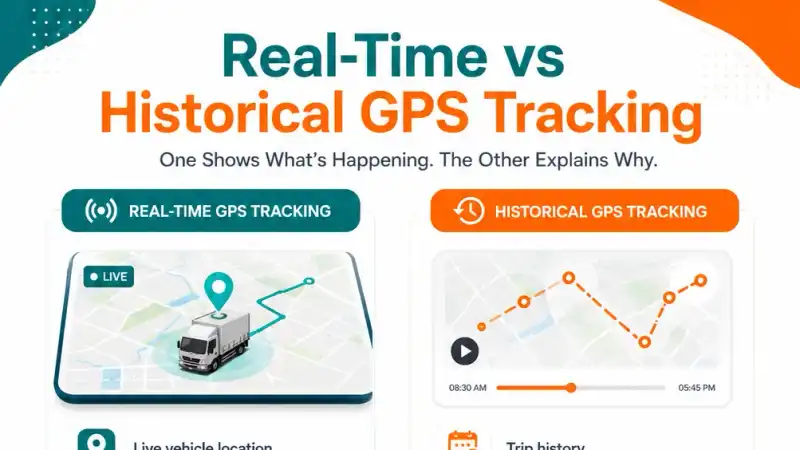
Real-Time GPS Tracking vs Historical Tracking: Key Differences
Although both capabilities rely on the same GPS tracking infrastructure, they solve different business problems.
| Real-Time GPS Tracking | Historical GPS Tracking |
|---|---|
| Displays live vehicle location | Stores completed journey data |
| Supports immediate operational decisions | Supports reporting and analysis |
| Helps dispatchers respond to events instantly | Helps managers identify long-term trends |
| Best for active fleet monitoring | Best for performance evaluation |
| Frequently updated location information | Searchable trip history and playback |
The most important distinction is timing. Real-time tracking helps you manage what is happening now. Historical tracking helps you understand what already happened.
Why Modern Fleets Need Both
One of the biggest misconceptions is that businesses must choose between real-time GPS tracking and historical GPS tracking. In reality, they complement each other. Think of real-time tracking as your operational dashboard, and historical tracking as your business intelligence report.
Consider a logistics company. During the day, dispatchers rely on real-time GPS tracking to monitor deliveries, respond to delays, and communicate accurate ETAs to customers. At the end of the week, operations managers review historical reports to evaluate driver productivity, optimize delivery routes, and identify opportunities to reduce operational costs. Neither view is complete without the other.
Choosing the Right GPS Tracking System for Your Business
If you're evaluating a GPS tracking solution, don't focus solely on whether it offers live tracking or historical reports. Instead, ask whether it provides the visibility your operations actually need. A modern commercial GPS tracking platform should include:
- Real-time vehicle tracking
- Historical trip playback
- Route history
- Driver behaviour insights
- Fleet reports and analytics
- Customizable alerts
- Dashboard visibility
- Integration with fleet management workflows
It's also worth understanding that live updates can be influenced by factors such as signal availability, update intervals, and network conditions. Learn more in our article on GPS Tracking Accuracy Explained.
Common Mistakes Fleet Managers Make
Assuming Live Tracking Is Enough
Monitoring vehicles in real time is valuable, but without reviewing historical reports, recurring operational inefficiencies often go unnoticed.
Ignoring Historical Trends
A single delayed trip may not indicate a problem. However, repeated delays on the same route or by the same vehicle often reveal opportunities for operational improvements.
Treating GPS as a Location Tool Only
Modern GPS tracking systems provide far more than location updates. When combined with reporting and analytics, they become decision-support tools that help improve productivity, reduce operational costs, and enhance customer service.
Final Thoughts
Real-time GPS tracking and historical GPS tracking are often presented as competing technologies. In reality, they answer different operational questions. Real-time tracking helps fleet managers understand what is happening right now, enabling faster decisions and better customer communication. Historical tracking helps businesses understand what happened, providing the insights needed to improve planning, optimize operations, and increase efficiency over time.
For most commercial fleets, the strongest results come from using both together. At Yatis, our GPS tracking solutions combine real-time visibility, historical trip analysis, intelligent reporting, and fleet analytics in a single platform—helping businesses move beyond simple vehicle tracking and towards data-driven fleet management.
Frequently Asked Questions
Ready to combine live and historical visibility?
Contact Yatis Telematics to see how our GPS tracking platform unifies real-time monitoring and historical trip analytics for smarter fleet decisions.
Contact Us →