

OBD GPS Tracker vs Wired GPS Tracker: Which Installation Option Is Right for Your Fleet?

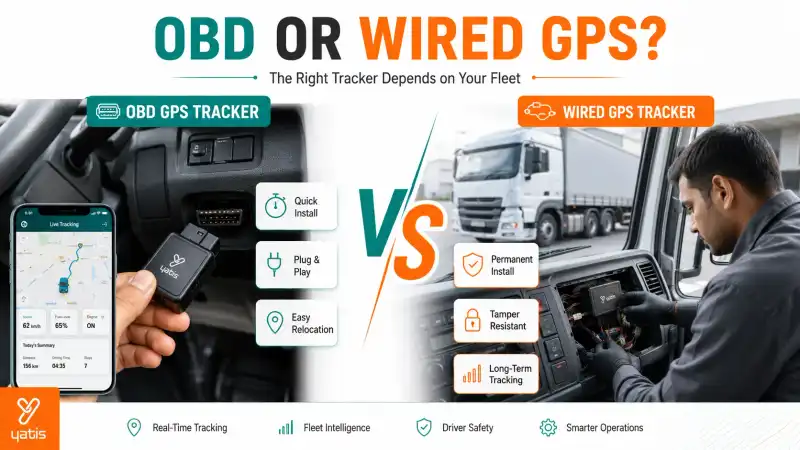
Choosing the right GPS tracking device involves more than comparing features — it also requires selecting the right installation method. Two of the most common options are OBD GPS trackers and wired GPS trackers.
Both provide vehicle location tracking, but they differ significantly in installation, security, maintenance, and long-term suitability. An OBD tracker prioritizes convenience and rapid deployment, while a wired tracker emphasizes reliability and permanent installation. Understanding these differences helps businesses choose a solution that aligns with their operational requirements rather than simply selecting the easiest device to install.
Quick Takeaways
- OBD trackers are easy to install
- Wired trackers provide better security
- Both support GPS tracking
- Installation method affects long-term reliability
- Fleet requirements determine the best choice
Comparison Snapshot
| Feature | OBD GPS Tracker | Wired GPS Tracker |
|---|---|---|
| Installation | Plug-and-play | Professional installation |
| Installation Time | Minutes | Longer |
| Power Source | OBD port | Vehicle electrical system |
| Tamper Resistance | Moderate | High |
| Removal | Easy | Difficult |
| Commercial Fleet Suitability | Small & medium fleets | Large & enterprise fleets |
What Is an OBD GPS Tracker?
An OBD GPS tracker is a plug-and-play GPS tracking device that connects directly to a vehicle's OBD-II diagnostic port. It draws power from the port and enables vehicle tracking without requiring permanent wiring or complex installation.
Most passenger vehicles manufactured in recent decades include an OBD-II port used for diagnostics. An OBD GPS tracker utilizes this port to receive continuous power, transmit location data, and begin tracking immediately after installation. Its biggest advantage is simplicity — many businesses can install an OBD tracker in just a few minutes without modifying the vehicle. For a fuller introduction to the device type, see what an OBD GPS tracker is and how it works.
What Is a Wired GPS Tracker?
A wired GPS tracker is permanently connected to a vehicle's electrical system, allowing continuous GPS tracking through a concealed installation that is more resistant to accidental removal or tampering.
Unlike plug-and-play devices, wired trackers are integrated directly into the vehicle. Typical characteristics include permanent installation, hidden mounting location, continuous power supply, stable long-term operation, and greater installation security. Because the device is usually concealed behind the dashboard or within the vehicle, it is less visible and more difficult to remove.
1. Installation Process
The first major difference is installation.
OBD GPS Tracker
Installation typically involves locating the OBD-II port, plugging in the tracker, and activating the device. No vehicle wiring is required.
Wired GPS Tracker
Installation generally involves connecting to the vehicle's electrical system, securing the device in a concealed location, testing power and connectivity, and completing configuration. Professional installation is generally recommended to ensure reliable operation.
2. Ease of Deployment
Businesses deploying GPS tracking across many vehicles often evaluate installation efficiency. An OBD GPS tracker enables rapid deployment because vehicles require minimal downtime. A wired GPS tracker takes longer to install but provides a more permanent solution for long-term fleet operations. Organizations should balance installation convenience against operational requirements.
3. Power Source
Power supply directly influences device reliability.
OBD GPS Tracker
Powered through the OBD-II port, relying on the availability of the diagnostic connector.
Wired GPS Tracker
Connected directly to the vehicle's electrical system and designed for continuous long-term operation.
For businesses operating commercial fleets, a stable power connection is often an important consideration.
4. Tamper Resistance
Wired GPS trackers generally provide greater tamper resistance because they can be concealed and permanently connected to the vehicle's electrical system. OBD GPS trackers are easier to access and remove because they plug directly into the diagnostic port.
For commercial fleets, this distinction can be important. An OBD tracker is visible and accessible by design — a driver or unauthorised person can generally identify the device and unplug it without tools. A wired tracker can be installed in a concealed location, making unauthorised removal considerably more difficult.
OBD GPS Tracker
Advantages: easy to access, simple to replace, quick to reinstall. Limitation: more exposed to accidental or intentional unplugging.
Wired GPS Tracker
Advantages: can be concealed, permanently connected, more difficult to remove casually. Limitation: requires professional installation for best results.
For fleets where continuous tracking and device security are priorities, wired installation generally has an advantage.
5. Reliability for Long-Term Fleet Operations
Wired GPS trackers are generally better suited to long-term commercial fleet operations because they are permanently installed and less likely to be accidentally disconnected. OBD trackers are better suited to fleets that prioritize rapid deployment and easy device relocation.
Reliability isn't determined by the tracker alone. It also depends on installation quality, power stability, device quality, vehicle compatibility, connectivity, environmental conditions, and maintenance practices.
A properly installed wired tracker can remain concealed and connected throughout the vehicle's operational life. OBD trackers, meanwhile, offer an important operational advantage: flexibility. If a business frequently moves tracking devices between vehicles, the plug-and-play nature of an OBD tracker can significantly simplify deployment.
6. Vehicle Compatibility
OBD GPS trackers require a compatible OBD-II port, while wired GPS trackers can be installed in vehicles where a suitable electrical connection is available. Compatibility should be checked against the vehicle make, model, electrical system, and intended installation location.
OBD GPS Tracker
Best suited to vehicles with compatible OBD-II ports, accessible diagnostic connectors, and suitable electrical characteristics.
Wired GPS Tracker
Can be more flexible for commercial vehicles, heavy vehicles, specialized vehicles, and equipment where OBD access is unavailable or unsuitable.
However, compatibility should always be verified with the device manufacturer before installation.
7. Maintenance and Device Replacement
OBD GPS trackers are generally easier to replace or move between vehicles because they use plug-and-play installation. Wired GPS trackers require more installation work when replaced, but their concealed installation can provide better long-term security.
Consider a fleet that frequently changes vehicles. With an OBD tracker, the process is relatively straightforward: remove, reassign, plug into another vehicle, and activate. With a wired tracker, moving the device requires additional installation work. This makes OBD devices particularly useful for:
- Temporary fleet deployments
- Rental vehicles
- Short-term projects
- Rapid fleet expansion
- Vehicles frequently reassigned between teams
Wired trackers are generally better suited to stable, long-term vehicle assignments.
Which Fleets Should Choose an OBD GPS Tracker?
OBD GPS trackers are well suited to businesses that prioritize quick installation, flexible deployment, and easy device transfer between vehicles, particularly smaller fleets and temporary or frequently changing vehicle assignments. An OBD tracker may be a strong choice when:
- Fast deployment is important
- Professional installation needs to be minimized
- Vehicles are frequently reassigned
- Devices may need to be transferred between vehicles
- The fleet has compatible OBD-II ports
- Tamper resistance is not the primary requirement
Typical use cases include small business fleets, sales vehicles, service vehicles, rental fleets, temporary deployments, and short-term projects. The key advantage is deployment flexibility.
Which Fleets Should Choose a Wired GPS Tracker?
Wired GPS trackers are generally better suited to commercial fleets that require permanent installation, greater tamper resistance, stable power, and long-term vehicle monitoring. A wired tracker may be preferable when:
- Vehicles remain permanently assigned
- Continuous tracking is critical
- Device removal should be difficult
- The tracker should remain concealed
- The fleet operates commercial or heavy vehicles
- Long-term monitoring is required
Typical use cases include logistics fleets, transport companies, large commercial fleets, construction fleets, field service fleets, and enterprise vehicle operations. For these businesses, the additional installation effort can be justified by stronger physical security and long-term deployment stability.
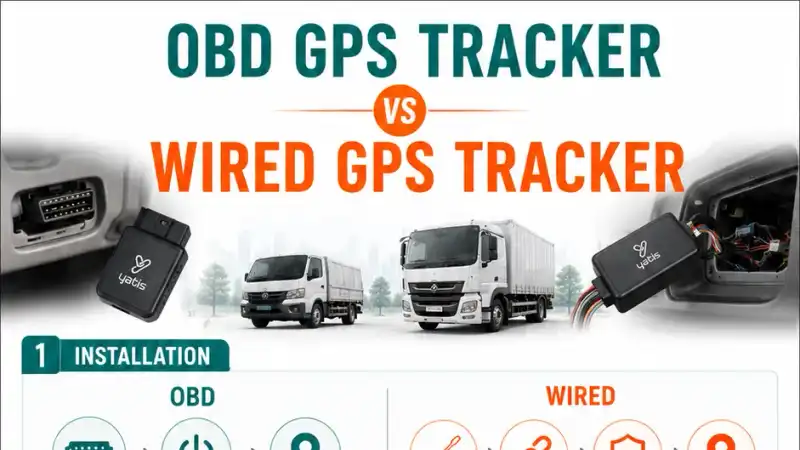
Feature Comparison
| Factor | OBD GPS Tracker | Wired GPS Tracker |
|---|---|---|
| Installation | Plug-and-play | Professional installation |
| Installation Time | Very short | Longer |
| Vehicle Wiring | Not required | Required |
| Power Source | OBD port | Vehicle electrical system |
| Device Visibility | Usually accessible | Can be concealed |
| Tamper Resistance | Moderate | Higher |
| Relocation | Easy | More difficult |
| Replacement | Easy | Requires installation |
| Long-Term Deployment | Good | Excellent |
| Temporary Deployment | Excellent | Less suitable |
| Fleet Security | Moderate | Stronger |
| Best For | Flexible deployment | Permanent fleet tracking |
Cost vs Long-Term Value
OBD GPS trackers can reduce installation costs because they require minimal setup, while wired GPS trackers may have higher installation costs but can provide greater long-term security and deployment stability. The cheapest installation isn't necessarily the most cost-effective solution.
Businesses should consider the total cost of ownership, including device cost, installation cost, installation downtime, device replacement, relocation requirements, maintenance, and potential tracking interruptions.
An OBD tracker's lower deployment friction makes it attractive when speed and flexibility outweigh permanent installation. A wired tracker's higher installation effort makes sense when security, permanence, and reliability outweigh installation convenience. The right choice depends on how the fleet actually operates. For a cost-and-scalability view of the same decision, see our companion guide on OBD vs hardwired GPS trackers for commercial fleets.
Decision Matrix
| Your Requirement | Recommended Option |
|---|---|
| Fast installation | OBD GPS Tracker |
| Plug-and-play deployment | OBD GPS Tracker |
| Frequently move devices | OBD GPS Tracker |
| Temporary tracking | OBD GPS Tracker |
| Permanent installation | Wired GPS Tracker |
| Better tamper resistance | Wired GPS Tracker |
| Concealed installation | Wired GPS Tracker |
| Long-term commercial tracking | Wired GPS Tracker |
| Large stable fleet | Wired GPS Tracker |
Common Mistakes When Choosing Between OBD and Wired GPS Trackers
The most common mistake is choosing a GPS tracker based only on installation convenience. Businesses should also evaluate vehicle compatibility, tamper resistance, deployment duration, relocation needs, power connection, and the level of tracking security required.
1. Choosing OBD Only Because It Is Easier to Install
OBD installation is fast, but convenience should not be the only consideration. If vehicles are permanently assigned and tracking continuity is critical, a concealed wired tracker may be more appropriate.
2. Choosing Wired Tracking When Vehicles Are Frequently Reassigned
A permanent installation can become inconvenient when vehicles frequently move between departments, projects, branches, customers, or short-term assignments. In these situations, the flexibility of an OBD tracker may provide greater operational value.
3. Assuming OBD Works With Every Vehicle
OBD trackers require a compatible diagnostic port. Before deployment, verify port availability, vehicle compatibility, device specifications, electrical characteristics, and physical accessibility. Do not assume that every commercial vehicle will support the same OBD configuration.
4. Ignoring Tamper Risk
If drivers or unauthorized personnel can easily access the tracker, accidental or deliberate disconnection can affect tracking continuity. For security-sensitive operations, consider whether the device should be visible and accessible, concealed, or permanently installed. This is one of the strongest arguments for wired installation in long-term commercial deployments.
5. Comparing Only Device Prices
A lower device price doesn't necessarily mean lower overall cost. Evaluate the complete deployment — device, installation, downtime, maintenance, relocation, and replacement — for a more realistic view of total ownership cost.
OBD vs Wired: Which One Is Better?
Neither OBD nor wired GPS tracking is universally better. OBD trackers are better when rapid deployment and flexibility are priorities, while wired trackers are generally better when permanent installation, concealment, and tamper resistance are more important. The decision should be based on the operating environment.
Choose OBD When Your Priority Is Flexibility
Choose an OBD tracker if you need fast installation, easy relocation, minimal vehicle modification, temporary tracking, or rapid fleet deployment.
Choose Wired When Your Priority Is Permanence and Security
Choose a wired tracker if you need concealed installation, greater tamper resistance, stable long-term deployment, permanent vehicle assignment, or stronger physical device security.
Buyer Checklist Before Purchasing
Before selecting a GPS tracking device, answer these questions:
Vehicle
- Does the vehicle have a compatible OBD-II port?
- Is the tracker intended for a passenger vehicle, commercial vehicle, or specialized equipment?
Deployment
- Is the tracker temporary or permanent?
- Will devices frequently move between vehicles?
Security
- Is tamper resistance important?
- Should the device remain concealed?
Operations
- Will vehicles remain assigned to the same fleet for years?
- How important is uninterrupted tracking?
Installation
- Can the business support professional installation?
- Is vehicle downtime during installation acceptable?
The answers will usually make the appropriate option clear.
Final Decision Guide
| If You Need... | Best Option |
|---|---|
| Installation within minutes | OBD GPS Tracker |
| Minimal installation effort | OBD GPS Tracker |
| Easy device relocation | OBD GPS Tracker |
| Temporary fleet deployment | OBD GPS Tracker |
| Permanent installation | Wired GPS Tracker |
| Concealed device placement | Wired GPS Tracker |
| Greater tamper resistance | Wired GPS Tracker |
| Long-term commercial deployment | Wired GPS Tracker |
| Stable vehicle assignment | Wired GPS Tracker |
Final Thoughts
OBD and wired GPS trackers both provide an effective way to connect vehicles to a GPS tracking platform, but they solve different deployment challenges.
OBD GPS trackers prioritize simplicity. They can be deployed quickly, moved between compatible vehicles, and used without extensive installation work. Wired GPS trackers prioritize permanence. They can be concealed, connected directly to the vehicle's electrical system, and are generally more appropriate when tamper resistance and long-term tracking continuity matter.
The right question isn't which GPS tracker is better — it's which installation method fits the way your fleet operates. For businesses that need rapid deployment and flexibility, OBD may be the more practical choice. For stable commercial fleets where security and permanent installation are priorities, wired tracking may provide the stronger fit.
Once the hardware decision is made, both device types can feed data into a broader GPS tracking system, where fleet managers can monitor vehicles, review trips, and manage fleet visibility from a centralized platform.
Frequently Asked Questions
Ready to get started?
Contact Yatis Telematics to find the right GPS tracker installation method for the way your fleet actually operates.
Contact Us →