

What Data Does a Telematics Device Collect From a Vehicle?

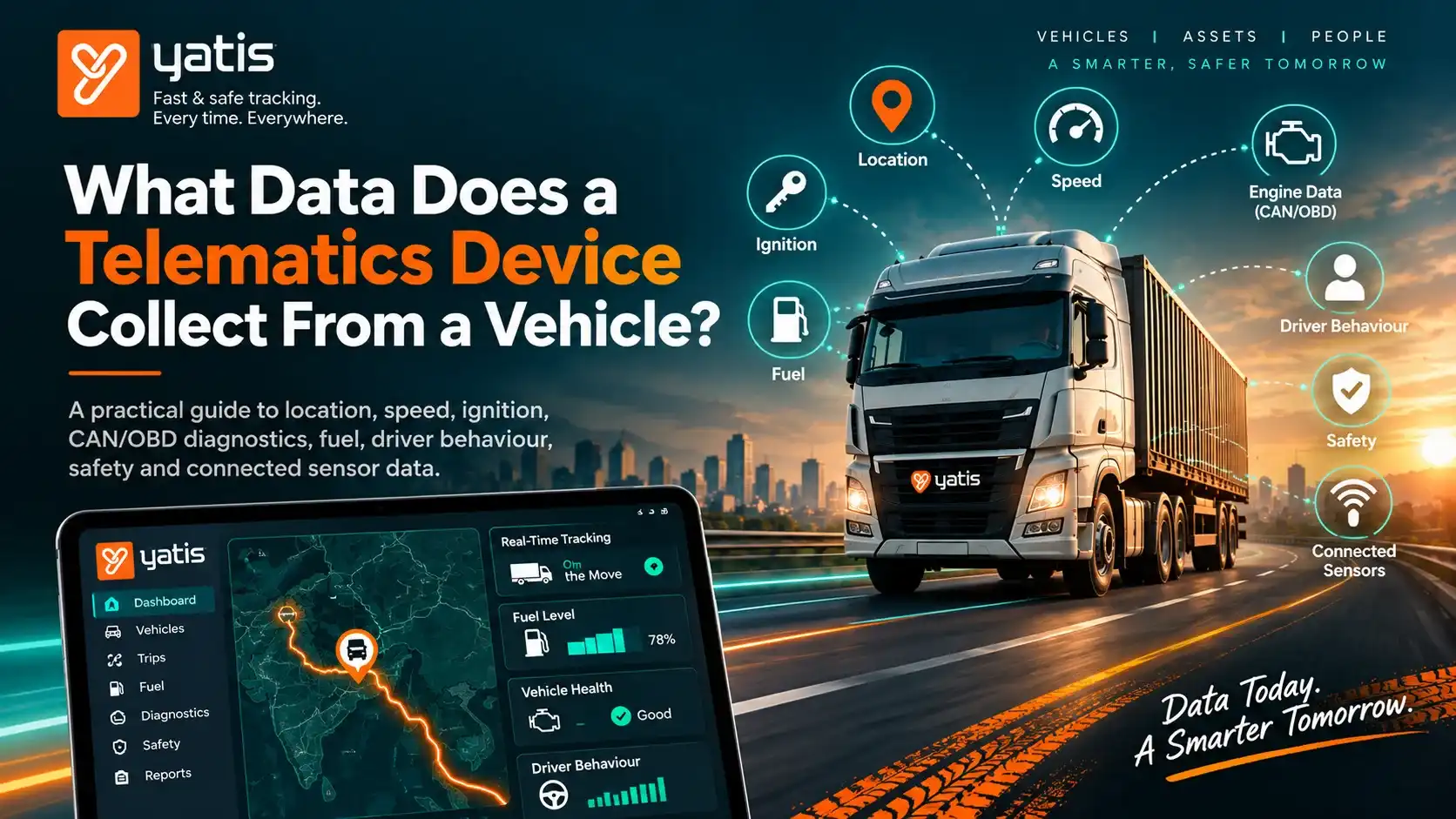
A telematics device can collect much more than a vehicle's location. Depending on the hardware, vehicle interface, sensors, connectivity and configuration, it may capture movement data, engine information, driving events, fuel-related signals and operational measurements.
Quick answer: Telematics data generally comes from three layers: positioning data from GPS/GNSS, vehicle data from ignition/CAN/OBD interfaces, and additional sensor data such as fuel, temperature, tyre pressure or video-derived events. Not every device supports every data type.
Why Telematics Data Matters
Location answers where is the vehicle? A richer telematics system helps answer how the vehicle is performing, why an issue may be occurring and what action a fleet manager should take.
These insights can support route adherence, driver coaching, fuel control, maintenance planning, utilisation and safety. Yatis combines GPS tracking, alerts, fuel monitoring, driver behaviour insights and reporting through its fleet GPS tracking platform.
1. Location and Movement Data
GPS/GNSS information
Typical fields include latitude, longitude, timestamp, speed, heading, movement status, trip start/end events, route history and stop locations. This supports live visibility, route playback, geofencing and ETA monitoring.
2. Speed, Distance and Trip Information
Depending on the system, telematics platforms can derive speed, distance travelled, driving time, trip duration, stop duration, dwell time and idle duration.
GPS speed, ECU speed and calculated distance may differ because of sampling frequency, signal quality, calibration and device configuration.
3. Ignition and Electrical Status
Possible fields include ignition on/off, engine-running status where available, battery or supply voltage, power interruptions and tamper/disconnection events.
The exact detection method depends on wiring, OBD data, voltage sensing and device design.
4. CAN Bus and OBD Data
CAN and OBD interfaces can provide deeper vehicle information than a location-only tracker. Depending on vehicle compatibility, supported parameters may include:
- Diagnostic Trouble Codes (DTCs)
- Engine RPM and temperature
- Battery voltage
- Engine load
- Fuel-related parameters
- Emission or system fault indicators
Yatis' OBD GPS Tracker is positioned around GPS tracking, diagnostics, driver behaviour analytics and maintenance-related insights. Confirm exact supported data points for each vehicle model.
Technical distinction: OBD is an access and diagnostic interface; CAN is a vehicle communication network. An OBD-connected device does not automatically expose every CAN signal or every parameter in a vehicle.
5. Fuel and Energy Data
Fuel information may come from CAN, vehicle signals, dedicated sensors or estimates. Possible fields include fuel level, consumption, refuelling events, sudden level changes and efficiency estimates.
A basic GPS tracker alone may not measure fuel accurately; sensor type, calibration and integration matter.
Yatis also provides fuel tracking, EV monitoring and connected-vehicle solutions.
6. Driver Behaviour Data
Many systems identify supported events such as overspeeding, harsh braking, rapid acceleration, excessive idling, sharp cornering and route deviation.
Metrics should be interpreted with context, including road conditions, traffic, vehicle type, thresholds and GPS limitations.
Explore Yatis' driver safety solution for driver-event monitoring and scorecards.
7. Safety and Emergency Events
Depending on hardware, a system may capture SOS/panic events, geofence alerts, overspeed alerts, ignition/tamper alerts, impact-related signals and video or AI-detected events.
A basic tracker cannot independently verify every type of incident. Configurable safety alerts help teams respond to exceptions such as geofence crossings, overspeeding and tamper events.
8. Sensor Data Beyond the ECU
External sensors and inputs extend telematics beyond engine data:
| Sensor / Input | Potential Data | Use Case |
|---|---|---|
| Temperature | Compartment / cargo temperature | Cold-chain monitoring |
| Tyre pressure | Pressure and temperature | Safety and maintenance |
| Fuel sensor | Tank level and changes | Fuel monitoring |
| Door sensor | Open / close events | Security and delivery control |
| Accelerometer | Motion / acceleration patterns | Event detection |
| Camera | Video and supported AI events | Incident review and safety |
For temperature-sensitive logistics, Yatis' reefer monitoring solution combines vehicle context with temperature monitoring and alerts. Explore the broader Yatis products range for connected-vehicle options.
9. From Raw Data to Fleet Intelligence
Raw signals become useful only after validation and processing:
- Capture: Device receives GPS, vehicle and sensor signals.
- Transmit: Data travels through supported cellular or IoT connectivity.
- Validate: The platform checks timestamps, missing fields and signal quality.
- Process: Rules derive trips, stops, events and metrics.
- Present: Dashboards, reports, alerts and APIs expose the information.
- Act: Teams investigate exceptions, coach drivers, schedule maintenance or change routes.
See the Yatis resources hub for related guides on fleet analytics, predictive fleet management and visibility beyond GPS.
The value of telematics is not the amount of data collected. It is the quality of the decisions that the data enables.
10. Is Telematics Data Always Real Time?
No. Data freshness depends on GPS sampling, event rules, cellular coverage, device power state, offline buffering, cloud processing and dashboard refresh behaviour.
A technical specification should define update intervals, offline storage, retransmission, timestamps and service availability.
11. Telematics Data Privacy and Governance
Telematics data can include location history, driver-related events, vehicle identifiers, video and operational information.
Organisations should define collection purpose, access rights, retention, sharing, deletion, audit controls and third-party integration rules. Requirements depend on the organisation, data and jurisdiction.
12. Practical Telematics Data Checklist
Use this checklist when comparing devices and platforms:
| Category | Questions to Ask |
|---|---|
| Location | Which positioning systems, update intervals and offline rules are supported? |
| Vehicle interface | Does the device use wired inputs, OBD, CAN or another interface? |
| Diagnostics | Which parameters and DTCs work with target vehicle models? |
| Fuel | Is fuel data sourced from CAN, a sensor or an estimate? |
| Driver behaviour | Which events and thresholds are configurable? |
| Sensors | Can temperature, tyre pressure or door sensors be integrated? |
| Security | What access controls, retention and audit features exist? |
| Integration | Are APIs, webhooks, CSV or MQTT supported? |
Frequently Asked Questions
Build Better Fleet Decisions With Connected Data
Yatis connects vehicle visibility, tracking, alerts, fuel monitoring, driver insights and operational analytics for commercial fleet environments. Explore the Yatis GPS Tracking System to turn telematics data into better fleet decisions.
Get Started Today →