

GPS Tracking for Mining Fleets: How Fleet Management Improves Mine Operations

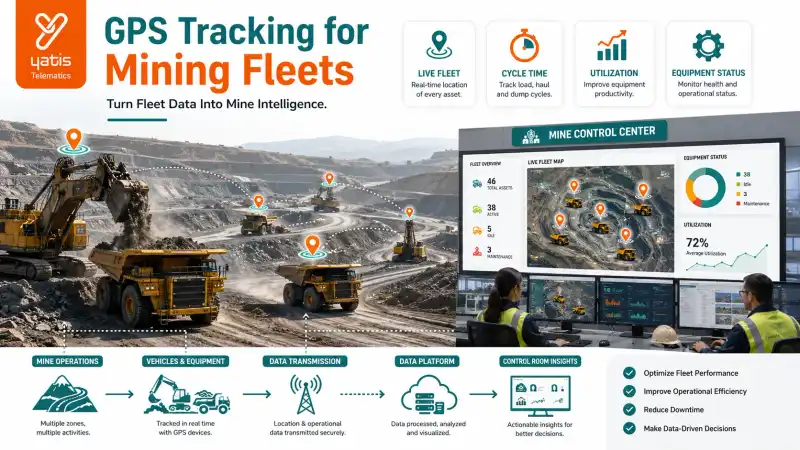
A mining operation can involve dozens or hundreds of moving assets. Haul trucks move material. Loaders feed trucks. Excavators and shovels load material. Drills prepare extraction areas. Graders maintain haul roads. Support vehicles move personnel, fuel and equipment.
When these machines operate simultaneously across a large mine, simply knowing where each vehicle is is not enough. Mine managers also need to understand which equipment is operating, which machines are waiting, where bottlenecks are developing, how long haul cycles are taking, whether equipment is assigned efficiently, where material is being moved, which assets are underutilized, and where operational delays are occurring.
This is where mining fleet management becomes more valuable than basic vehicle tracking. Modern mine fleet systems combine equipment location with operational information to provide a broader view of mine activity. Caterpillar, for example, describes fleet management as providing real-time visibility into cycle time, payload, machine location and material movement.
Quick Takeaways
- Real-time visibility of the entire mining fleet
- Haul-cycle monitoring from loading to dumping
- Faster identification of operational bottlenecks
- Reduced equipment waiting time at loading points
- Better equipment utilization and reassignment
- Material movement visibility across the mine
- Historical data for production analysis
What Is Mining Fleet Management?
Mining fleet management is the use of connected hardware, GPS or positioning technologies, telematics and fleet software to monitor and coordinate mining equipment and vehicles. It helps mine operators manage equipment location, utilization, haulage activity, assignments, delays and other operational metrics.
A simplified architecture runs: Mining Equipment → GPS / Telematics / Positioning → Communication Network → Fleet Management Platform → Mine Control and Operations Team.
The platform can turn individual equipment data points into an operational view of the mine. Instead of asking "Where is Truck 27?", the operations team can begin asking why Truck 27 is waiting, which loading point is creating the bottleneck, which truck should be assigned next, and how long the current haul cycle is running.
That is the difference between tracking equipment and managing a mining fleet.
Why GPS Tracking Matters in Mining
Mining sites are fundamentally different from ordinary road fleets. Equipment may operate across large open-pit sites, on dedicated haul roads, in remote areas, underground, around loading and dumping zones, and across changing work areas.
The scale and complexity make manual visibility difficult. A centralized tracking system can provide mine operators with a common operational view of equipment.
For surface mining, modern fleet systems can track machine locations and material movement while providing visibility into cycle time, payload and other operational parameters.
For underground mining, specialized positioning technologies may be required because conventional positioning approaches can behave differently underground. Caterpillar's underground fleet solution, for example, uses purpose-built high-precision positioning to track personnel and assets in underground environments. The mine environment should therefore be a key consideration when selecting the technology architecture.
What Mining Equipment Can Be Tracked?
Depending on the deployment and equipment compatibility, fleet-management systems can monitor:
| Equipment | Typical Operational Purpose |
|---|---|
| Haul trucks | Material transportation |
| Excavators | Excavation and loading |
| Wheel loaders | Loading and material handling |
| Bulldozers | Earthmoving |
| Drilling equipment | Production drilling |
| Graders | Haul-road maintenance |
| Water trucks | Dust suppression |
| Service vehicles | Fleet support |
| Fuel and service vehicles | Equipment support |
| Underground mining vehicles | Underground material movement |
The important point is that a mine fleet is rarely made up of only one equipment category. A useful fleet platform should therefore support mixed-fleet visibility where required.
Real-Time Equipment Visibility
Real-time fleet visibility allows mining operations teams to see where connected equipment is operating and identify its current status. This can help managers coordinate machines, identify delays and respond to changing operational conditions more quickly.
Without centralized visibility, the chain runs from equipment to site supervisor to radio or phone to control room. With centralized fleet monitoring, equipment reports directly into the fleet platform and appears on an operations dashboard.
The second model can reduce the dependence on manually communicating basic location information. More importantly, it allows different operational stakeholders to work from a common information source.
Monitor Haul Cycles
One of the most important mining-specific applications is understanding haul-cycle performance. A simplified haul cycle involves loading, loaded travel, dumping, empty return and repositioning.
GPS and fleet data can help establish how long equipment spends in different stages. This matters because a truck may spend less time actually hauling than expected. A truck waiting at the loader, loading, waiting at the dump point and returning may look busy while moving very little material.
The problem may not be the truck itself. The bottleneck could be loader availability, dump-point congestion, excessive travel distance, poor equipment assignment, shift changes or other operational delays. Modern mining fleet systems explicitly use cycle-time information to identify such operational gaps.
Reduce Equipment Waiting Time
Mining fleet management can help reduce equipment waiting time by showing where trucks and loading equipment are located, identifying operational bottlenecks, and supporting better equipment assignments and dispatch decisions.
Consider a loading area with one excavator and eight trucks. If the excavator can efficiently load only a smaller number of trucks at a time, additional trucks may spend time waiting. The reverse can also happen, with eight trucks and insufficient loading capacity elsewhere in the mine.
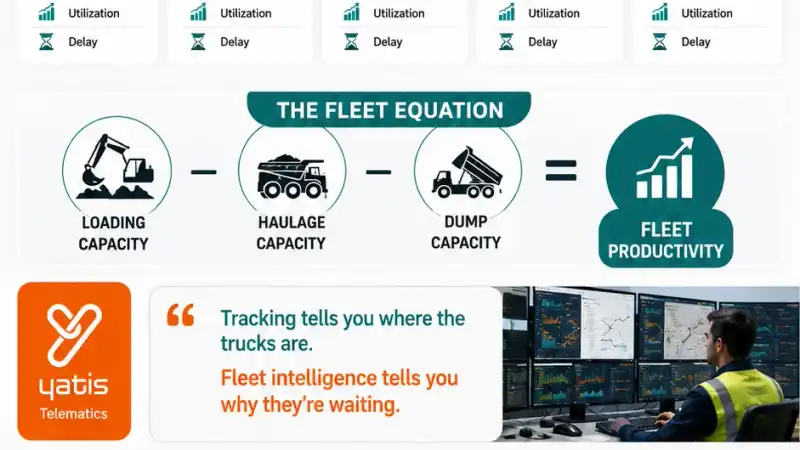
The fleet manager can use operational data to understand the imbalance. The goal is not simply to increase the number of trucks. It is to create a better relationship between loading capacity, haulage capacity and dump capacity.
Improve Equipment Utilization
Fleet tracking helps mining companies identify how equipment is being utilized by combining location and operational information. This can reveal idle equipment, excessive waiting, underused assets and opportunities to reassign machinery.
A machine that is physically present at a mine is not necessarily productive. One asset may be on site and available yet barely used, while another is on site, heavily utilized and frequently constrained. This information can influence equipment allocation decisions.
Caterpillar's mining fleet systems explicitly emphasize machine utilization and the ability to reassign equipment as operational requirements change.
Better Equipment Assignment
Mining operations change continuously. A truck may become unavailable. A loading area may become congested. A production target may change. A different material may need to be moved.
Fleet-management systems can help operations teams understand the current fleet situation and make more informed assignment decisions. Instead of relying solely on static schedules, planned assignment can evolve into data-informed assignment.
This is particularly valuable when equipment availability changes during a shift.
Track Material Movement
GPS tracking becomes more valuable when equipment movement is connected with the movement of material: loading point → haul route → dump point.
The objective is not merely to know that a truck moved. It is to understand where material was being moved and whether it followed the intended operational flow. Modern mining fleet platforms can combine equipment location with material movement information and, in some systems, payload and cycle data.
This can help identify misroutes, inefficient haul patterns, unexpected movement, incorrect material destinations and operational bottlenecks.
Surface vs Underground Mining Operations
The tracking environment matters a great deal when selecting a solution.
Surface Mining
Surface operations can involve large haul roads, open-pit equipment, long travel distances, loading and dumping zones, and large fleets operating simultaneously. Fleet systems can provide real-time visibility into equipment location, cycles, payload and material movement.
Underground Mining
Underground operations introduce additional challenges. Traditional positioning and communication approaches may not work identically underground, so specialized mine-tracking infrastructure may be required. Caterpillar describes purpose-built underground positioning technology for tracking personnel and assets, while Hexagon describes systems designed to track machines and miners in underground environments.
A mining company should therefore not assume that a generic road-fleet GPS solution will automatically provide the same functionality underground.
Mining Fleet Tracking and Operational Delays
A useful fleet-management system should help answer a single practical question: where is the delay occurring?
Potential delay points include loading, haulage, dumping, refueling, shift changes, equipment availability and traffic around loading areas.
Modern mine fleet systems are designed to expose operational delays and bottlenecks rather than simply display asset locations. This transforms fleet data into an operational diagnostic tool. For mines exploring wider digitization, our guide on IoT and AI in mine operations covers the next layer.
Key Benefits of Mining Fleet Management
| Capability | Mining Benefit |
|---|---|
| Real-time equipment visibility | Know where assets are |
| Cycle monitoring | Understand haul performance |
| Equipment utilization | Identify underused assets |
| Assignment visibility | Improve fleet coordination |
| Delay identification | Locate bottlenecks |
| Material movement monitoring | Improve haulage control |
| Historical data | Analyse past operations |
| Centralized dashboard | One operational view |
| Mixed-fleet visibility | Coordinate different equipment types |
What Should a Mining Company Look for in a Fleet Management Solution?
Mining companies should evaluate the operational environment, not just the GPS device.
1. Mine Type
Is the operation surface, underground, or mixed?
2. Fleet Composition
Can the system support haul trucks, loaders, excavators, drills and support vehicles together?
3. Positioning Environment
Can the technology operate effectively across the mine's specific environment?
4. Connectivity
What communication infrastructure is available across the mine?
5. Operational Data
Does the system provide only location, or can it support broader fleet information?
6. Cycle Visibility
Can operations teams analyse loading, hauling and dumping cycles?
7. Scalability
Can the platform grow as equipment and production requirements increase?
GPS Tracking vs Full Mining Fleet Management
This distinction is critical when evaluating solutions.
Basic GPS Tracking
Primarily answers one question: where is the vehicle?
Mining Fleet Management
Can answer where the equipment is, what it is doing, how long the cycle is running, where the delays are, how the fleet is being utilized, and how material is moving.
That is why mining operations should evaluate GPS tracking as one component of a broader fleet-management architecture.
Who Benefits From Mining Fleet Management?
Mine Managers
Get a consolidated view of fleet operations.
Dispatch Teams
Can coordinate equipment assignments more effectively.
Production Teams
Can analyse haulage and cycle performance.
Maintenance Teams
Can understand equipment activity and availability when integrated with relevant machine data.
Operations Leadership
Can use fleet data to identify productivity gaps and operational trends.
The Business Value of Mining Fleet Tracking
The commercial value isn't simply "we know where our trucks are." It is a chain: location produces operational visibility, which produces bottleneck identification, which produces better fleet decisions, which produces higher productivity potential.
Modern mining technology providers increasingly position fleet management around this broader operational intelligence. Hexagon, for example, describes mine fleet management as a means of maximizing fleet effectiveness while improving safety, while Caterpillar highlights fleet visibility, utilization, assignment and productivity.
Final Thoughts
Mining fleets operate in environments where equipment movement, production cycles and operational coordination directly influence productivity.
GPS tracking provides the foundational visibility needed to know where machines are operating. But the greater opportunity comes when location information is connected with operational data. That enables mining companies to move from "Where is my equipment?" to "How effectively is my fleet operating?"
A modern fleet management solution can bring together equipment visibility, operational monitoring and historical data to help mine teams identify bottlenecks, improve equipment utilization and make better allocation decisions.
For mining companies, GPS tracking is therefore not simply an asset-location technology. It can become part of a broader mine operations intelligence layer.
Frequently Asked Questions
Ready to get started?
Contact Yatis Telematics to learn how mining fleet management can turn equipment location into measurable productivity gains.
Contact Us →