

What Is Telematics? A Complete Guide for Indian Fleet Managers in 2026

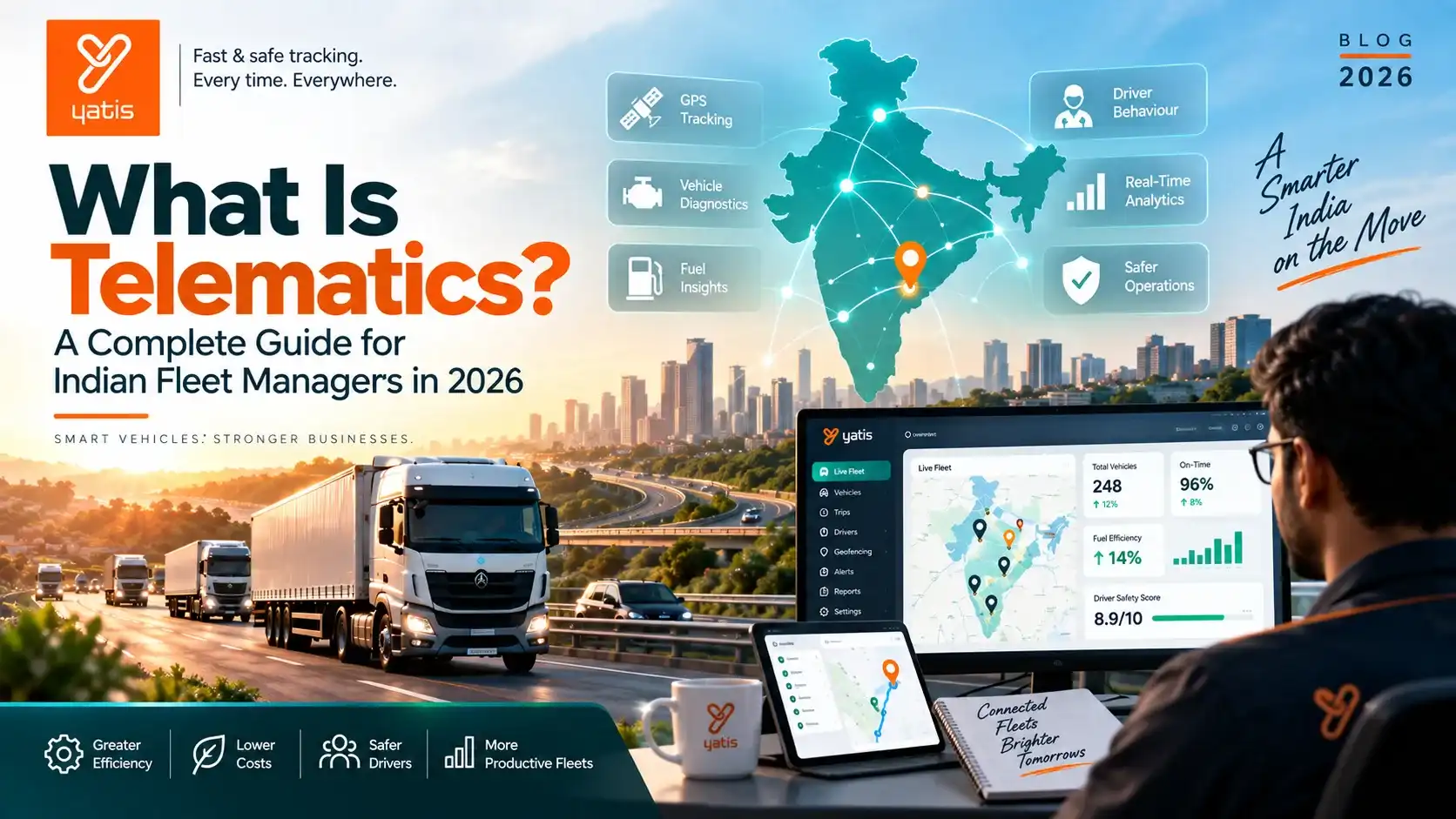
Telematics is much more than a GPS dot on a map. This India-first guide explains how vehicle data moves from sensors and onboard systems to software — and how fleet managers can turn that data into visibility, safety, compliance and operational intelligence.
If you have searched for “what is telematics?”, you have probably encountered a surprisingly broad set of answers. Some describe telematics as GPS tracking. Others focus on vehicle diagnostics, driver behaviour or connected-car technology.
All of those descriptions touch part of the picture. Telematics is the connected technology layer that collects information from a vehicle or remote asset, communicates that information over a network, and makes it available for monitoring, analysis or control.
For an Indian fleet manager, that distinction matters. A tracking device can tell you where a truck is. A telematics system can help you understand where it went, what the vehicle reported, what happened during the trip and which events require attention. A basic GPS tracking system provides location visibility, while telematics connects that location with vehicle and operational context.
Telematics = connected vehicle data + communication + software intelligence. In fleet operations, the result can be a continuous data loop between the vehicle, the network and the people or systems managing the fleet.
The simplest way to remember it: GPS answers “where?” Telematics can connect “where?” with “what happened?”, “how?”, “why?” and “what should we do next?”
What Is Telematics?
The word telematics comes from the combination of telecommunications and informatics. In practical vehicle operations, it refers to technologies that collect, transmit, process and present information from connected vehicles or assets.
A modern vehicle telematics system may combine a GNSS receiver, vehicle interfaces, sensors, communication hardware and cloud software. The exact configuration depends on the vehicle, application and level of intelligence required. Explore the broader telematics product ecosystem to see how hardware, connectivity and software fit together.
Fleet telematics is the application of this technology across multiple vehicles or assets. Instead of viewing one vehicle as an isolated unit, fleet managers can compare vehicles, trips, routes, drivers and operational events in one environment.
You may also see the search term “telemetatics”. It is commonly used as a misspelling of “telematics”; the established technical term is telematics.
How Does a Telematics System Work?
Think of telematics as a pipeline rather than a single device. Data originates in the vehicle, moves through communication infrastructure, reaches a software platform and is then converted into information that a person or another system can use.
Telematics Architecture: From Vehicle to Decision
| Stage | Layer | Function |
|---|---|---|
| 01 | Vehicle and Sensors | GNSS, CAN, OBD, accelerometer and connected sensors generate signals |
| 02 | Telematics Control Unit | Collects, timestamps and packages vehicle data for transmission |
| 03 | Network and Cloud | Cellular and IP communication, data ingestion and processing |
| 04 | Software Intelligence | Analyse with rules and analytics, visualise on maps and dashboards, trigger alerts, and integrate through APIs |
1. Data Is Generated
The vehicle and connected equipment produce signals: location, speed, heading, ignition state, engine information, fault codes, driver events, fuel-related signals or external sensor readings.
2. The Telematics Unit Collects the Signals
The onboard telematics device acts as the collection and communication point. It can combine positioning data with vehicle or sensor information and prepare it for transmission.
3. Data Is Transmitted
Communication hardware sends the information to a backend platform, typically through cellular connectivity. Requirements vary by geography, update frequency and hardware design.
4. Software Turns Signals Into Information
The platform processes incoming data and can transform raw signals into trips, routes, geofences, alerts, reports and analytics. Advanced systems can apply rules, models or AI to identify patterns. Configured tracking alerts and event rules help teams surface exceptions, while mobile apps extend that visibility to field teams.
5. People and Systems Act on It
The final value is not the data itself. It is what the fleet team does with it: responding to alerts, investigating deviations, scheduling maintenance, improving routes or integrating data into another workflow.
What Data Does Telematics Collect?
There is no single universal telematics dataset. The information available depends on the device, vehicle interface, sensors, firmware, configuration and software platform.
| Category | Examples | Source Layer |
|---|---|---|
| Location and movement | Latitude and longitude, direction, speed, trip history, stops, routes, geofences and movement status | GNSS and GPS |
| Vehicle signals | Ignition, engine-related parameters, fault information and other signals exposed through vehicle interfaces | CAN and OBD |
| Driver events | Depending on configuration: speeding, harsh acceleration, harsh braking, cornering and other defined driving events | Motion sensing plus rules |
| Fuel and energy | Depending on vehicle and integration: fuel-related readings, consumption indicators, battery information and energy data | Vehicle interfaces and sensors |
| Safety and emergency | Panic or SOS events, tamper conditions and other configured safety signals, especially relevant to regulated applications | Safety layer |
| External sensors | Temperature, door status, tyre-related data, cargo conditions or other sensor inputs depending on deployment | IoT sensors |
Important: Do not assume a telematics device automatically provides every data point above. Ask exactly which signals the hardware captures, how frequently they are sampled, how they are transmitted and whether the data remains accessible through the platform or API. For diagnostic-oriented deployments, review OBD-based fleet intelligence options alongside wired alternatives.
GPS vs CAN vs OBD vs IoT: How Do They Fit Into Telematics?
These terms are often mixed together in vendor presentations. They are not interchangeable; they represent different layers or data sources.
| Technology | What It Primarily Provides | Role in Telematics |
|---|---|---|
| GNSS and GPS | Position, movement, speed and time-related information | Creates the location and movement layer |
| CAN bus | Vehicle network messages from electronic control systems | Can expose deeper vehicle parameters depending on access and vehicle model |
| OBD | Standardised diagnostic interface on supported vehicles | Provides a practical interface for diagnostics and selected vehicle data |
| IoT sensors | External physical conditions or states | Extends telematics into cargo, environment and equipment |
| Cellular and IP | Data communication | Moves telematics data from asset to backend |
A useful distinction: GPS is a positioning technology. OBD and CAN are vehicle data interfaces. IoT sensors extend what can be measured. Telematics is the connected system that can bring these layers together.
Why CAN Data Can Be Valuable
CAN, or Controller Area Network, is a communication system used by vehicle electronic control units. Access to relevant CAN signals can provide information a location-only tracker cannot see. What is available varies by vehicle and integration.
Why OBD Is Different
OBD, or On-Board Diagnostics, provides access to diagnostic information through a vehicle interface. It can be useful for selected applications, but available parameters should be validated for the exact vehicle population. Learn more about OBD GPS trackers for commercial vehicle intelligence.
Where IoT Sensors Add Value
Some fleet problems are not visible from vehicle electronics. Cold-chain operations may require temperature sensors; cargo operations may need door sensors. IoT extends the measurement layer beyond the vehicle itself. For temperature-sensitive cargo, see reefer monitoring solutions.
What Are the Benefits of Fleet Telematics?
The business case changes by fleet type. A logistics operator may prioritise route visibility and fuel control; a school transport operator may prioritise safety and route monitoring; a field-service organisation may prioritise job visibility and technician workflows.
- Visibility: Know where assets are and understand historical movement.
- Safety: Identify defined driving events and support targeted intervention. See driver safety tracking for safety workflows.
- Control: Use alerts and geofences to surface exceptions. Configurable alerts help teams act on deviations.
- Maintenance: Use available vehicle data to support maintenance decisions.
- Compliance: Support regulated tracking requirements where applicable.
- Integration: Move fleet data into ERP, dispatch, CRM or analytics systems. Route performance can be further improved with route optimization.
The strategic shift is from visibility to action. A dashboard showing hundreds of vehicles without helping an operator prioritise work is generating information without necessarily generating intelligence.
Where Is Telematics Used in India?
Telematics is not limited to logistics trucks. Its usefulness comes from adapting the data layer to the operating problem.
Logistics and Transportation
Live fleet visibility, trip monitoring, route deviation, geofencing, driver events, fuel-related monitoring and operational reporting. Teams often combine this with route optimization practices to manage deviations and delays.
School Bus and Employee Transport
Route monitoring, vehicle visibility, schedule awareness, safety events and controlled journey information. Regulated applications may also require certified tracking.
Field Service and Mobile Workforce
Connect vehicle movement with job schedules, customer locations and technician workflows to understand travel patterns and exceptions.
Construction and Off-Road Assets
Monitor equipment and mobile assets for location, utilisation, unauthorised movement and operating conditions where suitable sensors are available.
Cold-Chain Logistics
External IoT sensors can extend vehicle telematics into cargo conditions, associating temperature or other environmental readings with journeys. Dedicated reefer solutions address cold-chain visibility.
Commercial and Regulated Passenger Transport
Support vehicle tracking, emergency signalling, operational visibility and compliance workflows where mandated standards and state-level processes apply.
Electric and Connected Fleets
EV-oriented telematics can combine movement with available battery, charging and energy information, depending on vehicle integration.
India-first consideration: vehicle types, cellular conditions, state processes, regulatory requirements, OEM interfaces, installation practices and local support can materially affect the right telematics architecture.
What KPIs Can Fleet Telematics Track?
Telematics can generate hundreds of data points. Fleet managers rarely need hundreds of KPIs. Select measurements that correspond to operational decisions.
| Objective | KPI Examples | Question It Answers |
|---|---|---|
| Visibility | Active vehicles, trip status, route status, geofence events | What is happening? |
| Safety | Speeding, harsh events, safety exceptions | Where are recurring risks? |
| Utilisation | Operating hours, trips, distance, availability | Are assets being used effectively? |
| Fuel and energy | Fuel indicators, idle time, consumption trends | Where are avoidable consumption patterns? |
| Maintenance | Fault events, vehicle health, downtime | Which assets require attention? |
| Service | On-time events, route adherence, stop duration | Are commitments being met? |
| Compliance | Tracking status, alerts, device health | Is the tracking layer functioning? |
For broader fleet-management content, explore the Yatis resource library. This article intentionally focuses on the definition and architecture of telematics rather than repeating a full fleet-productivity framework.
How to Choose a Telematics Platform in India
Do not begin with a feature-count comparison. Start with the operational problem, then test whether the hardware, data layer and software can solve it.
- Define the fleet and use case: vehicle types, fleet size, geography, operating hours, regulations and decisions the platform must support.
- Validate hardware compatibility: check vehicle models, installation, power, GNSS, CAN and OBD access and external sensor support.
- Check data quality and frequency: ask about location accuracy, update intervals, offline buffering, timestamps and behaviour during connectivity loss.
- Evaluate software, not only the device: test dashboards, maps, reports, alerts, user roles, historical data and exception handling. Field access through mobile apps is often essential.
- Check configuration flexibility: can you define geofences, alerts, rules, roles and reports without depending on the vendor for every change?
- Ask about APIs and integrations: confirm connectivity with ERP, TMS, dispatch, CRM, HR and analytics systems.
- Verify India-specific requirements: for regulated deployments, validate current certification, government integration and state process.
- Understand security and data ownership: ask about authentication, access controls, encryption, backups, retention and portability.
- Calculate total cost of ownership: include device, installation, connectivity, subscription, support, replacements, integrations and scaling.
- Test support and scalability: evaluate onboarding, installation, replacement, escalation, response times and fleet-growth readiness.
The Telematics Buyer Decision Tree
| Step | Question | Focus Area |
|---|---|---|
| A | What must I solve? | Visibility, safety, compliance, cost, maintenance or integration |
| B | What data is required? | GNSS, vehicle signals, sensors, events and external systems |
| C | Can the platform turn it into action? | Alerts, workflows, analytics, reports and APIs |
Yatis maintains a resource library covering fleet management, IoT, telematics, compliance and technical guides. For procurement, use a structured vendor comparison rather than choosing based on device price alone.
What About AIS-140?
For Indian fleet managers, AIS-140 deserves a separate distinction because compliance and telematics are related but not synonymous.
AIS-140 defines technical requirements for applicable vehicle tracking systems. A telematics platform can use location and other vehicle data for a much wider set of operational applications. An AIS-140-compliant tracking layer may therefore be part of a connected fleet architecture, but compliance alone does not deliver the operational intelligence, analytics and workflow integration that telematics enables.
If your deployment has a compliance requirement, review AIS-140 fleet management options and validate current certification, device approvals and government integration for your state and vehicle category.
Telematics vs GPS Tracking vs Fleet Management
These three terms are often used interchangeably, but they describe different scopes. GPS tracking is a component, telematics is the connected data architecture, and fleet management is the operational discipline supported by software.
| Aspect | GPS Tracking | Telematics | Fleet Management |
|---|---|---|---|
| Primary focus | Position and movement visibility | Connected vehicle, sensor and event data | Planning, execution and optimisation of fleet operations |
| Data sources | Mainly GNSS location, speed and heading | GNSS plus CAN, OBD, sensors, driver events and communications | Telematics data plus orders, schedules, costs and workforce inputs |
| Typical outputs | Live map, trip history, geofences and basic alerts | Diagnostics, events, analytics, alerts, reports and APIs | Dispatch, maintenance, compliance, cost and performance workflows |
| Best fit | Teams that need reliable location awareness | Teams that need vehicle context with location | Teams managing the full operating lifecycle |
A GPS tracking system can be the right starting point for visibility. Telematics builds on that foundation when you also need vehicle signals, sensor context and deeper analytics, while a fleet management approach connects those inputs to daily decisions. Safety programmes, for example, often pair location with driver safety monitoring.
Telematics Outlook for 2026
Looking toward 2026, Indian fleets are moving from isolated tracking deployments toward connected platforms. The emphasis is shifting from collecting more signals to improving data quality, integration and decision support.
- Deeper vehicle integration: wider use of CAN, OBD and EV-related signals where vehicle access allows.
- Sensor expansion: continued adoption of temperature, door, fuel and equipment sensors for cargo and asset context.
- Actionable software: greater focus on exception handling, role-based dashboards and API connectivity.
- Compliance-aware architectures: aligning regulated tracking layers with broader operational analytics.
The fleets that gain the most will be those that define clear use cases first and then select hardware, connectivity and software that support those decisions.
Frequently Asked Questions About Telematics
Conclusion: From Visibility to Operational Intelligence
Telematics answers a broader question than “where is my vehicle?” It connects location with vehicle behaviour, sensor context and operational events so fleet managers can prioritise safety, control costs, support compliance and improve service.
Start with the decision you need to improve, validate that the hardware and data layer can support it, and choose software that turns signals into action. To continue exploring, visit the resources library or review the broader Yatis product range.
Build Your Telematics Stack With Yatis
Choosing a telematics platform for Indian fleets means balancing hardware compatibility, data quality, connectivity, analytics and support. Talk to Yatis about your vehicles, routes and operating goals, and build a telematics stack that scales with your fleet.
Get Started Today →