

Digital Twin for Fleet Operations: How Virtual Fleet Models Can Improve Decision-Making

Fleet managers already use dashboards to answer one question: where are my vehicles? Analytics helps answer a second: how is my fleet performing? Predictive fleet management asks a third: what might happen next?
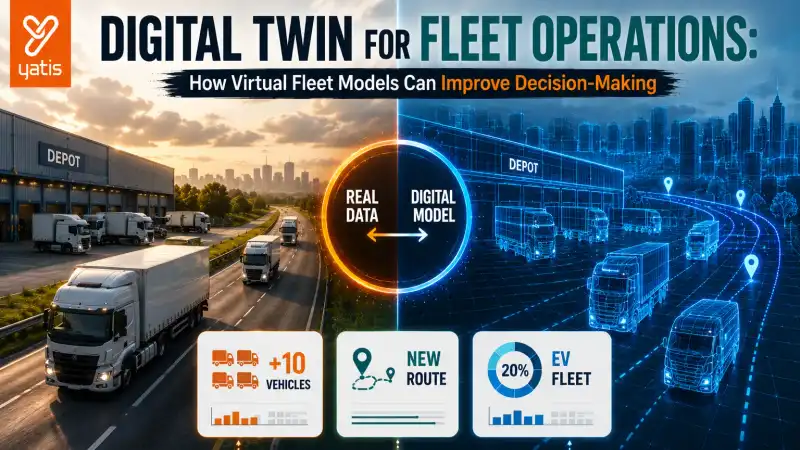
A digital twin introduces another question entirely — what could happen if I change something? That is what makes digital twins particularly interesting for fleet operations. Instead of experimenting on the physical fleet first, operators can increasingly use data-driven virtual models to evaluate possible scenarios.
What Is a Digital Twin for Fleet Operations?
A fleet digital twin is a virtual representation of a real-world fleet that is connected to relevant operational data and can be used to understand current conditions, evaluate scenarios and model potential future outcomes.
Think of it as a chain of relationships: Real Fleet → Real-World Data → Virtual Fleet Model → Analysis and Simulation → Operational Decision.
A fleet twin can represent relevant elements such as:
- Vehicles
- Routes
- Utilization
- Operating conditions
- Fleet capacity
- Maintenance information
- Energy or fuel use
- Operational constraints
The exact scope depends on the use case. A digital twin doesn't necessarily need to model every component of every vehicle to be useful. It should model the elements that matter to the decision being made.
Digital Twin vs GPS Tracking: What's the Difference?
This is probably the most important distinction for a GPS-focused audience.
GPS tracking tells you: where is the vehicle?
GPS tracking establishes position, movement and journey history.
Fleet analytics tells you: what happened?
Fleet analytics converts that data into KPIs and trends.
Predictive analytics tells you: what might happen?
Predictive fleet management uses patterns to anticipate future outcomes.
Digital twin technology asks: what could happen if we change something?
For example, a GPS system might show 20 vehicles currently operating. Analytics might show three vehicles are consistently underutilized. Predictive analysis might suggest demand may exceed current capacity next month. A digital twin could allow the operator to explore what happens if we add two vehicles, or what happens if we move three vehicles to another depot.
That's the conceptual leap.
A Digital Twin Is Not Just a Fleet Dashboard
A dashboard displays information. A digital twin uses that information as part of a model of the real operation. This distinction matters.
A dashboard shows the current state. A digital twin represents the system and can be used to evaluate possible states. The Digital Twin Consortium describes digital twins as integrated, data-driven virtual representations that use real-time and historical data and can support simulation of predicted futures.
So a digital twin doesn't become a digital twin simply because a dashboard has vehicle icons, live GPS, charts, sensors or a 3D interface. The key capability is the connection between the real system, its data representation and the model used for analysis or simulation.
How Does a Fleet Digital Twin Work?
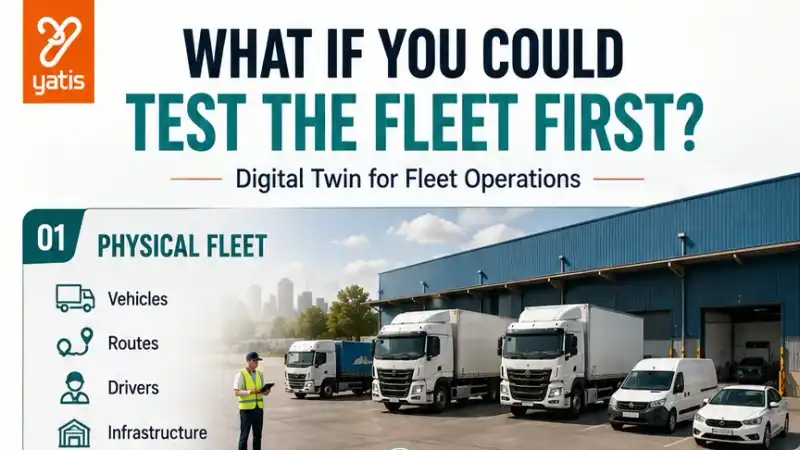
A simplified architecture moves through five stages.
Physical Fleet
Vehicles, drivers, routes, depots and infrastructure.
Data Layer
GPS, telematics, diagnostics, operational data and historical records.
Digital Model
A virtual representation of fleet operations.
Simulation and Analysis
Test scenarios, compare outcomes and evaluate constraints.
Decision
Change allocation, modify routes, plan capacity, evaluate infrastructure or adjust operations.
The decision is then implemented on the real fleet, and the real-world result generates new data. That creates a continuous feedback loop: real world → digital model → decision → real world.
What Data Can Feed a Fleet Digital Twin?
There is no single universal data requirement. The model depends on what the organisation wants to simulate.
Vehicle Data
- Location
- Speed
- Mileage
- Operating hours
- Diagnostics
Operational Data
- Trips
- Routes
- Stops
- Delivery schedules
- Vehicle assignments
Fleet Data
- Vehicle availability
- Capacity
- Utilization
- Maintenance status
Environmental and External Data
- Traffic
- Weather
- Terrain
- Energy infrastructure
- Charging availability
The principle is simple: the twin needs enough relevant data to represent the part of the operation being evaluated.
The Most Valuable Capability: What-If Scenarios
Scenario modelling is one of the most important applications of digital twins in fleet operations. Fleet managers regularly make decisions such as whether to add vehicles, change a route, move vehicles between locations, introduce EVs, or where charging infrastructure should be installed.
These decisions can be expensive to reverse. A digital twin can provide a virtual environment for evaluating alternatives. For example, Scenario A might be the current fleet of 100 vehicles, Scenario B might add 10 vehicles, and Scenario C might add 10 vehicles alongside a change in depot allocation. Each can then be compared on cost, capacity, utilization, service level and energy or fuel consumption.
The objective isn't to predict the future with certainty. It is to compare possible futures before committing resources. Scenario management is specifically identified as a key digital-twin capability for fleet operations because proposed operational changes can be tested against models and operational data before implementation.
Digital Twins for Fleet Capacity Planning
Consider a delivery operation expecting higher demand. A traditional planning process might ask how many vehicles we think we need. A digital twin frames this differently.
Starting from a current state of 100 vehicles at 78% utilization, the operator can model adding five vehicles, adding ten vehicles, or reallocating existing vehicles — then compare fleet utilization, capacity, cost, service levels and operational constraints across each option.
This makes fleet expansion a scenario-analysis problem rather than purely an intuition-based decision.
Digital Twins and Fleet Electrification
Digital twins are particularly interesting for electric fleets because operators must consider multiple interconnected variables:
- Vehicle range
- Route length
- Energy consumption
- Vehicle load
- Charging locations
- Charging time
- Depot capacity
- Operating schedules
Recent research has used digital-twin and co-simulation approaches to evaluate electric-truck routing and charging infrastructure under real operational conditions.
A fleet operator could therefore explore what happens if 20% of the fleet becomes electric, then change the assumptions to 40% and 60% while evaluating how different charging and routing scenarios affect operations. This is far more useful than treating electrification as simply replacing a diesel vehicle with an EV.
Digital Twin vs Fleet Analytics
These technologies answer different questions.
| Technology | Main Question |
|---|---|
| GPS Tracking | Where is it? |
| Fleet Analytics | What happened? |
| Predictive Analytics | What may happen? |
| Digital Twin | What could happen if we change something? |
This is why a digital twin shouldn't replace analytics. It builds on the data and models produced by the broader fleet technology stack.
Digital Twin for Route and Operational Planning
Routes don't exist in isolation. A route decision can affect vehicle utilization, driver hours, fuel or energy consumption, delivery times, vehicle availability and maintenance cycles.
A digital twin can model these relationships. For example, what happens if Route A is moved from Vehicle 12 to Vehicle 18? The model could evaluate the change against relevant constraints and performance measures. This is particularly valuable when fleet operations become too complex for simple spreadsheet-based scenario planning, and it complements conventional route optimization.
Research into transportation digital twins is increasingly exploring real-time transportation modelling, simulation and disruption analysis.
Digital Twin for Maintenance Planning
A digital twin can also support maintenance scenarios. Suppose Vehicle 42 is currently available. Scenario A services it tomorrow. Scenario B services it next week. Scenario C assigns its scheduled work to another vehicle during maintenance.
The question becomes: which option creates the least operational disruption? This is different from simply predicting that maintenance may be needed. Prediction identifies the potential issue; simulation can help evaluate how to respond.
What a Fleet Digital Twin Should Not Be Confused With
Several technologies can look similar but aren't identical.
GPS Tracking
Tracks location.
Fleet Dashboard
Visualizes fleet information.
Digital Model
Represents an asset or operation virtually.
Simulation
Models possible scenarios.
Digital Twin
Connects the virtual representation to its real-world counterpart through relevant data and uses that relationship for ongoing understanding, analysis and potentially simulation.
The distinction becomes especially important because "digital twin" is increasingly used as a marketing label. A sophisticated visual interface alone doesn't make something a digital twin.
Does a Digital Twin Need AI?
Not necessarily. AI can enhance a digital twin, but it is not the definition of a digital twin. A fleet twin can use rules, mathematical models, simulation, historical data, optimization algorithms, machine learning or AI depending on the problem.
Keeping these concepts separate makes the technology easier to understand. The digital twin is the connected virtual representation and modelling environment. AI is one possible intelligence technology used within it. Predictive analytics is one possible analytical capability.
What Are the Practical Benefits?
The value of a fleet digital twin ultimately comes from better decision-making. Potential applications include:
- Fleet planning — test different fleet sizes.
- Capacity planning — model demand and resource requirements.
- Route planning — evaluate operational alternatives.
- Electrification — model EV deployment and charging scenarios.
- Maintenance — evaluate maintenance timing and operational impact.
- Infrastructure — assess depot and charging requirements.
- Operations — test changes before implementing them.
The common principle: make expensive operational decisions in a virtual environment before making them in the physical one.
The Digital Twin Decision Loop
A useful way to understand the technology is as a repeating cycle.
- Observe — collect real-world fleet data.
- Represent — update the virtual fleet model.
- Simulate — test potential scenarios.
- Compare — evaluate outcomes and constraints.
- Decide — select an operational approach.
- Implement — apply the decision to the real fleet.
- Learn — feed the resulting real-world data back into the model.
This creates a continuous cycle rather than a one-time simulation.
What Should Businesses Consider Before Building a Fleet Digital Twin?
A digital twin isn't something every fleet needs immediately. Before considering one, ask:
1. What decision are we trying to improve?
If there is no meaningful decision to simulate, a digital twin may add unnecessary complexity.
2. Do we have usable data?
Poor or disconnected data will limit the model.
3. What level of detail is actually necessary?
Not every vehicle component needs to be modelled.
4. Can the model be validated?
A simulation should be compared against real-world outcomes.
5. Can the output influence operations?
The purpose is better decisions, not a more impressive dashboard.
Where Digital Twins Fit Into the Fleet Technology Stack
Conclusion
A fleet digital twin isn't simply a 3D version of a fleet dashboard. Its value comes from connecting a virtual representation of fleet operations with real-world data and using that model to analyse or simulate scenarios.
That creates a new way to approach fleet decisions. Instead of "let's make the change and see what happens," fleet managers can increasingly ask what the model suggests could happen under each scenario. This can be particularly valuable for decisions involving fleet capacity, vehicle allocation, routes, maintenance, electrification, charging infrastructure and operational planning.
GPS shows the fleet. Analytics explains the fleet. Predictive models anticipate the fleet. A digital twin lets you experiment with the fleet without changing the physical fleet first. And that makes digital-twin technology particularly relevant as fleet operations become more connected, complex and data-driven.
Frequently Asked Questions
Ready to get started?
Contact Yatis Telematics to learn how connected fleet data can support better operational decisions across your fleet.
Contact Us →