

AI-Powered GPS Tracking Systems: What AI Adds Beyond GPS

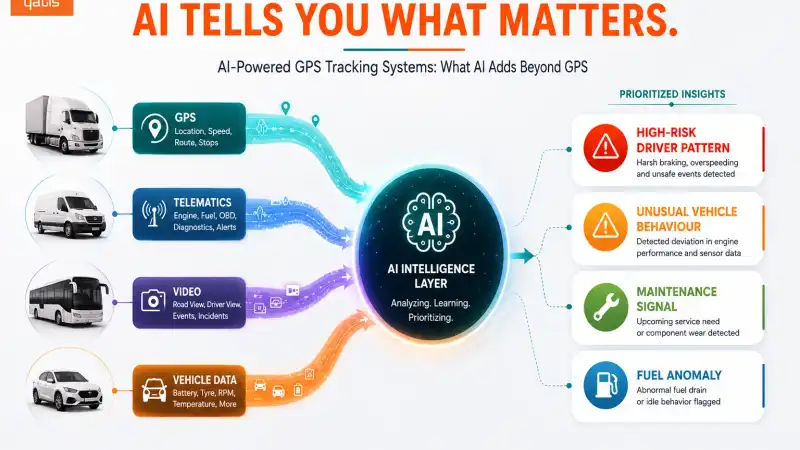
GPS tracking solved one of fleet management's first major problems: where is my vehicle? But modern fleets generate far more information than location coordinates. They generate data about vehicle movement, speed, driving behaviour, fuel, diagnostics, maintenance, routes, video, trips and stops.
The challenge is no longer simply collecting data. It is knowing what matters inside all that data. That's where AI GPS tracking becomes relevant.
What Is AI GPS Tracking?
AI GPS tracking uses artificial intelligence alongside GPS, telematics and other connected-fleet data to identify patterns, detect unusual behaviour, prioritize events and support operational decisions.
The distinction is simple. Conventional GPS moves data to a dashboard. AI-enabled tracking moves data through analysis to insight to action.
For example, a GPS system might record that Vehicle 27 stopped for 42 minutes. An AI-enabled system could compare that event with historical behaviour and determine that this stop is unusual for this vehicle and may require investigation.
AI therefore isn't simply another GPS feature. It is an intelligence layer applied to fleet data.
What Can AI Do That GPS Tracking Cannot?
This is the question businesses should ask before buying an AI-powered tracking solution.
GPS is highly effective at providing location, movement, distance, speed, trip history, stops and route information. AI can work on top of those signals to identify patterns, anomalies, risk, behavioural trends, potential maintenance issues, significant events and relationships between different data points.
The difference: GPS reports an event. AI interprets the pattern around the event. That distinction is critical.
What AI Does Not Automatically Do
A GPS tracking system does not become genuinely AI-powered simply because a vendor adds an AI label. AI should provide capabilities such as pattern recognition, anomaly detection, prediction, classification, prioritization or contextual analysis beyond conventional tracking and rule-based alerts.
For example, a standard GPS system reports that a vehicle exceeded 80 km/h. An AI-enabled capability reports that this driver has shown a recurring overspeeding pattern on this route compared with their normal behaviour.
The second output contains context. That's the difference businesses should look for. A genuine AI capability should answer a question that conventional tracking could not answer efficiently.
The AI GPS Tracking Maturity Model
A fleet doesn't jump directly from basic GPS to full autonomous intelligence. The evolution looks more like this.
| Level | Capability | Main Question |
|---|---|---|
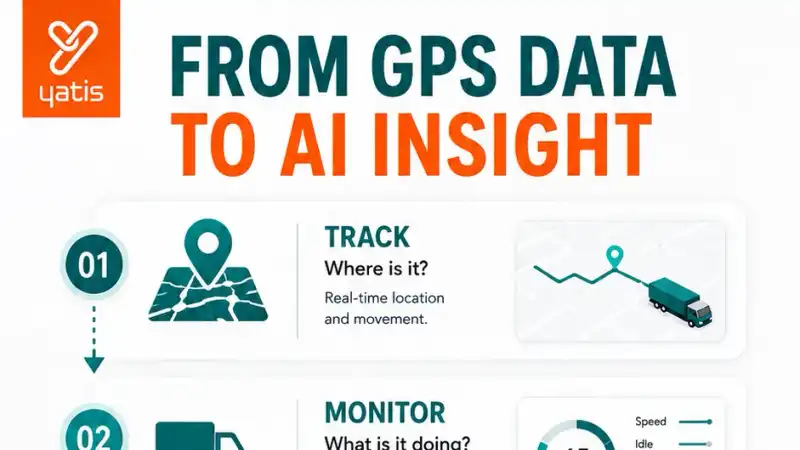
| 1. Tracking | GPS location | Where is it? |
| 2. Monitoring | Telematics | What is it doing? |
| 3. Analytics | KPIs and trends | What happened? |
| 4. AI | Pattern and anomaly detection | What matters? |
| 5. Prediction | Predictive analytics | What may happen next? |
| 6. Decision Support | Recommendations | What should we investigate or do? |
AI is the intelligence layer. Predictive fleet management is the next capability built around anticipating future outcomes.
How Does AI GPS Tracking Work?
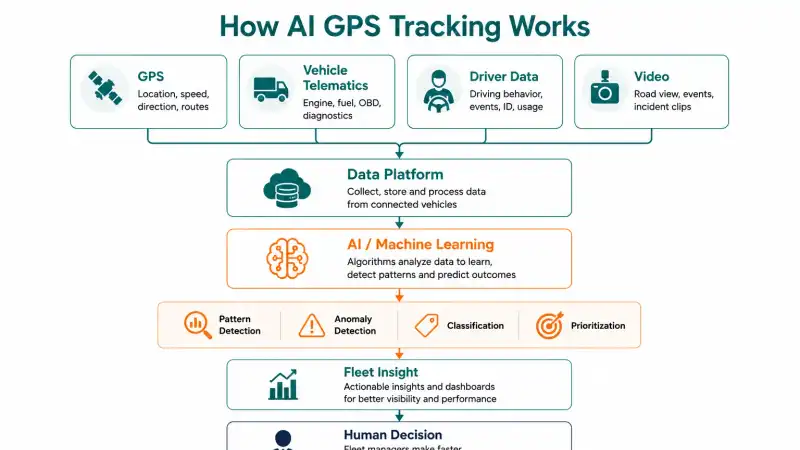
AI Can Detect Anomalies
AI anomaly detection identifies behaviour or events that differ from an expected pattern. In fleet management, this can help highlight unusual stops, route behaviour, fuel patterns, vehicle activity or driver behaviour for further investigation.
Imagine a fleet of 500 vehicles. Each vehicle produces thousands of data points. A fleet manager cannot manually examine all of them. AI can help distinguish expected behaviour, where a vehicle operates within its normal pattern, from unusual behaviour, where the vehicle suddenly behaves differently.
Potential examples include an unusually long stop, unexpected movement, abnormal fuel consumption, repeated harsh-driving events, unusual operating hours, or a route pattern that differs from normal activity.
The important point is that AI doesn't necessarily say this is definitely a problem. It can instead say this pattern is unusual enough to investigate. That makes fleet monitoring more focused.
AI Can Prioritize Fleet Alerts
One of the biggest problems in connected fleets isn't lack of data. It's too much data. Suppose a fleet generates hundreds of alerts every day. If everything is treated as equally important, the fleet manager still has to manually determine what deserves attention.
AI can potentially help rank events based on factors such as severity, frequency, historical behaviour, vehicle context, driver context and operational impact.
Instead of 500 alerts producing 500 equally important notifications, the workflow can become 500 events → AI analysis → priority events → human review. This is a much more useful application of AI than simply generating more alerts.
AI-Powered Driver Behaviour Analysis
GPS systems can already detect overspeeding, harsh braking, harsh acceleration, sudden movements and excessive idling. AI can add behavioural context.
Consider two drivers. Driver A records one harsh-braking event this month. Driver B records twenty repeated harsh-braking events across similar routes. A basic system reports both events. AI can identify the recurring pattern.
That can help fleet managers prioritize driver coaching, safety reviews, route-specific interventions and behavioural monitoring. The objective should not be to automatically label a driver. It should be to identify patterns worth acting on.
AI Plus Video Telematics: Adding Context to GPS
This is where AI becomes particularly powerful. GPS may tell you that harsh braking was detected at 11:42 AM. But GPS alone doesn't explain what happened. Video can potentially show that a vehicle suddenly entered the lane. AI can then analyse the visual event and associate it with vehicle data.
The workflow runs from GPS event to harsh braking to video context to AI analysis to incident classification to fleet manager review. This is why video telematics is a natural extension of AI-powered GPS tracking. AI-based video systems can analyse visual events alongside vehicle data, helping identify risky driving behaviour and provide context around incidents.
The key idea: GPS tells you where the event happened. Video can help show what happened. AI helps connect the two.
AI Can Identify Patterns Humans May Miss
Consider three similar vehicles.
| Vehicle | Fuel Consumption Trend |
|---|---|
| A | 8.2 → 8.3 → 8.2 |
| B | 8.4 → 8.5 → 8.4 |
| C | 8.3 → 8.7 → 9.1 |
A conventional dashboard can display all three. But Vehicle C shows a clear deterioration. AI can help identify these changes across large datasets and surface vehicles whose behaviour is moving away from their historical baseline.
This creates a shift from snapshot monitoring, which asks what is happening now, to pattern monitoring, which asks how this is changing over time.
AI Can Support Predictive Maintenance
Traditional fleet maintenance often relies on time or mileage — for example, service every 10,000 km. AI-enabled systems can add another layer by asking whether the vehicle's data indicates an emerging problem.
Potential inputs can include vehicle diagnostics, fault codes, mileage, operating conditions, historical maintenance and vehicle behaviour. The objective isn't to promise that AI can predict every mechanical failure. It is to identify signals that may justify earlier investigation.
This is also where AI starts moving toward the next stage: predictive fleet management.
AI GPS Tracking Use Cases
| AI Capability | Fleet Use Case | Potential Output |
|---|---|---|
| Anomaly detection | Unusual vehicle behaviour | Investigation priority |
| Pattern recognition | Recurring driver risk | Coaching priority |
| Predictive analysis | Potential vehicle deterioration | Maintenance attention |
| Computer vision | Road and driver events | Visual incident context |
| Event prioritization | Large alert volumes | High-priority events |
| Natural-language analysis | Fleet data queries | Faster insight |
The common thread is simple: AI reduces the distance between raw fleet data and a useful decision.
From Data to Recommendation
The most useful AI systems shouldn't stop at reporting that something unusual happened. They should help provide context around it.
For example, the observation is that fuel consumption has increased. The pattern is that the increase has continued for three weeks. The context is that the vehicle's route and operating pattern have remained relatively stable. The potential action is to review fuel records, vehicle condition and recent maintenance.
The AI doesn't have to make the final decision. It can make the decision-making process faster and more focused.
AI GPS Tracking vs Conventional GPS
| Capability | Conventional GPS | AI-Powered GPS |
|---|---|---|
| Live location | Yes | Yes |
| Trip history | Yes | Yes |
| Route visibility | Yes | Yes |
| Speed monitoring | Yes | Yes |
| Rule-based alerts | Yes | Yes |
| Pattern recognition | Limited | Yes |
| Anomaly detection | Limited | Yes |
| Intelligent prioritization | Limited | Yes |
| Predictive insights | Limited | Yes |
| AI video analysis | Not available | When integrated |
| Recommendations | Limited | Potentially yes |
AI does not replace GPS. It adds an intelligence layer above it.
What Data Does an AI GPS Tracking System Need?
AI becomes more useful when it can analyse relevant data from multiple sources.
Location
- GPS coordinates
- Routes
- Distance
- Stops
Vehicle
- Speed
- Diagnostics
- Engine data
- Fuel
Driver
- Driving events
- Historical behaviour
Video
- Road events
- Driver behaviour
- Incident context
Operations
- Trips
- Assignments
- Delivery schedules
- Historical performance
This is why the future of intelligent fleet management is unlikely to be built around GPS coordinates alone. It depends on connected fleet visibility across multiple data sources.
AI GPS Tracking vs Predictive Fleet Management
These concepts are connected, but they are not the same.
AI GPS tracking uses AI to understand fleet data. It can detect, classify, prioritize, identify patterns and generate insights. Predictive fleet management uses data to anticipate future outcomes, focusing on potential maintenance requirements, future downtime, utilization changes, operational risks and demand patterns.
So AI is an intelligence capability. Predictive fleet management is an application of that intelligence toward future outcomes.
What Should Businesses Look for in an AI GPS Tracking System?
Don't select a platform simply because its marketing says AI-powered. Ask six questions.
1. What data does the AI analyse?
GPS alone, telematics, diagnostics, video or IoT?
2. What does it actually detect?
Anomalies, risk, behaviour or maintenance patterns?
3. Does it prioritize events?
Or does it simply create more alerts?
4. Can the system explain why something was flagged?
Context matters.
5. Can the insight lead to an operational action?
An insight without an action pathway has limited value.
6. Can it integrate with the rest of the fleet ecosystem?
AI becomes more useful as relevant operational context increases.
The Evolution of Fleet Intelligence
The progression can now be summarized clearly. Track answers where it is. Monitor answers what it is doing. Analyse answers what happened. AI answers what matters. Predict answers what may happen next. Decide answers what we should do.
This is the transition from GPS tracking to intelligent fleet management.
Conclusion
GPS made fleets visible. Analytics made them measurable. AI is making them increasingly understandable.
The real value of AI GPS tracking isn't putting an AI label on a conventional tracking dashboard. It is using intelligence to detect patterns, spot anomalies, prioritize risks, understand context and support better decisions.
And when GPS is combined with video telematics, vehicle events can be connected with visual context, helping fleet managers move beyond simply knowing where an event occurred toward understanding what happened.
The next evolution is prediction. Instead of asking only what is happening, fleets can begin asking what is likely to happen next. That's where predictive fleet management enters the picture.
Frequently Asked Questions
Ready to get started?
Contact Yatis Telematics to see how AI, GPS and video telematics can help your team focus on the events that actually matter.
Contact Us →