

Predictive Fleet Management Using GPS Data: From Tracking to Anticipation

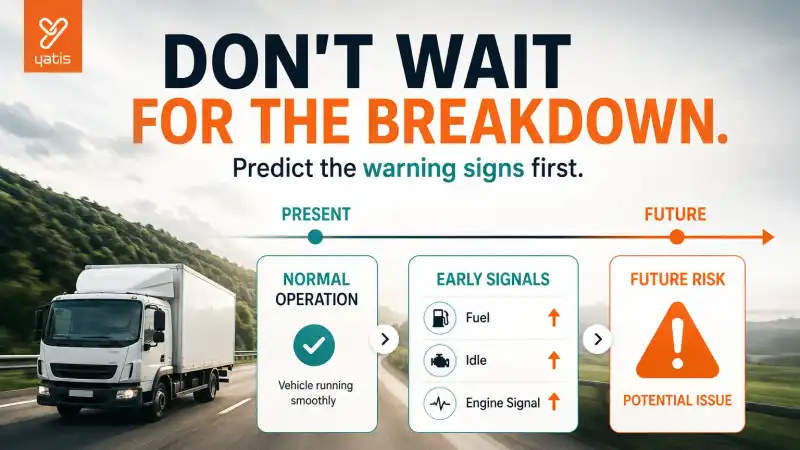
Traditional fleet management is often reactive. A vehicle breaks down. A route gets delayed. Fuel efficiency falls. A vehicle remains underutilized. A driver repeatedly creates risk. Then the fleet manager investigates.
Predictive fleet management changes the question. Instead of asking what went wrong, it asks what the current signals are telling us about what could happen next. That shift — from reaction to anticipation — is the real value of predictive fleet management.
What Is Predictive Fleet Management?
Predictive fleet management uses historical and current fleet data to forecast potential operational outcomes and identify risks before they occur. GPS data can provide information about location, movement, routes, stops and driving patterns, while telematics, diagnostics, maintenance and other data can add further predictive context.
A simplified progression is: fleet data → historical patterns → predictive model → potential future outcome → preventive action.
For example, the current signal is that vehicle fuel efficiency is gradually deteriorating. The historical pattern shows similar changes have previously preceded a maintenance issue. The predictive insight is that the vehicle may require inspection. The action is to investigate before the issue becomes a breakdown.
That's fundamentally different from waiting for the vehicle to fail.
Predictive Analytics vs Traditional Fleet Reporting
This is one of the most important distinctions to understand.
Reporting asks: what happened?
For example, Vehicle 42 consumed 8% more fuel this month.
Analytics asks: why did it happen?
For example, the increase coincided with longer idle periods and a change in operating conditions. This is the territory of GPS tracking data analytics.
Predictive analytics asks: what is likely to happen next?
For example, if the current pattern continues, Vehicle 42 may experience further efficiency deterioration.
So reporting looks at the past, analytics builds understanding, and prediction looks toward the future.
How Does Predictive Fleet Management Use GPS Data?
GPS provides much more than a dot on a map. Over time, it creates a behavioural history. That history can contain patterns around routes, distance, stops, idle time, speed, trip duration, operating hours, route deviations and vehicle utilization.
When combined with other fleet data — route history, vehicle data and maintenance history — these patterns can become inputs for predictive models that flag potential operational risk.
The important point is that GPS is one input into predictive fleet intelligence, not the entire predictive system.
What Can Fleets Predict?
Predictive fleet management can be applied to several areas.
| Predictive Area | What It Can Help Anticipate |
|---|---|
| Maintenance | Potential vehicle or component issues |
| Downtime | Vehicles at increased risk of becoming unavailable |
| Utilization | Future under- or over-utilization |
| Fuel | Deteriorating efficiency patterns |
| Driver Risk | Recurring behavioural risk |
| Routes | Potential delay or inefficiency |
| Demand | Future vehicle and resource requirements |
| Fleet Availability | Potential capacity gaps |
This is why predictive fleet management shouldn't be reduced to the idea that AI predicts when your truck will break down. That's only one application.
Predictive Maintenance: One Part of the Bigger Picture
Predictive maintenance is probably the most familiar use case. Instead of relying only on calendar-based or mileage-based servicing, a predictive system can analyse signals such as diagnostics, fault codes, vehicle usage, mileage, operating patterns, fuel behaviour and maintenance history to identify potential deterioration.
Research and industry implementations commonly combine telematics, diagnostics, fuel and maintenance history to identify early patterns associated with potential failures.
But predictive fleet management goes beyond maintenance. A fleet could have perfectly healthy vehicles and still suffer from poor utilization, capacity shortages, route inefficiency, driver-risk patterns and excessive idle time. Prediction can be applied to these areas too.
Predicting Vehicle Downtime
Downtime is expensive because the problem isn't only the repair. A vehicle that becomes unavailable can trigger a chain: trip reassignment, operational disruption, potential delivery delay and customer impact.
Predictive models can use historical and current vehicle signals to identify units that may have a higher probability of downtime. The goal is not to claim a vehicle will definitely fail tomorrow. A responsible predictive system should instead communicate that a vehicle is showing signals associated with elevated risk and should be investigated.
That distinction matters because predictions are probabilities, not guarantees.
Predicting Fleet Utilization
Not every fleet problem is a breakdown. Sometimes the problem is that the business owns or operates capacity it doesn't fully use.
Consider Vehicle A at 91% utilization, Vehicle B at 88% and Vehicle C at 43%. Historical data may reveal that Vehicle C is consistently underutilized. Predictive analysis can take this further by asking whether it is likely to remain underutilized.
If demand patterns and historical utilization suggest a persistent imbalance, managers can investigate vehicle allocation, depot distribution, route assignment, fleet size and seasonal demand. This makes predictive fleet management relevant to capacity planning, not just vehicle maintenance.
Predicting Fuel Efficiency Problems
Fuel costs are usually measured after the fuel has already been consumed. Predictive analysis changes the focus toward trend detection.
Imagine a vehicle moving from 8.4 km/l in month one to 8.2, then 7.9, then 7.6. A basic report tells you the numbers. A predictive model can investigate whether this deterioration resembles patterns associated with vehicle condition, driver behaviour, route changes, excessive idling, load conditions or maintenance requirements.
The objective is to identify a deteriorating pattern before it becomes a much larger cost problem.
Predicting Driver Risk
Driver safety data can also become predictive. Suppose a driver repeatedly shows harsh braking, overspeeding, aggressive acceleration and frequent high-risk events. A single event may not be meaningful. A recurring pattern is different.
Predictive analytics can potentially identify drivers or operating conditions associated with increasing risk and allow fleet managers to intervene earlier. This creates a more proactive coaching cycle: behaviour → pattern → risk signal → coaching → monitor change — instead of waiting for an incident to force the intervention.
Predictive Route and Delay Insights
GPS provides historical information about how vehicles actually travel. That can reveal typical journey durations, frequent delays, recurring stops, route-specific bottlenecks and time-of-day patterns.
Predictive models can use historical patterns and current conditions to estimate potential delays. For example, a route that normally takes 55 minutes may show a higher probability of delay given current conditions and historical behaviour.
That allows operations teams to act earlier, by adjusting dispatch timing, reassigning vehicles, informing customers or changing routes where appropriate.
Predictive Fleet Management Is About Probability
This is an important point that many AI articles skip. Prediction is not certainty. A predictive system should ideally communicate risk as low, medium or high, rather than pretending it knows the future with absolute certainty.
Saying "Vehicle 18 shows elevated maintenance risk" is more useful and responsible than saying "Vehicle 18 will break down tomorrow." The quality of predictive fleet management therefore depends not only on the model but also on how its predictions are presented and acted upon.
What Data Does Predictive Fleet Management Need?
Predictive models become stronger when multiple relevant data sources are connected.
GPS Data
- Location
- Distance
- Routes
- Stops
- Speed
- Idle time
Vehicle Data
- Diagnostics
- Fault codes
- Engine parameters
- Operating conditions
Maintenance Data
- Service history
- Repairs
- Component replacements
- Failure history
Driver Data
- Driving events
- Behaviour trends
Operational Data
- Trips
- Loads
- Delivery schedules
- Vehicle assignments
A useful principle is that the prediction is only as informative as the data and context behind it. A GPS-only system can provide valuable location patterns, but vehicle-health predictions generally need additional diagnostic and maintenance information.
Historical Data Is the Foundation
Prediction requires a history to learn from. Consider a fleet with only one week of data. It may be difficult to establish meaningful long-term patterns. Now consider a fleet with 12 months of GPS data, vehicle diagnostics, maintenance history and trip records. The system has much more context from which to identify recurring relationships.
This is why predictive fleet management isn't simply installing GPS, turning on AI and predicting everything. It is a process of collect, clean, contextualize, model, validate and improve.
Prediction Needs a Feedback Loop
This is an important concept for mature predictive systems. Suppose the system predicts that Vehicle 27 has elevated maintenance risk. The fleet team investigates and discovers a cooling-system issue. The vehicle is repaired.
That outcome should ideally become part of the historical record. The system can then compare the prediction against the actual outcome. Over time, these feedback loops can help organisations evaluate and improve predictive performance. Predictive-fleet literature increasingly emphasizes combining predictions with actual maintenance outcomes rather than treating the prediction as the end of the workflow.
Predictive Fleet Management vs AI GPS Tracking
These two topics are closely connected, but they have different purposes.
| AI GPS Tracking | Predictive Fleet Management |
|---|---|
| Uses AI to interpret fleet data | Uses data to anticipate future outcomes |
| Detects patterns | Forecasts potential outcomes |
| Detects anomalies | Estimates future risk |
| Prioritizes events | Helps plan ahead |
| Can analyse video and context | Focuses on future operational states |
| Broader intelligence layer | Specific predictive application |
The simple distinction: AI helps the fleet understand the data. Predictive management uses that understanding to anticipate what comes next.
From Reactive to Predictive Fleet Management
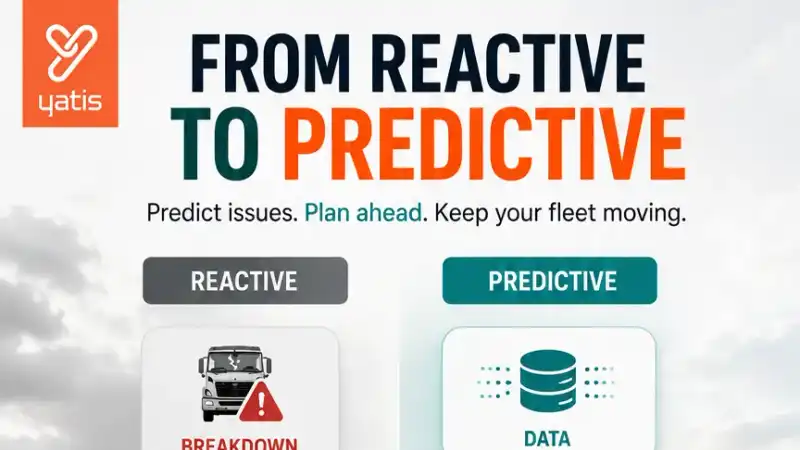
The difference can be visualized simply. A reactive fleet moves from breakdown to repair to downtime to operational disruption. A predictive fleet moves from data to pattern to risk signal to planned intervention to reduced disruption.
The objective isn't to eliminate every breakdown. It's to move the intervention earlier whenever the data provides a useful warning signal.
What Should Businesses Look for in a Predictive Fleet Platform?
Don't evaluate a platform simply by asking whether it has AI. Ask better questions.
1. What can it predict?
Maintenance, downtime, fuel, utilization or driver risk?
2. What data feeds the prediction?
GPS alone, telematics, diagnostics or maintenance records?
3. Can it explain the prediction?
A fleet manager needs context.
4. Can predictions be prioritized?
Not every risk deserves the same response.
5. Can actual outcomes be recorded?
Without feedback, measuring prediction quality becomes difficult.
6. Can the insight trigger an operational workflow?
The goal isn't another dashboard. The goal is earlier action.
The Predictive Fleet Management Loop
A mature predictive fleet system can be thought of as a repeating loop.
- Collect — GPS, telematics, vehicle and operational data.
- Identify — patterns and signals.
- Predict — potential future outcome.
- Prioritize — risk and urgency.
- Act — maintenance, coaching, allocation or planning.
- Measure — what actually happened.
- Learn — improve future predictions.
This is where predictive fleet management becomes an operational system, rather than merely an analytics feature.
Conclusion
Traditional fleet management often waits for an event before responding. Predictive fleet management tries to move the decision before the event.
GPS provides a valuable historical and real-time view of where vehicles go, how they move, when they stop, how routes behave and how vehicles are utilized. When those signals are combined with telematics, diagnostics, maintenance and operational history, they can become inputs for predictive models.
The result isn't a crystal ball. It is something more practical: an earlier warning that gives a fleet manager more time to act. That could mean investigating a vehicle before a potential failure, addressing a deteriorating fuel-efficiency trend, coaching a driver before risky behaviour escalates, or identifying a future capacity problem before it affects operations.
The evolution is therefore: track → analyse → predict → act. And that is the real promise of predictive fleet management.
Frequently Asked Questions
Ready to get started?
Contact Yatis Telematics to see how connected GPS and telematics data can give your fleet an earlier warning before problems become downtime.
Contact Us →