

GPS Tracking vs Telematics vs Fleet Management: What Is the Difference?

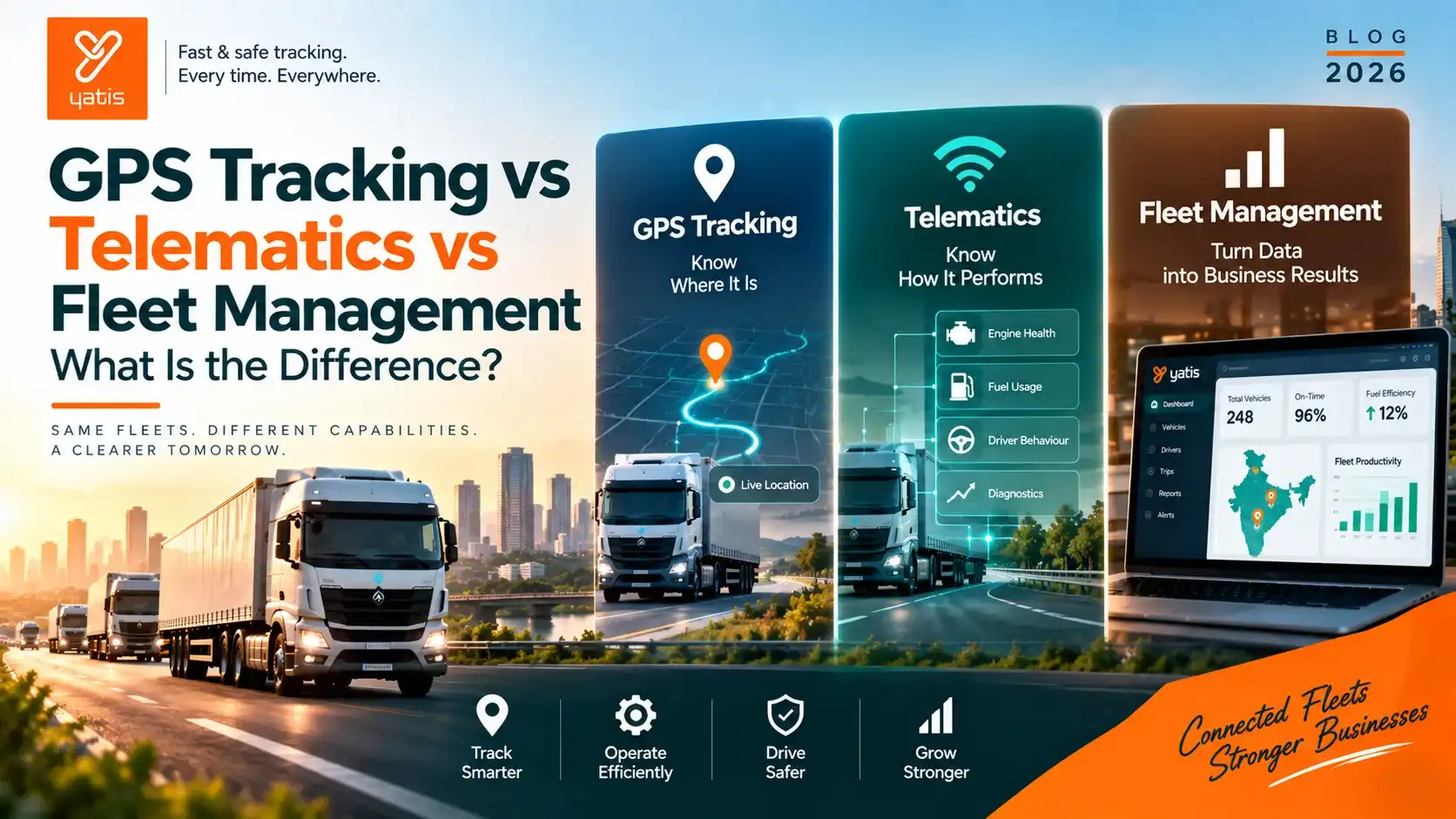
Three terms are often used as if they mean the same thing. They do not. This guide separates the technology layers, compares their data depth, and explains what an Indian fleet should actually buy — whether that is GPS tracking, telematics, or full fleet management.
The Short Answer
GPS tracking answers “Where is the vehicle?” Telematics answers “What is the vehicle doing and what is happening inside it?” Fleet management answers the broader operational question: “How do we run the fleet better?”
The three are complementary rather than mutually exclusive. A modern fleet platform may contain all three, but the depth of hardware data, software workflows, integrations and operational control can be very different.
This distinction matters when comparing vendors because a low-cost GPS tracker and a full fleet-management platform can both advertise “real-time tracking” while delivering very different levels of operational intelligence.
1. Start With the Terminology
Think of the relationship as visibility → vehicle intelligence → operational management, not as three competing products.
GPS Tracking: Location Visibility
GPS tracking is primarily a location-visibility capability. A GPS/GNSS receiver determines where an asset is, while a connected tracker transmits that information so a user can see position, movement and historical trips.
A basic GPS tracking system is therefore the right starting point when the core problem is visibility and proof of movement.
Telematics: Vehicle Intelligence
Telematics is the broader vehicle-data layer. In addition to location, a telematics system can ingest information from vehicle electronics and connected sensors — such as speed, ignition state, diagnostic information, fuel-related signals, battery parameters or driver-behaviour events — depending on the hardware and vehicle interface.
For commercial vehicles, this often means an OBD or CAN-connected device, such as an OBD GPS tracker for fleet intelligence, rather than a location-only tracker.
Fleet Management: Operational Management
Fleet management is the operational management layer. It uses tracking and telematics data alongside workflows such as dispatch, maintenance, compliance, driver management, utilisation, reporting and integrations to manage the business around the vehicles.
Explore the full range of Yatis fleet products to see how tracking data connects to operational workflows.
2. The Easiest Way to Understand the Difference: Three Layers
GPS/GNSS position is captured and transmitted by the tracker. Vehicle data from ECU, CAN, OBD and sensors adds telematics context and events. The fleet platform then adds rules, workflows and integrations with ERP, TMS, CRM and APIs so operations teams can decide and act. Exact capabilities depend on the device, vehicle interface, network, software plan and integrations.
Layer 1 — GPS Tracking
The core output is location intelligence: current position, trip history, speed and direction, geofences and location-based GPS tracking alerts. For a business that mainly needs visibility and proof of movement, this may be enough.
Layer 2 — Telematics
Telematics adds vehicle and operating context to the location stream. The question changes from “Where is Truck 27?” to “Where is Truck 27, how is it being driven, is the engine reporting a fault, how long has it been idling, and does its behaviour require intervention?”
This is where driver safety telematics and vehicle-health signals separate telematics from location-only tracking.
Layer 3 — Fleet Management
Fleet management turns those signals into processes. A maintenance event can become a service workflow; a route deviation can trigger an operations response; utilisation data can influence allocation; compliance records can feed reporting. The value comes from connecting data to recurring decisions, including route optimization and dispatch.
3. GPS Tracking vs Telematics vs Fleet Management: Data Depth
The biggest buying mistake is comparing products by feature names instead of asking what data enters the system, what happens to it, and what action can come out of it.
| Capability | GPS Tracking | Telematics | Fleet Management |
|---|---|---|---|
| Live location | Core | Core | Core |
| Trip / route history | Core | Core | Core |
| Geofencing | Common | Common | Common |
| Vehicle diagnostics | Device-dependent | Core differentiator | Often integrated |
| Driver behaviour | Basic / event-dependent | Detailed events | Scorecards + workflows |
| Fuel / energy intelligence | Limited | Vehicle / sensor data | Analytics + controls |
| Maintenance workflows | Usually outside scope | Data + alerts | Workflow layer |
| Dispatch / job workflows | Not the core purpose | Integration possible | Core platform use case |
| APIs / integrations | Varies | Important | Strategic requirement |
| Business reporting | Tracking reports | Operational analytics | Cross-functional reporting |
This is a functional comparison, not a universal product specification. Vendors can bundle capabilities differently; buyer diligence should verify exactly what hardware, software tier and integration package is included.
4. The Use Case Decides the Right Layer
Start from the operational question, not the product name. Each statement below points to a different layer.
“I need to know where my vehicles are.” — GPS Tracking
Choose a strong GPS tracking foundation if location, trip history, geofences and basic alerts solve the problem.
“I need to understand vehicle behaviour.” — Telematics
Move into telematics when diagnostics, driving events, idling, fuel or energy signals, or richer vehicle data matter.
“I need to run the operation from one system.” — Fleet Management
Look for fleet management when tracking must connect to maintenance, dispatch, compliance, workforce and business systems.
Examples by Fleet Type
| Fleet Situation | Likely Starting Point | Why |
|---|---|---|
| Small delivery fleet | GPS tracking → telematics | Start with visibility; add driver and vehicle intelligence as operations mature. |
| Large logistics fleet | Telematics + fleet platform | Location alone rarely explains fuel, safety, maintenance and utilisation performance. See GPS tracking for logistics companies. |
| School / staff transport | GPS tracking + safety workflows | Live visibility, route adherence, geofences and escalation can be the primary priorities. |
| Field-service vehicles | Telematics + dispatch integration | Vehicle location becomes more valuable when connected to jobs, technician availability and arrival times. |
| EV / mixed-energy fleet | Telematics + energy intelligence | Battery, charging and vehicle-state data can become operational inputs beyond simple location. |
5. GPS Tracking vs Telematics: Is the Cheaper Option Actually Cheaper?
There is no universal price boundary between GPS tracking and telematics. The commercial difference usually comes from hardware complexity, data interfaces, connectivity, software depth, integrations, support and deployment.
GPS tracking, telematics and a full fleet platform sit on an illustrative complexity index — not a price chart. Actual total cost of ownership varies materially by fleet size, device type, connectivity, subscription, installation, integrations and service requirements.
Calculate Total Cost of Ownership, Not Just Device Price
- Hardware + installation
- SIM / data / connectivity charges
- Platform subscription and feature tiers
- Replacement, warranty and field support
- API / integration or customisation costs
- Driver onboarding and operational training
- Migration and data-export requirements
Buyer principle: if a slightly cheaper device cannot supply the data your maintenance, safety or dispatch process needs, the apparent saving can become a recurring operational cost.
6. Who Needs GPS Tracking, Telematics or Full Fleet Management?
Choose GPS Tracking When
- Your main problem is vehicle visibility.
- You need location history, geofences and basic movement alerts.
- Your operational processes already live in another system.
- You want a simple entry point before expanding data depth.
Choose Telematics When
- Vehicle health and driver behaviour affect operating cost or risk.
- You need more than coordinates to explain an event.
- Fuel, idling, diagnostics, utilisation or maintenance signals matter.
- You want a data foundation for analytics and automation.
Choose Fleet Management When
- Multiple teams need the same operational data.
- Dispatch, maintenance, compliance and driver workflows must connect.
- You need APIs, role-based access, reporting and process automation, including mobile apps for field and management users.
- Fleet data needs to influence day-to-day business decisions, not just monitoring.
Where regulatory fit matters — for example AIS-140 compliance — evaluate the compliance layer alongside data depth. See the best AIS-140 GPS tracker guide for fleet management.
7. The Practical Upgrade Path: GPS to Telematics to Fleet Intelligence
You do not necessarily need to jump from a basic tracker to a large platform in one purchase. A staged architecture can reduce implementation risk — provided the first hardware and data layer are open enough to support the next stage.
Stage 1: GPS Visibility
Location, trips and geofences. Establish reliable visibility first.
Stage 2: Telematics Depth
Vehicle, driver and sensor data. Add diagnostics, behaviour and fuel or energy context.
Stage 3: Fleet Intelligence
Workflows, APIs and automation. Connect data to maintenance, dispatch and business systems.
The Critical Question: Can Stage 1 Support Stage 3?
Before selecting a tracker, ask whether the provider exposes APIs, supports the required vehicle interfaces, retains usable historical data, permits hardware portability, and offers a roadmap for additional sensors and integrations. An apparently inexpensive closed system can become expensive to replace later.
8. Buying Checklist: 10 Questions to Ask a Telematics Vendor
- What exactly is included? Hardware, SIM, platform, installation, support and warranty?
- What data does the device collect? GPS only, or vehicle, diagnostic and sensor signals too?
- How is data refreshed? Confirm configurable reporting intervals and event-based transmission.
- What happens during network loss? Ask about local storage, buffering and later synchronisation.
- Can you access the data by API? Ask for documentation, limits and authentication method.
- Can the system integrate with your existing stack? ERP, TMS, CRM, dispatch, maintenance or BI?
- Which alerts are rule-based? Understand whether alerts can be customised by vehicle, driver, geography or event.
- Can you export historical data? Avoid unnecessary lock-in.
- What is the five-year total cost of ownership? Include hardware replacement, subscriptions, integrations and support.
- What is the upgrade path? Make sure today's tracker does not block tomorrow's telematics or fleet-management requirements.
Compare answers against practical fleet resources and your own route, vehicle-mix and compliance requirements before committing.
Frequently Asked Questions
Final Thoughts: Choose the Layer That Matches the Problem
GPS tracking, telematics and fleet management are three layers of the same journey: visibility, vehicle intelligence and operational management. Buying the right layer means matching data depth to the decisions you need to make every day.
If location visibility solves the problem, start with GPS tracking. If vehicle behaviour, diagnostics or fuel performance drive cost and risk, add telematics. If multiple teams must act on the same data through dispatch, maintenance and compliance workflows, invest in fleet management.
Choose the Right Layer for Your Fleet
Talk to Yatis to pick GPS tracking, telematics or full fleet management for your operation. We will help you match hardware, data depth and software workflows to your fleet size, vehicle mix and budget.
Get Started Today →